Ornamental · Caryophyllaceae
Sweet William
Dianthus barbatus
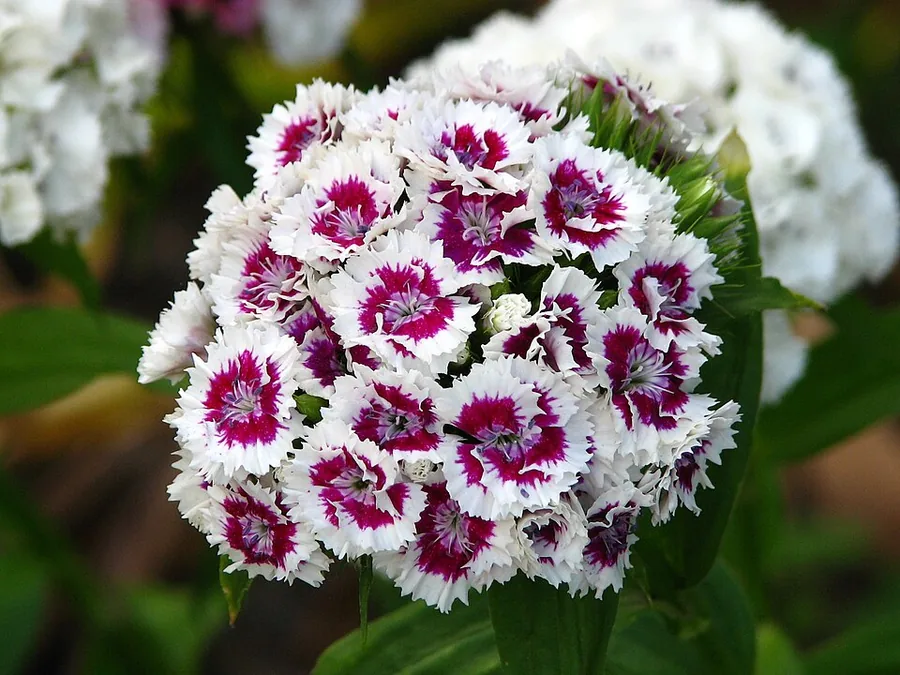
Small flowers packed into dense, flat-topped heads, many centered with a contrasting eye and carrying a light clove scent: that is Sweet William up close.
Full sun
Every 3–7 days
USDA 3–9
12–24 in · 30–60 cm
Overview
Look closely at Sweet William and the flower head is the first thing to catch the eye. Dozens of small blooms crowd together into a dense, flat-topped cluster, broad and level across the top, in white, pink, red, and two-tone combinations. At the center of many of the little flowers sits a contrasting ring, an eye of a second color that stipples the whole head with pattern. It sits in the pink family with carnations and garden pinks, its wild form found in the mountains of southern Europe, and each open head gives off a light clove scent.
The plant shows two very different faces across its life. In its first year it stays low, a leafy rosette hugging the ground with no bloom to speak of. The next spring and early summer it sends up stems that lift those flat flower heads clear of the leaves, and after the color fades the heads dry to seed. It lives as a biennial or short-lived perennial, and the seed that falls sprouts into fresh rosettes that keep the patch going.
In the garden the clumps stay modest, the flowering stems rising only so far above that low cushion of leaves. For all the detail packed into the flower heads, the plant asks little beyond full sun, freely draining soil, and open air around the foliage. Wet soil is what it cannot abide, since standing moisture at the base rots the crown and breeds the fungal disease that pulls the plant down.
Care
The short version: Sweet William wants full sun, or a little afternoon shade in heat, and rich free-draining soil kept evenly moist and off the leaves; snip the faded heads for more bloom, and leave a few to ripen into seed if you want fresh rosettes next year.
Light
In full sun the flower heads come thick and the stems stand firm, and a little afternoon shade is fine where summers are hot. Too much shade shows in the plant itself: fewer blooms, and stems that grow thin, weak, and prone to leaning.
Water
Give it even, medium moisture in soil that drains, so the roots meet neither dust nor mud. Watering at the base with a soaker or drip line leaves the foliage dry to the touch. Where water goes overhead, the morning is best, so beads of water burn off the leaves before nightfall and fungal disease cannot settle on damp tissue.
Soil
Set it in deep, rich, free-draining loam or sandy loam, loosened with compost. It takes a pH of 6.0 to 8.0 in stride, at home on neutral to slightly alkaline ground where the roots run freely.
Humidity
Plain garden air suits it, with no target level to meet. Air movement is what shows on the leaves, because foliage left damp and packed tight is where the raised spots of rust and the soft rot of the crown begin.
Feeding
It feeds lightly. A balanced general-purpose fertilizer turned into the top 4 to 6 inches of soil at planting is all the richness the roots draw on through the season.
Pruning
Cutting off the spent heads keeps new flowers coming and nudges the plant toward perennial habits. There is a visible trade with biennial plantings: remove every head and no seed forms, which ends the self-sowing that fills the patch next year, so let some heads brown and ripen if you want a return.
Size & spacing
A plant stands 12 to 24 inches (30 to 60 cm) tall over a base 6 to 12 inches (15 to 30 cm) wide, the flowering stems held above a low mound of leaves. Space them to that width so air slips between the clumps and the foliage dries.
When to plant
Sweet William reveals itself slowly. Seed sown in late winter to early spring, or in late summer to early fall, first becomes a low rosette of leaves, and only the following year do the stems rise and the flat heads color up, from late spring into summer where the air stays cool. Plants go into the ground in late spring.
Northern hemisphere
Southern hemisphere
Typical months for a temperate climate: start earlier in warm zones, later where spring frosts linger.
- Sow: Late winter to early spring, or sow in late summer/early fall for bloom the following year
- Plant: Direct sow or transplant in late spring; fall-sown seedlings may be set out for next-year bloom
- Harvest: Late spring to early summer, often continuing into summer in cooler climates
Hardiness
USDA hardiness zones: 3–9
Temperature: down to -40°C
Troubleshooting
The signs of trouble in Sweet William are written on the plant itself. Wet soil and still air are behind almost all of it, and the clues show up as color and texture changes on the leaves and at the crown. Match what you see below, down to the marks and trails, and act while the change can still be reversed.
Soft rot and collapse right at the soil line
A plant slumping at the base, its lowest stems gone soft and brown at the crown, is showing crown rot, which takes hold where the crown sits in soggy, poorly drained soil. Once the tissue has rotted there is no saving the plant, so lift it and throw it out. Sharpen the drainage, leave gaps for air between plants, and send water to the base rather than over the leaves.
Fix:
- Remove and discard affected plants
- Improve soil drainage
- Avoid overwatering and overhead watering
One side yellows and wilts while stems rot through
Leaves yellowing and wilting down just one side of the plant, with the top shoots sometimes bent at right angles, mark fusarium wilt, a soil fungus that clogs the stem from within and rots the roots. Nothing cures it, so pull the plant, destroy it, and set no more Dianthus in that soil. Begin again in clean, free-draining ground with disease-free seed or cuttings.
Fix:
- Remove and destroy infected plants
- Avoid replanting Dianthus in the same soil
- Use pathogen-free planting material
Raised rust-red spots freckling the leaf
The small, raised rust-red pustules dotting the leaves are rust, a fungus that breaks out on damp foliage in still air. Pick off the freckled leaves and burn or bin them, then space the plants so air threads between them. Keep water off the foliage, and turn to a protective fungicide only if the spots keep spreading across healthy leaves.
Fix:
- Remove and destroy infected foliage
- Improve air circulation
- Apply a protective fungicide to healthy plants if needed
Ragged holes and a silvery trail on the leaves
Leaves eaten into ragged holes with a silvery, glistening trail across them are the work of slugs and snails, which feed after damp weather. Go out at dusk when they are on the move and pick them off by hand. Clear the leaf litter and boards that hide them, water in the morning so the surface dries, and set baits or barriers where they keep coming back.
Fix:
- Hand-pick slugs and snails in the evening
- Remove garden debris that provides shelter
- Use slug baits or barriers as needed
Toxicity
Handsome as it is up close, Sweet William is mildly toxic rather than harmless. Like other dianthus and carnations, its tissues hold saponins that upset a pet's stomach, and the sap can leave a person's skin red and itching. The petals are edible when the plant is grown clean, the leaves are not, so keep curious pets and children away from the foliage.
Toxic to
Cats · Dogs · Horses · Rabbits · Livestock · Birds · People
Cats Mild
A cat that bites the leaves usually drools and then vomits or passes loose, watery stools, and a brush against the plant can raise a patch of mild, reddened skin.
Dogs Mild
A dog that chews the foliage tends to show an upset stomach with vomiting and loose stools, and mild dermatitis reddens the skin wherever the sap has touched.
Horses Caution
The plant's saponins can leave a grazing horse with a mild, unsettled stomach, so the leafy clumps are best kept beyond its reach.
Rabbits Caution
The foliage can turn a rabbit's sensitive gut, so the plant is best kept well away from them.
Livestock Caution
Grazing livestock seldom bite into it, but a mouthful of the leaves may bring on mild digestive upset from the saponins in the tissue.
Birds Caution
Little suggests birds feed on it, though the irritant compounds in the leaves make it wise to keep inquisitive pet birds away.
People Caution
The petals are edible off a clean-grown plant, but the leaves can bring on a mild stomach upset if eaten, and the sap leaves some people with itchy, reddened skin, so wear gloves to handle it.
Wear gloves when handling, as contact with the plant can cause mild skin irritation in sensitive individuals.
Helpline numbers

United States
ASPCA Animal Poison Control: (888) 426-4435 (fee applies)
Poison Control: (800) 222-1222



Canada
Poison Centres: 1-844-764-7669
Varieties
The named forms of Sweet William differ most in the color of their flowers and leaves, from pale, eyed heads to blooms so dark they read almost black. A few stand out for their looks.
Pinocchio
A compact dwarf, low and short-stemmed, that suits the front of a bed and containers.
Sooty
Carries flowers of deep maroon so dark they read close to black, held over dark foliage.
Nigrescens
Sets deep crimson blooms against bronze-purple, dark-leaved foliage.
How to propagate
Sweet William multiplies easily, either from the seed its dried heads scatter or by splitting the leafy clump at the base.
SeedEasy
Direct sow in late spring for bloom the following year, or sow in late summer/early fall; some cultivars bloom the first year if started early. · Germination in about 1 to 2 weeks; plants typically bloom the season after sowing for biennial types
Seed is the simplest route, shaken from the dried heads. Sow it straight into the ground in late spring for bloom the following year, or in late summer and early fall for the same result, though a few cultivars flower in their first year when started early. The seedlings show in 1 to 2 weeks as small rosettes, and most, being biennial, hold their flowering for the season after sowing. Left to self-sow each year, the patch renews itself and lives on like a long-lived perennial.
DivisionEasy
Divide established clumps in spring or early fall · Several weeks to re-establish roots
The short-lived perennial forms can be split at the base to stay vigorous. Lift an established clump in spring or early fall, tease it into rooted pieces, replant them at once, and give them several weeks to knit fresh roots before they push new growth.
Myths
Sweet William is a long-lived perennial that returns dependably every year.
In fact it is a biennial or short-lived perennial that returns by seed dropped from its dried heads. Cut off every head and no seed forms, so the reseeding that renews the patch ends. Leave a few heads to ripen if you want fresh plants next year.
Sweet William flowers are only for show and nothing more.
The petals are edible when the plant is grown clean, and they are sometimes crystallized in sugar to sit on a cake. The leaves are another matter, and eating them can bring on a mild stomach upset.