Ornamental · Acoraceae
Sweet Flag
Acorus gramineus
Kept in constantly wet ground with some sun, sweet flag stands in narrow, upright fans of grassy blades all season.
Full sun
Every 1–3 days
USDA 5–11
0–4 ft · 0.2–1.2 m
Overview
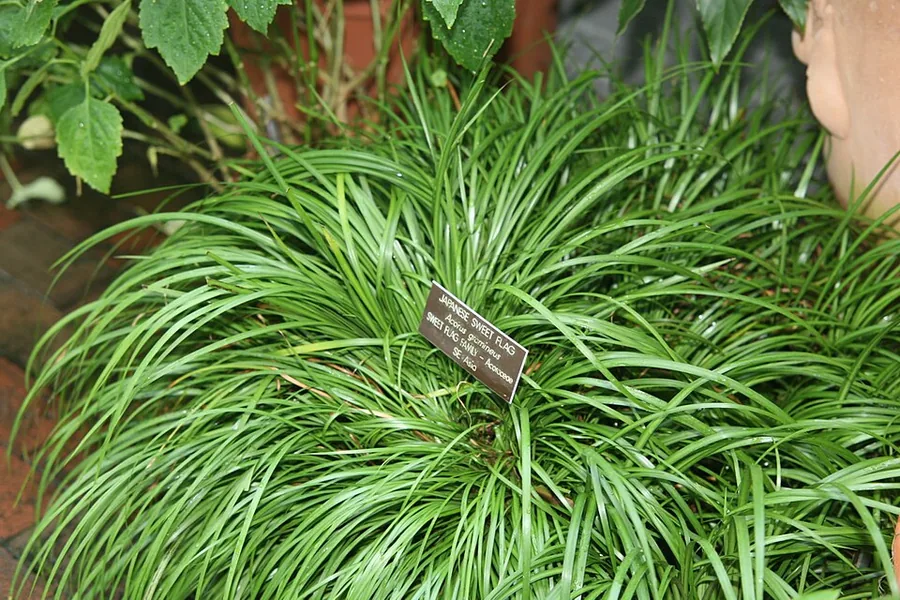
Sweet flag rises in tight, upright fans of narrow, sword-like blades, grass-green and aromatic, with flowers that stay small and easy to overlook. It is an Acorus, a genus held apart in its own family, Acoraceae, and the leaves only look like a grass or an iris without being either. Bruise one blade and a warm, spicy scent lifts from the crushed tissue, the source of the plant's name.
The name covers two plants of different size and heft. The dwarf Acorus gramineus stands just 6 to 12 inches, its slender fans carrying the gold and cream-striped forms, while the common sweet flag, Acorus calamus, is taller at a couple of feet, its blades broad and flat like an iris. Both grow from creeping rhizomes and thrive where their roots stay wet at a pond or stream edge, in a bog, or in a container standing in a saucer of water.
Up close the blades are slender and fine, fanning out from a low crown and spreading outward year by year on slow, creeping rhizomes. The plant carries itself on foliage more than flowers, and it needs little beyond water. When the soil dries, that even green gives way at the edges as the leaf tips scorch and brown, the first visible sign of trouble.
Care
The short version: the grassy fans keep their color and shape in full sun to part shade where the soil stays constantly moist to wet, or under shallow standing water, and never dries. A light feeding in spring and a shear of browned, tatty blades in late winter keep the clump clean.
Light
In full sun the blades color up hardest, though they stay sound in partial sun and partial shade. The gold and variegated fans show their brightest yellow and cream where light is strong, but in hot summers the same fans singe at the edges without a little afternoon shade.
Water
Sweet flag is a marginal bog plant, and its fans stay full only where the soil is constantly moist to wet, or where the crown sits in a few inches of standing water at a pond or stream edge. The broad-bladed Acorus calamus wades into deeper water than the dwarf gramineus. Let the soil dry and the blades brown fast, tip first, which is the commonest way the plant fails.
Soil
The roots run through rich soil that stays consistently moist to wet, indifferent to whether it is clay, loam, sand, or silt, and untroubled by frequent standing water over them. The blades hold up across a pH from 5.5 to 7.5, mildly acidic to neutral.
Temperature
The clump stands through a wide temperature span, from -20°F to 95°F (-29°C to 35°C). At the cold end the fans die back and the rhizome rides out winter underground, which is how the plant holds on in zone 5.
Humidity
The air around the leaves makes no difference, so there is no humidity figure to note. What keeps the blades green is water at the roots, the crown wanting to sit wet rather than the foliage wanting damp air.
Feeding
This is a light feeder, and rich, moist soil keeps the fans green with little else. A single dose of balanced slow-release fertilizer in spring is as much as the blades ask for, and even that is optional.
Pruning
The clump is very low maintenance and needs no routine cutting. The tatty, scorched, and winter-browned blades are sheared or trimmed away in late winter or early spring, and fresh green fans push up to replace them.
Repotting
In a pot the rhizomes fill in and want dividing or potting on every 2 to 3 years. The tells are roots and rhizomes crowding and pushing up out of the pot, the crown lifting above the soil line, and a thinning, hollowing center to the clump.
Size & spacing
Height runs 6 to 47 inches (15 to 120 cm), from the ankle-high gramineus dwarfs to the tall, broad-bladed calamus. Set at 6 to 24 inches (15 to 60 cm) apart, the fans knit into a low grassy carpet, faster where they are placed closer.
When to plant
Hardy from zone 5 to 11, sweet flag greens up from divisions set out in spring once frost has passed, into ground that stays wet. In May and June it lifts slim, greenish-yellow flower spikes, the inconspicuous spadixes that give the plant its bloom. They are small and quiet against the foliage, and easy to miss.
Northern hemisphere
Southern hemisphere
Typical months for a temperate climate: start earlier in warm zones, later where spring frosts linger.
- Sow: not typically grown from seed; propagate by division instead
- Plant: spring after frost, into constantly moist or wet ground or shallow water
- Harvest: spring to early summer (May-June); flowers are inconspicuous greenish-yellow spadixes and the plant is grown for foliage, not bloom
Hardiness
USDA hardiness zones: 5–11
Temperature: down to -29°C
Troubleshooting
Read the blades and they tell you what sweet flag needs, and nearly always the answer is water. Kept wet, the fans stay whole and green; left dry, the tips discolor within days. Match what you see on the leaves to the cases below before the browning climbs down the clump.
Blade tips browning as the fan scorches out
Since sweet flag is a bog and waterside plant, browned, withering blades almost always mean the soil went dry. The gold 'Ogon' and the cream-striped forms singe soonest in a hot, open spot, their pale tissue browning at the tips first. Move the clump to wet ground or stand the pot in a saucer of water, then cut away the worst blades so fresh green fans can grow in.
Fix:
- Move the plant to constantly moist or wet ground, a bog, pond/stream edge, or stand the container in a saucer of water so the soil never dries
- Water deeply and keep the soil saturated; mulch to retain moisture
- Trim off badly scorched foliage; new growth recovers once moisture is restored
- In hot climates give gold and variegated forms some afternoon shade or filtered sun to reduce scorch
A clump that stays small and fills in slowly
A clump slow to widen is usually just the plant's slow habit, with the fans healthy and green the whole time. Sweet flag inches outward on rhizomes over several seasons, and the dwarf gold cultivars are the slowest to bulk up. Wet soil and bright light coax out what growth there is, and divisions set about 8 to 12 inches apart close the gaps sooner.
Fix:
- Be patient: allow clumps to expand over several seasons
- Keep soil consistently wet and provide adequate light to maximize growth
- Plant closer together (about 8-12 in apart) for faster groundcover coverage
Creeping rhizomes spreading through nearby wet ground
In steadily wet soil the broad-bladed common sweet flag (Acorus calamus) runs its rhizomes outward and thickens into wide colonies. The dwarf Acorus gramineus keeps to a tighter clump. Lifting and dividing the outer rhizomes in spring reins it in, and a submerged pot pens the running rhizomes of calamus.
Fix:
- Divide and lift edges in spring to keep the clump in bounds
- Grow in a submerged container or pot to contain the rhizomes, particularly for Acorus calamus
- Install an edging barrier in bog or pond plantings
Toxicity
Every part you see and handle is safe, since sweet flag is not listed as a toxic plant. The caution lies out of sight in the rhizome, the thick aromatic root that holds beta-asarone, a mild toxin and possible carcinogen. The green blades are no worry, but that pungent root is best left unearthed and uneaten.
Toxic to
Cats · Dogs · Horses · Rabbits · Livestock · Birds · People
Cats Mild
The green blades are no real worry, but the thick aromatic rhizome underground carries beta-asarone, and a cat that chews into that root may drool or have a brief stomach upset. The safe course is to keep the rhizome out of reach.
Dogs Mild
A dog nosing the leaves comes to no harm, though gnawing the pungent, aromatic rhizome can bring on mild drooling or loose stools. The blades themselves are no concern.
Horses Mild
Cropping the leaves poses little risk, but the beta-asarone in the aromatic rhizome makes that root worth fencing off from a curious horse.
Rabbits Mild
Rabbits can nibble the slim grassy blades without trouble, yet the aromatic rhizome holds beta-asarone and is best kept beyond their reach.
Livestock Mild
Cattle, sheep, and goats tend to pass over the bitter, aromatic plant, and the caution rests with the pungent rhizome rather than the blades.
Birds Mild
Birds rarely touch sweet flag, but the beta-asarone in the rhizome means that root should not be eaten.
People Caution
The plant is safe to grow and to handle, blades and all, but do not eat the rhizome. For all its old use as calamus flavoring, that aromatic root holds beta-asarone, which the US FDA bars from food as a possible carcinogen.
Safe as an ornamental around pets. Note, however, that the rhizome of the larger common/Eurasian sweet flag (Acorus calamus), especially diploid/triploid forms, contains beta-asarone, a compound the US FDA has banned as a food or flavoring additive (21 CFR 189.110) because of potential carcinogenicity. Although the rhizome was used historically as a medicine and flavoring (calamus), it should NOT be eaten or used as a calamus herbal remedy. This does not affect the plant's safety as a non-toxic ornamental for pets.
Helpline numbers

United States
ASPCA Animal Poison Control: (888) 426-4435 (fee applies)
Poison Control: (800) 222-1222



Canada
Poison Centres: 1-844-764-7669
Varieties
The Acorus worth a close look are mostly dwarf selections set apart by the color running through their blades, along with the larger common sweet flag. Here is how each one reads up close.
Acorus gramineus 'Ogon'
A dwarf Japanese sweet flag whose bright gold, yellow-and-green striped blades fan out about 6 to 12 inches tall, burning brightest in more sun but browning at the edges without a little afternoon shade where summers run hot.
Acorus gramineus 'Variegatus'
A dwarf form whose fine blades are striped cream and green, reading as a soft, finely lined groundcover or a slim accent at a pond edge or in a container.
Acorus gramineus 'Minimus Aureus'
A tiny golden dwarf of only a few inches, its little gold fans sized for small containers and miniature or fairy plantings.
Acorus calamus 'Variegatus'
The large common sweet flag at around 2 to 2.5 feet, its broad, flat, iris-like leaves boldly striped cream and green on a sterile triploid plant.
How to propagate
Sweet flag is increased by splitting the rhizomatous clump, the one dependable way to carry the striped color forms on unchanged.
DivisionEasy
Spring (or early summer) · A few weeks to a season
Splitting the rhizomatous clump is the standard, dependable, and easy way to make more. In spring or early summer the clumps are lifted whole, the creeping rhizomes pulled apart into pieces, and those pieces held constantly moist or in shallow water while roots and new fans form over the next few weeks to a season. The striped forms like 'Ogon' and 'Variegatus' only carry their color on through division, not from seed.
Myths
Sweet flag is a true grass or a kind of iris.
The blades fool the eye, but it is neither. Sweet flag is Acorus, alone in its own family Acoraceae, grown for those aromatic, sword-like fans of foliage. The grassy, iris-like blades are a look-alike, not a relative.