Ornamental · Asteraceae
Sunflower
Helianthus annuus
Set it in full sun with some shelter, and the sunflower lifts its broad head from summer into fall.
Full sun
70–100 days
USDA 2–11
2–10 ft · 0.5–3 m
Overview
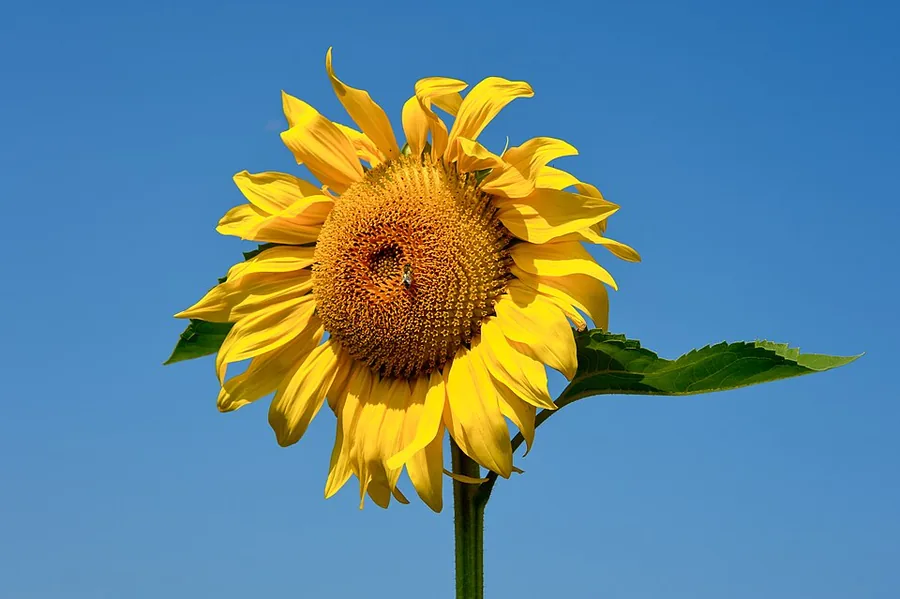
The sunflower rises on a single stout stem that can stretch to 10 feet (3 m) in one season, lifting a broad head high overhead. A member of the daisy family, it grows wild through much of North America, and it is that weighty head atop a tall stalk that gives the plant its shape. In full sun the stem thickens and the head reaches its fullest width.
Up close, the forms differ in build. A single-stem giant carries one massive head, its wide center packed edge to edge with developing seed, while a branching type divides into many stems, each tipped with a smaller flower. The pollenless kinds hold a clean face free of loose pollen, and the dwarf Teddy Bear crowds its head with soft, doubled petals until it looks almost fluffy.
As the season turns, the change is easy to read on the plant itself. The back of each ripening head shifts from green to yellow-brown and the whole head bows and nods toward the ground under the weight of its seed. Even through a dry spell the established stem stands firm, its deep taproot holding it upright while the head fills.
Care
The short version: the sunflower takes full sun and a deep, loose, well-drained soil of average fertility for that taproot, steady moisture while the seedling roots and again as the head fills, then far less once the stem stands settled and drought tolerant.
Light
The sunflower answers to full sun more than anything, and the brightest, most open ground shows in the plant: a thick, upright stem and a wide, well-filled head. Starved of light in shade, the stem thins and leans and the flowers come few and small.
Water
The soil stays moist while the seed sprouts and the young root takes hold. Deep, regular water then runs for about 20 days before and after flowering, the stretch when the swelling head draws hardest on the stem. Once rooted deep, the plant turns drought tolerant and the stem holds without much more.
Soil
Give the roots deep, loose, well-drained soil of average fertility to work through. The long taproot drives straight down, so any hard pan broken up before sowing lets it reach full depth. Plain garden soil is texture enough.
Humidity
Open air sets the humidity, so no reading applies. Moving air is what shows on the leaves, since a still, damp canopy is where downy mildew mottles them gray.
Feeding
The sunflower draws little from the soil. A single band of slow-release all-purpose fertilizer, laid alongside once a few true leaves widen, carries the plant. Too much nitrogen swells the leaves and invites disease while the flowers lag.
Pruning
There is almost nothing to cut. Snapping off a spent head, or deadheading, keeps a branching plant pushing new flowers, and any bruised or diseased growth comes away as it appears.
Size & spacing
Stems reach anywhere from 18 inches to 1.5 to 10 feet (0.5 to 3 m) tall, and the leafy spread runs 1.5 to 3 feet (46 to 91 cm) across. Fit the plant to its place and leave a gap between stems so air slips through the leaves.
When to plant
Frost cuts the sunflower down, so the seed waits for warmth. Sown after the last spring frost, once the soil warms past 60°F (16°C), the seedling breaks the surface and climbs through summer into fall. By early fall the broad heads hang heavy and their backs pale to yellow-brown, the plant's own sign that the seed is ready.
Northern hemisphere
Southern hemisphere
Typical months for a temperate climate: start earlier in warm zones, later where spring frosts linger.
- Sow: Usually unnecessary; sunflowers resent transplanting, so indoor starting is generally not recommended
- Plant: After the last spring frost, once soil has warmed to at least 60°F (16°C)
- Harvest: Blooms mid to late summer into fall; harvest seed heads in early fall when the back of the head turns from green to yellow-brown and nods downward
Hardiness
USDA hardiness zones: 2–11
Temperature: down to -46°C
Troubleshooting
Read trouble on the sunflower where it shows: mottling and insects on the leaves, damage inside the flower head, or a lean in the tall stem. The earlier the sign is caught, the smaller it stays. Find the look that matches below and act on it.
Tunneled seeds and gray webbing knotting the head
Split a suspect head and caterpillars, often sunflower moth larvae, sit among the seeds they have hollowed, wrapped in loose webbing and speckled with dark frass. They chew through buds, petals, and the soft forming seed at the head's center. Lift them out, cut away a head too far riddled, and use a labeled control at early flowering if the boring spreads.
Fix:
- Handpick caterpillars where practical
- Remove and destroy heavily infested heads
- Apply a labeled biological or insecticidal control at early flowering if needed
Pale mottling on top with gray felt on the underside
Downy mildew paints pale, washed-out blotches across the top of a leaf and lays a gray, downy felt on the underside, worst in cool, wet weather. The new growth above it puckers and stunts as the fungus takes hold. Pull and burn the marked plants, widen the gaps between them, and keep the leaves dry.
Fix:
- Remove and destroy affected plants and debris
- Improve air circulation and avoid overhead watering
- Plant resistant cultivars where available
Emptied seed sockets across the ripening face
A raided head shows empty sockets where birds have prised the ripening seed straight from the face. A mesh bag or row cover, tied on as the seed plumps, shields the head. Spinners, reflective tape, or an owl decoy unsettle them, and a near-ripe head can be cut to finish drying under cover.
Fix:
- Cover maturing heads with mesh or row cover
- Use scare devices such as spinners, reflective tape, or owl decoys
- Cut and dry nearly mature heads indoors to finish ripening
A thick stem bowed low or cracked at the base
When the head grows too heavy for the stalk, the tall single-stem giants lodge, the thick stem bowing low or cracking as wind and rain push on it. A stake set against the tall cultivars early holds the stem before the head loads up. Deep, even water thickens the root below, and a sheltered spot keeps the hardest gusts off the head.
Fix:
- Stake tall and giant cultivars
- Provide deep, even watering to encourage strong rooting
- Site plants where they are sheltered from strong wind
Beaded insects and a glassy sticky film on the stems
The stems and leaf undersides carry tight bunches of aphids, soft green to black specks that pierce the plant and leave a glassy, sticky honeydew over the surface. A hard jet of water knocks the clusters loose, and lady beetles and lacewings pick off the rest. Insecticidal soap comes out only when a colony coats the stem.
Fix:
- Dislodge aphids with a strong jet of water
- Encourage natural predators such as lady beetles and lacewings
- Apply insecticidal soap if populations are heavy
Toxicity
Nothing on the sunflower needs to be feared at close range. The ASPCA lists it as non-toxic to cats, dogs, and horses, and the plump seeds in the head are the same ones people and birds eat. A leaf or petal taken by a curious mouth does no harm.
Safe for
People · Cats · Dogs · Horses · Rabbits · Livestock · Birds
Cats None
A cat that mouths a sunflower leaf or petal comes to no harm, as every part of the plant is safe to it.
Dogs None
A dog is safe around the whole sunflower, and the seeds packed in the head make a wholesome treat in small amounts.
Horses None
A horse can crop the leaves and stems safely, the plant listed by the ASPCA as non-toxic to it.
Rabbits Safe
A rabbit may strip the leaves and petals with no ill effect, so a chewed stem is nothing to note.
Livestock Safe
Cattle, goats, and sheep browse the plant safely, and its seed even goes into their feed.
Birds Safe
Birds prise the seed from the head unharmed, and a ripe, drooping head feeds them straight off the plant.
People Safe
People eat the seeds raw or roasted, and no part of the plant harms them.
Varieties
Sunflowers run to the thousands, yet a few forms show off the range, from a giant on one thick stem to slender cut flowers. These are the ones to picture first.
Mammoth (Russian Giant)
This single-stem giant tops the group, one thick stalk bearing an outsized head crammed with edible seed.
Autumn Beauty
This branching form scatters many smaller heads in warm autumn tones along its side stems through a long season.
ProCut and Sunrich series
These pollenless single-stem series open a clean, even face that lasts long once cut.
Teddy Bear
This dwarf packs its short head with soft, doubled petals into a rounded, fluffy pompon.
How to propagate
Every sunflower begins as a single seed pressed into the ground, which makes raising one about as plain as growing gets.
SeedEasy
Direct-sow after the last spring frost once soil has warmed to at least 60°F (16°C) · Germinates in about 7 to 10 days
Press each seed into its final spot after the last spring frost, once the soil holds past 60°F (16°C). Sunk 1 to 2 inches down, it splits and sends up a shoot in about 7 to 10 days. The taproot resents any move, so the seed goes straight into the ground rather than a pot indoors.
Myths
The open sunflower keeps turning its heavy head to follow the sun across the sky all day.
Only a young, growing shoot swings its tip, leaning east to west through the day and easing back east by night. The moment the head opens wide at maturity, the stem stiffens and the turning stops. A grown sunflower holds its face to the east and no longer follows the sun.