Houseplant · Piperaceae
String of Turtles
Peperomia prostrata
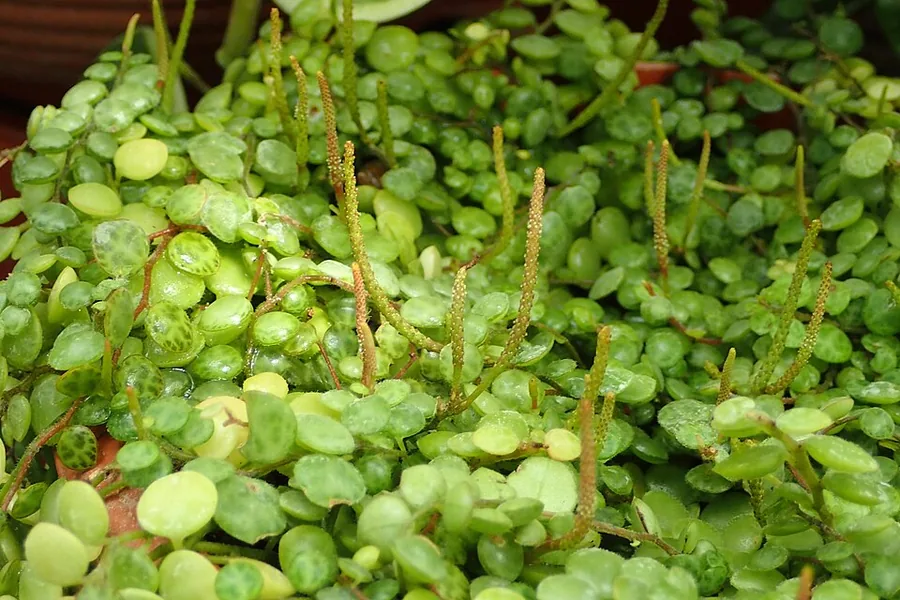
A trailing peperomia hung with round, fingernail-sized leaves, each veined like a small turtle shell.
Bright indirect
Every 7–14 days
68–75°F · 20–24°C
USDA 10–12
Overview
String of turtles is a small trailing peperomia from the rainforest floor of Ecuador, where thin stems creep across mossy logs. The leaves make it. Each one is round, plump, and barely the size of a fingernail, its surface crossed by a pale web of veins that draws out the look of a small turtle shell. New leaves ride along slender, wiry stems that lengthen slowly, trailing 9 to 12 inches (23 to 30 cm) before they fill out.
Up close the leaves feel firm and fleshy rather than papery, a sign of their semi-succulent build. That thickness lets each little leaf hold a small store of water, and it gives the foliage a rounded, slightly domed profile along the stem. The pale veining stands out most where the light is good, sharpening the shell-like pattern across the surface.
Set several stems together and the plant reads as a close-packed trail of patterned discs, each leaf overlapping the next down the line. The whole thing stays fine-textured and low, a slow build of small round leaves rather than a fast, leafy sprawl. Given good light, that veined pattern holds crisp and clear for years.
Care
The short version: the veined little leaves want bright, indirect light, a fast-draining pot, and water only once the top half of the soil has dried. Keep the plant warm, feed it lightly through the growing season, and hold back on the water to spare the roots.
Light
It wants bright, indirect light, the soft light a few feet back from an east or south-facing window. Medium and even low light are tolerated, but the pale turtle-shell veining fades and flattens without enough of it. Harsh, direct sun scorches the thin-skinned little leaves.
Water
Let the top half of the soil dry before the next watering, which tends to fall every 7 to 14 days. The fleshy, semi-succulent leaves hold their own reserve, so the plant weathers dryness far better than a soggy pot. Overwatering is the surest way to lose it.
Soil
Plant it in a well-drained houseplant or cactus mix that lets water drain straight through. A loamy or sandy texture works well, and the plant takes a pH from 5.5 to 7.5 without trouble. Drainage counts for more than anything else here.
Temperature
It sits comfortably at 68°F to 75°F (20°C to 24°C), plain room warmth. The plant has no tolerance for frost or cold drafts, so keep those small leaves away from chilly windows and winter doorways.
Humidity
Average household humidity is plenty, with no number to track. The plant likes a little extra moisture in the air, yet the fleshy leaves keep it going in ordinary room air, without misting or a humidifier.
Feeding
Feed lightly through spring and summer, while new leaves are forming. A weak liquid fertilizer about once a month suits it, or a slow-release granular feed once a year. This is a slow grower, so the foliage builds gradually and needs little food.
Pruning
Pinch the trailing stems back here and there to push fuller, bushier growth and more overlapping leaves. Trim off any stem that stretches leggy or shows damage, and the plant keeps its dense, rounded look.
Repotting
The roots sit happily pot-bound and can stay in the same pot for several years. Move up a size only when roots break from the drainage holes, water runs straight through, or the leaves stop coming.
Size & spacing
It stays small, trailing 9 to 12 inches (23 to 30 cm) with a narrow spread of only 3 to 4 inches (8 to 10 cm). The result is a fine, close trail of little round leaves rather than a broad, bushy plant.
Troubleshooting
Most trouble here shows first in the leaves and roots, and it traces back to water or light. Read those close-up signs early, from soft stems to flattened veining, and the plant usually recovers. Match what you see below.
Dropping or yellow leaves with soft, mushy stems
Leaves that yellow and fall while the stems turn soft and mushy signal root rot from overwatering, the fastest killer of this plant. Below the soil the roots go brown and slack in the constant wet, and the leaves lose their grip. Cut back the water, move it into fresh well-draining mix, and trim off the rotted roots before the rot climbs further.
Fix:
- Reduce watering frequency
- Let soil dry partway before watering again
- Repot into fresh well-draining mix and trim rotted roots if rot is present
Sticky film, fine webbing, or small insects on leaves and stems
A sticky sheen on the leaves, fine webbing, or small crawlers at the stem joints marks sap-sucking pests, usually mealybugs, spider mites, scale, or whiteflies tucked under the foliage. Wipe them from the leaves and stems, treat with insecticidal soap, and keep the plant apart from others while it clears. This one usually resists pests, so an infestation most often rides in on a new plant.
Fix:
- Wipe off pests
- Treat with insecticidal soap
- Isolate the plant to prevent spread
Flat, pale leaves with faded veining
When the pale turtle-shell veining goes flat and washed out, the plant is short on light. It has been sitting too deep in a dim corner, away from a window. Bring it into bright, indirect light near an east or south-facing window and the veined pattern sharpens back across each leaf.
Fix:
- Move to a spot with bright, indirect light from an east or south-facing window
Toxicity
Good news for a home with pets or small children. The ASPCA lists this trailing peperomia as non-toxic, and no part of the plant, leaf or stem, is known to harm cats, dogs, or a curious child. A low shelf carries no risk.
Safe for
People · Cats · Dogs · Horses · Rabbits · Livestock · Birds
Cats None
The ASPCA lists this peperomia non-toxic to cats. A nibbled leaf does a cat no harm.
Dogs None
The plant is non-toxic to dogs by the ASPCA's listing. A chewed trailing stem will not poison a dog.
Horses Safe
Nothing in this peperomia is known to harm horses, though a small trailing houseplant rarely reaches them.
Rabbits Safe
A rabbit that bites off a mouthful of the round leaves stays unharmed, as the plant holds no toxins that affect it.
Livestock Safe
Cattle, goats, and sheep face no toxic risk from this peperomia.
Birds Safe
A pet bird can perch on the stems and peck the leaves without harm, since nothing in the plant is toxic to it.
People Safe
The plant is safe around children, so a stray leaf in a small hand is harmless.
How to propagate
More string of turtles comes easily from the plant itself, and one specimen offers plenty to work with. A single round leaf or a length of trailing stem will root, both taken in the warm growing months.
Leaf cuttingsEasy
Spring or summer during active growth · Several weeks to a few months to root and establish
Take a single healthy leaf with its short stalk attached and press it flat into moist, well-draining mix. Do this in spring or summer during active growth, then wait, since roots and a small new plant form slowly over a few weeks to a couple of months.
Stem cuttingsEasy
Spring or summer during active growth · Several weeks to root
Cut a trailing stem a few inches long in spring or summer and lay it against moist mix. A little rooting hormone speeds things, and the stem usually puts down roots within a few weeks.
Myths
String of turtles is a true succulent that wants cactus-style watering and bone-dry soil.
Not so. The fleshy leaves make it only a semi-succulent, so while each one banks a little water, the plant prefers to dry just partway between drinks rather than fully. Left bone dry it sulks, but overwatering is the far greater danger and the usual reason one is lost to rot.