Ornamental · Asteraceae
Strawflower
Xerochrysum bracteatum
Grown in full sun and dry soil, the strawflower opens stiff, papery bracts that crackle at a touch and hold their color for months.
Full sun
75–90 days
USDA 8–10
1–5 ft · 0.3–1.5 m
Overview
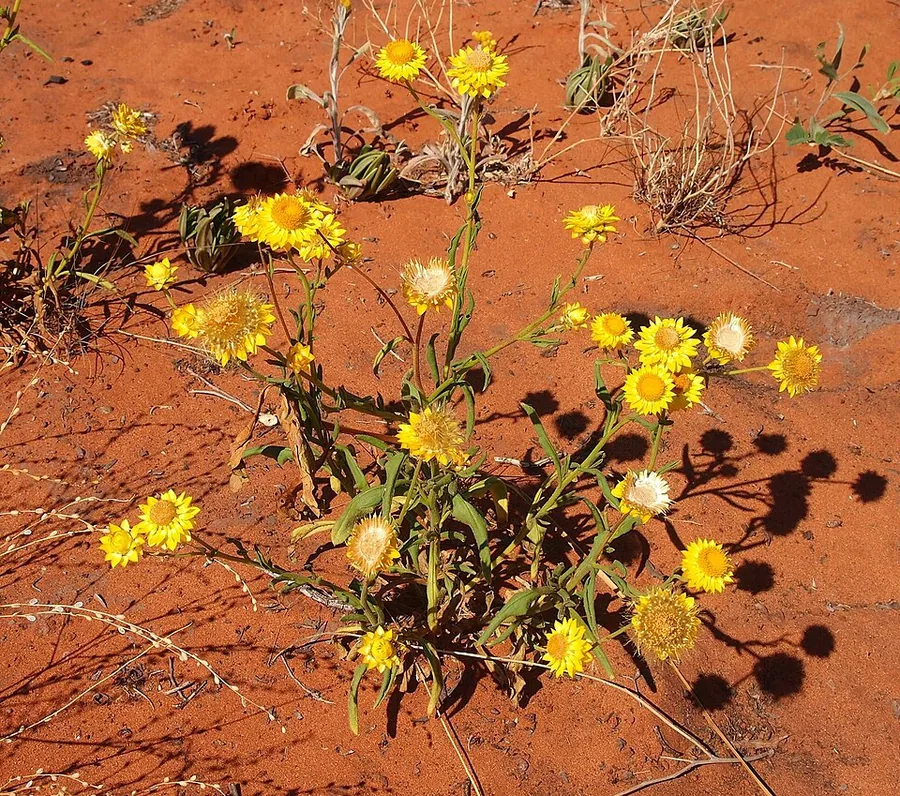
Run a finger over a strawflower and the surprise is instant: what looks like a ring of petals is really a set of stiff, papery bracts, dry and crisp, that crackle under the touch and keep their color for months after cutting. The heads sit atop upright stems above narrow green leaves, and the plant, a daisy relative from Australia, grows as a warm-season annual.
The bracts curve inward around a small central disk, layered like overlapping straw, and catch the light with a faint sheen. Their color runs across gold, bronze, pink, and white, sometimes deepening toward the center of the head. Bees and butterflies work the open disk through the summer.
Cut while the bracts are still half-closed, the heads hold that tight, sculpted form as they dry. Hung upside down, the stems stiffen and the bracts set into lasting, paper-dry blooms that keep both shape and color long after the green plant outdoors has faded.
Care
The short version: full sun and well-drained soil kept on the dry side. Watering waits until the surface dries, deadheading keeps fresh bracts opening, and the taller stems need staking before they bow.
Light
The strawflower opens its fullest, straightest heads in full sun, six or more hours a day. Light afternoon shade is tolerated, but in dim light the stems stretch thin and lean, and far fewer papery bracts form.
Water
Let the top half of the soil dry between waterings. The plant is drought tolerant once established, and its worst enemy is standing wet, which softens the roots into rot. Average to dry ground suits it far better than wet.
Soil
The roots run best in well-drained loam of average fertility. The plant takes a wide pH range from 5.5 to 8.0 and holds up in dry, lean soil where richer feeders would struggle. Drainage counts more than fertility.
Humidity
Ordinary outdoor air is enough, so there is no level to reach for. Air moving over the leaves is what matters, since still, muggy air around crowded plants leaves a film of mildew on the foliage.
Feeding
This light feeder colors up well in plain soil. A balanced general-purpose fertilizer once a month through the growing season is all it draws on, and heavier feeding adds nothing to the bracts.
Pruning
Snipping off the spent, faded heads keeps fresh bracts opening in their place. A light pinch on a young plant thickens it into a bushier, sturdier frame, and the tallest stems may lean on a stake.
Size & spacing
By variety the stems rise from a low 12 inches to a towering 1 to 5 feet (30 to 152 cm), with a leafy spread of 6 to 18 inches (15 to 45 cm). Spacing that lets air slip between the plants keeps the foliage dry.
When to plant
The strawflower runs on warmth and will not take a frost. The seeds start indoors in early spring, the young plants go out once the cold has gone and the soil has warmed, and the bracts open from early summer until the first frost.
Northern hemisphere
Southern hemisphere
Typical months for a temperate climate: start earlier in warm zones, later where spring frosts linger.
- Sow: 6 to 8 weeks before the last spring frost; do not cover seed, as light aids germination
- Plant: After the last frost when soil has warmed
- Harvest: Blooms summer to fall (about June until frost); harvest for drying when bracts are partly open
Hardiness
USDA hardiness zones: 8–10
Temperature: down to -12°C
Troubleshooting
In a sunny, open spot the strawflower stays crisp and upright, and most trouble traces to too much water or too little air. The first signs read on the leaves, stems, and roots before a small problem spreads.
Drooping, yellow leaves above a soft, dark base
When the leaves yellow and hang limp above a mushy stem base, the roots below have gone to root rot in soil left too wet. Pulled from the ground, those roots come up dark and soft, no longer firm enough to draw water. Drier soil is the first step, followed by better drainage or a move to ground that never stays saturated.
Fix:
- Stop overwatering and let soil dry
- Improve drainage or move to a better-drained site
A chalky white or fuzzy film dusting the green leaves
That pale, powder-like film is powdery or downy mildew, a fungus that grips leaves left damp in the still air of a crowded planting. It spreads as a white-to-grayish crust across the leaf surface. Stripping the coated leaves clears the worst of it, wider spacing lets air pass over the foliage, and watering low at the soil leaves the leaves dry. Full sun and open air keep the surfaces clean.
Fix:
- Improve spacing and air flow
- Water at the soil line and avoid wetting foliage
- Remove and discard affected leaves
Long slender stems bowing under their flower heads
On the taller cultivars, the flower heads ride high on slim stems, leaving them top-heavy enough to bow and pitch over after rain or wind. A stake set early holds the stem straight before it lengthens. Pinching a young plant thickens the base into a lower, branching frame that carries the weight on its own.
Fix:
- Stake or provide support for tall plants
- Pinch young plants to promote sturdier branching
Toxicity
The strawflower is non-toxic in every part, leaf, stem, and papery bract alike. The ASPCA lists it as safe for cats, dogs, and horses, and rabbits, livestock, birds, and people are safe as well. A stray nibble poisons no one.
Safe for
People · Cats · Dogs · Horses · Rabbits · Livestock · Birds
Cats None
A cat is safe with it. The ASPCA lists the strawflower as non-toxic, so a nibble at the papery blooms brings no poisoning.
Dogs None
A dog is in no danger from it. A chewed leaf or flower head carries no poison, though a large mouthful of any plant can unsettle a sensitive stomach.
Horses None
A horse is safe near it. The strawflower is listed as non-toxic, so grazing beside the stems carries no danger.
Rabbits Safe
A rabbit can browse the leaves and stems unharmed, since no part of the plant is poisonous to it.
Livestock Safe
Cattle, goats, and sheep can crop the foliage safely, as it holds no toxins that trouble grazing stock.
Birds Safe
A bird comes to no harm here, whether it picks at the dried seed heads or lands among the stems.
People Safe
The plant is harmless to people. The stiff, papery blooms are a favorite for drying, and handling the leaves and stems poses no risk to children.
Varieties
Strawflowers vary in stem height and bract color, from knee-high dwarfs to plants near three feet. These named ones are worth seeking out.
Bright Bikini
A dwarf strain that stops near 15 inches, its short stems carrying blooms across a mix of colors that suits containers.
Dargan Hill Monarch
A cultivar with grey-toned leaves that set off large flower heads of deep golden-yellow.
Kimberly Sunset
Another grey-leaved selection, its bracts opening in a soft pink.
Kingsize Mixed
A type with oversized blooms held on stems that reach about 3 feet.
How to propagate
Strawflowers grow from fine seed or from stem cuttings. Seed gives a mix of bract colors, while a cutting copies one plant exactly.
SeedEasy
Start indoors 6 to 8 weeks before last frost; surface-sow as light aids germination · Germinates in roughly 1 to 3 weeks; blooms within the first season
The fine seed starts indoors 6 to 8 weeks before the last frost. It rests on the surface, uncovered, since light on the seed coat triggers germination, and the first green sprouts push up within 1 to 3 weeks. The seedlings move outside after frost and open their first bracts that same season.
Stem cuttingsEasy
During active growth in the growing season · Several weeks to root
A stem cutting keeps a named cultivar true to type. Cut from firm, actively growing shoots and given several weeks to root, it grows into an exact copy of the parent, right down to the bract color, where seed would give a mixed result.
Myths
Strawflowers are true everlasting flowers that never fade or die.
The name reaches past the truth. Once dried, the stiff papery bracts keep their color and hold their curled shape for a long time, which is where the everlasting name began, but the living plant is short-lived and grown as an annual. The bracts endure long after the green plant has died back.
You can save seed from a favorite cultivar and get identical plants.
The seed will not match the parent, because named cultivars do not come true from seed and instead throw a variable mix of forms and colors. To keep one particular bract color and habit, take stem cuttings rather than saving seed.