Vegetable · Amaranthaceae
Spinach
Spinacia oleracea
Sown cool and cut young, spinach fills a low rosette with tender, dark-green leaves in about six weeks.
Full sun
Every 2–4 days
32–77°F · 0–25°C
40–50 days
Overview
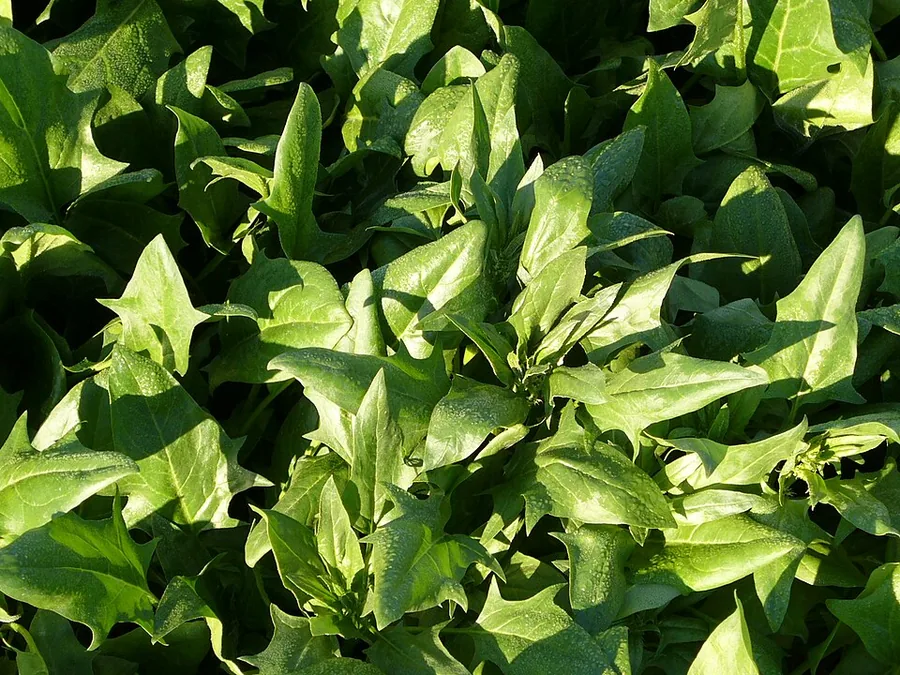
Spinach forms a low rosette of tender, dark-green leaves that comes on fast in cool weather. In about 40 to 50 days the small seedling opens into a full cluster of pickable foliage, ready early in spring and again in fall. When heat arrives, the leaves shrink and a stalk pushes up from the center as the plant bolts.
Up close the plant stays small, just 6 to 12 inches (15 to 30 cm) tall and about as wide, the leaves layered outward from a central crown. The outer leaves, the largest and oldest, are picked first while smaller ones keep unfurling at the middle. That steady renewal of new foliage carries a single sowing through weeks of cutting.
The leaves that make the whole plant are also high in oxalates. On the plate that is no concern, but the same compound is why the foliage is fed to pets and grazing animals only in small amounts, never in large helpings.
Care
The short version: spinach raises its low rosette of tender leaves while spring or fall stays cool, in full sun to partial shade and rich, damp soil, and the outer leaves are cut before heat shrinks the foliage and pushes up a flower stalk.
Light
In the cool months spinach spreads its dark-green leaves wide in full sun, and it holds that color in partial shade too. As the air heats, a little afternoon shade keeps the leaves broad and slows the stalk of a bolt.
Water
The leaves are thin and the roots shallow, so they go limp fast once the soil dries. Hold the ground evenly moist, looked over every few days, and the foliage stays plump and tender, holding the bolt off a little longer as the weather warms.
Soil
Spinach roots into rich, well-drained soil full of organic matter and pushes out broader, faster leaves for it. It takes a pH of 6.0 to 7.5 in stride, and a bed worked with compost shows in the fullness of the foliage.
Temperature
Cool air keeps the leaves sweet and broad. Spinach carries from near freezing to about 77°F (25°C), growing best low in that range; past it the foliage turns small and the plant reaches for a stalk.
Humidity
Plain outdoor air suits the plant, so no number applies. What the leaves need is moving air around them, since a still, damp crowd of foliage is where the gray fuzz of downy mildew settles in.
Feeding
A heavy feeder, spinach turns nitrogen straight into more green leaf. Dig plenty of compost or a balanced, nitrogen-rich fertilizer through the soil before sowing, and side-dress later if the color pales toward yellow.
Pruning
No pruning as such. The outer leaves are cut once they broaden while new ones keep rising at the center, and any leaf gone yellow or any climbing bolt stalk is snapped off.
Repotting
Grown as an annual, spinach lives out one season and is never repotted. Once the leaves are spent and the plant has stretched to seed, it is cleared away and a new crop sown rather than shifted.
Size & spacing
Full grown, the plant is a low mound of leaves, 6 to 12 inches (15 to 30 cm) tall and roughly as wide. Seedlings are thinned to 3 to 6 inches apart so each rosette has air around it and space to broaden.
When to plant
Spinach is a cold-weather plant that turns fast and coarse in heat. The first leaves go in once spring soil loosens, another sowing follows in late summer, and the dark-green foliage is cut all through the cool spell before a stalk rises.
Northern hemisphere
Southern hemisphere
Typical months for a temperate climate: start earlier in warm zones, later where spring frosts linger.
- Sow: Usually direct-sown; optionally start 4-6 weeks before the last spring frost if transplanting.
- Plant: Early spring as soon as soil is workable (about 4-6 weeks before last frost) once soil reaches 45°F, and again in late summer for a fall crop.
- Harvest: Harvest leaves roughly 40-50 days after sowing, before plants bolt; grown for foliage rather than bloom.
Hardiness
USDA hardiness zones: 2–11
Temperature: down to -46°C
Troubleshooting
Spinach writes its troubles on the leaves, in mottled color, winding marks, or a stalk climbing out of the center. Read those changes early and most of the foliage is still worth cutting. Match what shows on the plant below and act before the leaves turn or a disease spreads.
Yellow blotches above, a gray-violet fuzz below
This is downy mildew. On top the leaf shows soft yellow blotches, and turning it over reveals a gray to violet fuzz coating the underside. It races through leaves left cool, wet, and packed together. Strip off the marked leaves, thin the stand so air moves between the plants, and water at the roots early in the day so the leaf surfaces dry fast.
Fix:
- Remove and destroy infected leaves and plants
- Improve air circulation and avoid overhead watering
A stalk climbs from the center and the leaves turn bitter
This is bolting. As the days grow long and the heat builds, a flower stalk shoots up through the middle of the rosette and the plant pours itself into seed. The leaves left along the stem grow small and turn bitter. Lift the entire plant as soon as that stalk shows, and sow again where it stays cool.
Fix:
- Harvest the entire plant promptly once bolting begins
- Remove bolted plants and sow a fresh cool-season planting
Pale, twisting tunnels traced under the leaf skin
The pale trails are leafminer larvae eating through the inside of the leaf, between its upper and lower skins where sprays never reach. Look for tan, winding lines and blister-like blotches with the grub still inside. Pick off the marked leaves and destroy them, and lay a floating row cover over the bed to shut the egg-laying flies out.
Fix:
- Pick off and destroy mined leaves
- Remove badly infested plants
Toxicity
For all its wholesome dark-green look, spinach carries a high oxalate content in every leaf. That is only a dietary footnote for people prone to kidney stones, and it is the reason cats, dogs, and horses should take the leaves in small amounts rather than large servings.
Toxic to
Cats · Dogs · Horses
Safe for
People · Rabbits · Livestock · Birds — the leaves
Cats Caution
A single bite of the leaves will not hurt a cat, though spinach is dense with soluble oxalates. Offered often or in a large pile, they can strain the kidneys and turn the stomach, so let it stay a rare, small taste.
Dogs Caution
Most dogs manage a little spinach, but the oxalates in the leaves mount up. Large or repeated helpings can inflame the gut and press on the kidneys, a heavier concern for a dog already prone to kidney trouble.
Horses Caution
Spinach is no poison to a horse, but the heavy oxalates in the leaves can lock up calcium and lean on the kidneys in quantity. Keep it to an occasional handful.
Rabbits Safe
Rabbits take spinach leaves as one green among a varied mix. Their oxalate load means the leaves are best alternated with other greens rather than fed every day.
Livestock Safe
Cattle, goats, and sheep browse moderate amounts of spinach, trimmings and all, and nothing in the leaves is toxic enough to harm a grazing animal.
Birds Safe
Pet birds and backyard fowl pull at spinach leaves readily. Give them a few other greens alongside so the oxalates stay a small share of what they eat.
People Edible
For people the leaves are wholesome food, good raw or cooked. They carry a natural load of oxalates that is a concern only for anyone prone to kidney stones, and a spell of cooking drops the level.
Spinach is high in oxalates, a human dietary consideration (relevant to kidney-stone-prone individuals); cooking reduces oxalate levels.
Helpline numbers

United States
ASPCA Animal Poison Control: (888) 426-4435 (fee applies)
Poison Control: (800) 222-1222



Canada
Poison Centres: 1-844-764-7669
Varieties
Spinach leaves range from deeply puckered savoy types through semi-savoy to flat smooth-leaf kinds, and a few varieties show that range well. The varieties below show that range by look.
Bloomsdale Long Standing
A savoy heirloom whose dark-green leaves are thick and deeply puckered, standing firm through the cold.
Tyee
A semi-savoy hybrid that holds off bolting in the heat and is cut in about 45 days.
Melody
A lightly crinkled 1977 All-America Selections winner, slow to throw a stalk and mild on the tongue.
Companions
Spinach grows best alongside other cool-season crops, especially legumes that share its early timing and feed nitrogen back into the bed.
Plant near
Peas: Shares cool-season preferences and the legume fixes nitrogen, making it an efficient early-spring interplant.
Bush beans: Listed on cool-season interplanting guides as a compatible companion that supplies nitrogen.
Brassicas: Cool-season brassicas pair well with spinach for interplanting in spring and fall beds.
How to propagate
Spinach starts from seed sown right into the soil, no transplants involved, and quickly pushes up its first true leaves.
SeedEasy
Direct sow in early spring once soil reaches about 45°F and again in late summer for fall. · Germinates in about 7-14 days; harvestable in roughly 40-50 days.
Spinach comes up straight from seed sown where it will grow, with no transplanting. Set the seed 1/4 to 1/2 inch deep as the soil warms to about 45°F (7°C), then space the seedlings 3 to 6 inches apart. The first shoots break the surface in 7 to 14 days, and the leaves reach cutting size in roughly 40 to 50 days.
Myths
Spinach leaves pack in iron the body soaks up with ease.
The leaves do hold iron, but the non-heme kind, and their own oxalates tie up a large share as it digests. The green delivers far less usable iron than the Popeye image promises, so it earns its keep through other nutrients.
The leaves only fill out under all-day full sun.
The plant grows well in full sun and keeps its dark-green color in partial shade. A stretch of afternoon shade actually spares the leaves in the heat, slowing the bolt that high temperatures bring on.