Vegetable · Amaranthaceae
Swiss Chard
Beta vulgaris subsp. vulgaris
Cut the thick outer stalks and Swiss chard keeps unfurling fresh glossy leaves all season.
Full sun
Every 3–7 days
41–86°F · 5–30°C
50–60 days
Overview
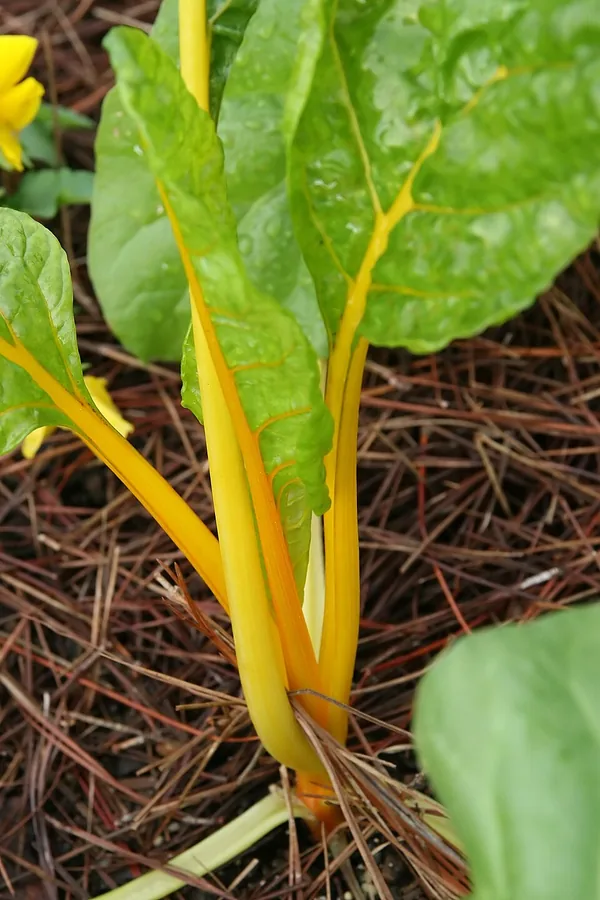
Swiss chard grows as a low clump of broad, glossy leaf blades lifting from thick, fleshy stalks, and both parts are eaten. The blades run deep green above stalks that range from pale to boldly colored, marking a plant that is the same species as the beet yet built for its leafy top rather than a swollen root. As a biennial grown as an annual, it keeps this leafy form through the first season and sends up no flower.
Up close, the color is what holds the eye. In the brightest kinds the stalks and the veins feeding each blade glow in red, pink, yellow, and white, threads of color lit against the dark, glossy green of the leaf. The blades are broad and smooth with a wet-looking shine, the stalks beneath them thick and fleshy, a sturdy build that carries the plant through summer heat and light frost alike.
Run a hand over a plant and the parts read clearly: firm, fleshy stalks below and wide leaf blades fanning out above. New leaves push up from the center while the older outer leaves spread at the edges, cut at the base once they reach full size. Given steady water and rich soil, the clump keeps sending up fresh, glossy blades.
Care
The short version: full sun or a little afternoon shade, rich soil kept evenly moist, and steady cutting of the thick outer stalks so smooth new blades keep unfurling from the center.
Light
Chard colors up best in full sun but keeps its form in partial shade, and that shade slows the plant's push toward a seed stalk in hot weather. In deep shade the blades come in thin and pale and the whole clump slows down.
Water
Kept in evenly moist soil, about 1 to 1.5 inches of water a week, the blades stay thick, smooth, and tender. Let the soil dry and heat build, and the plant answers by shooting up a seed stalk instead.
Soil
Chard sinks its roots best into rich, well-drained loam dark with organic matter. A pH of 6.0 to 7.0 suits it, and compost dug in before sowing gives the roots a crumbly, open bed to spread through.
Temperature
The blades hold their color and shape across a wide range, from about 41°F to 86°F (5°C to 30°C). A light frost leaves them unmarked, and they stay firm through summer heat that wilts softer greens.
Humidity
Open outdoor air, somewhere around 40% to 70% humidity, keeps the leaves in good order. Moving air matters more than any reading, since blades left crowded and damp soon show the spotting of leaf spot.
Feeding
A balanced, nitrogen-containing vegetable fertilizer side-dressed through active leaf growth, starting in spring, keeps the new blades broad and deep green. With leaves cut all season, that steady nitrogen shows directly in the size and color of the regrowth.
Pruning
Cutting is how you shape the plant. Slice the outer leaves at 4 to 12 inches right near the base, leaving the tight central crown, and fresh blades keep rising from the middle cut-and-come-again.
Repotting
Grown as an annual, chard is never repotted. Reseed containers each season rather than lifting a plant, and give the roots a deep, roomy pot so the clump can bulk out without crowding.
Size & spacing
A full plant stands 12 to 24 inches (30 to 60 cm) tall and fans out 8 to 18 inch (20 to 45 cm) wide, a dense rosette of blades and stalks. Thin the seedlings to 4 to 6 inches apart so each clump has room to broaden and air to slip between the leaves.
When to plant
Chard is a cool-season grower that holds its color through both spring chill and summer heat. Seed can start indoors in late winter, or go straight into the ground a couple of weeks before the last frost, where the first pale seedlings soon push up. A second sowing in late summer sends up a fresh flush of glossy blades for fall.
Northern hemisphere
Southern hemisphere
Typical months for a temperate climate: start earlier in warm zones, later where spring frosts linger.
- Sow: 4 to 6 weeks before the last spring frost
- Plant: 2 to 3 weeks before the last spring frost, and again in late summer for a fall crop
- Harvest: Harvest leaves from early summer through fall (and over winter in mild climates)
Hardiness
USDA hardiness zones: 3–10
Temperature: down to -40°C
Troubleshooting
Most of what troubles chard writes itself right onto the leaf, in tunnels, spots, or a sudden stalk you can see at a glance. Look closely at the blades and stalks and the early signs stand out plainly. Match what shows on the plant below, then cut away the marked tissue while it still helps.
Round tan spots rimmed in purple across the blade
Small round spots, tan at the center and rimmed in purple, are the marks of Cercospora leaf spot, a fungus that spreads until the spots run together across the blade. Cut off and destroy the speckled leaves, then keep taking the clean outer ones. Thinning the clump so air moves between the blades is what checks it best.
Fix:
- Remove and destroy infected leaves
- Harvest healthy outer leaves
- Improve air circulation by thinning
A tall, smooth stalk climbing above the leaves
A single tall, smooth stalk rising from the center marks bolting, the plant turning from leaf to seed after a long hot spell or an early cold snap. As that stalk climbs, the new blades come smaller and the flavor sharpens toward bitter. Cut the good leaves while they last, pull the bolted plant, and sow again for a fresh stand.
Fix:
- Harvest remaining leaves before they turn bitter
- Pull bolted plants and resow for a fresh crop
Pale, twisting tunnels etched under the leaf surface
The pale, twisting lines etched across a blade are the tunnels of leafminer larvae, feeding in the thin layer between the upper and lower surfaces. Hold the leaf to the light and the small grub or a scatter of dark frass shows plainly inside the mine. Pick off and destroy the marked blades as they appear, and a strong plant pushes out fresh leaves to replace them.
Fix:
- Pick off and destroy mined leaves promptly
- Remove larvae by hand
- Keep plants vigorous so outer leaves can be sacrificed
Toxicity
For people, Swiss chard is a wholesome green eaten cooked or raw, with nothing toxic in its glossy blades or bright stalks. It does hold a good deal of soluble oxalates, a mild caution for cats, dogs, horses, and grazing animals that eat a lot of it over time. A single taste does no harm, though it should not become a regular part of any animal's diet.
Toxic to
Cats · Dogs · Horses · Rabbits · Livestock · Birds
Safe for
People
Cats Caution
Chard is not poisonous to cats, but those glossy leaves are loaded with soluble oxalates. A small nibble does nothing, while a large helping eaten often can irritate the gut and, over time, strain the kidneys.
Dogs Caution
A few leaves will not hurt a dog. Keep the servings small, since the high oxalate load in the leaves can upset the stomach and, in large amounts, work against the kidneys.
Horses Caution
A small taste is fine for a horse, but chard carries more oxalate than is ideal. Steady, heavy grazing on the leaves can throw off how the body handles calcium and tax the kidneys.
Rabbits Caution
A rabbit can have chard as part of a mix of leafy greens, though not as a daily staple. The oxalates build up, so rotate it with lower-oxalate greens rather than feeding the leaves alone.
Livestock Caution
Goats, sheep, and cattle take a little chard without trouble. Large, repeated helpings of the oxalate-rich leaves over time can interfere with calcium and press on the kidneys.
Birds Caution
Backyard hens and pet birds can peck at the leaves now and then. Because of the oxalates, chard stays an occasional treat rather than a regular ration.
People Edible
For people, Swiss chard is a nutritious green, cooked or raw, and safe to eat. Its one caveat is the high oxalate content in the leaves, which matters mainly for anyone prone to kidney stones.
No special handling precautions are required; rinse leaves before eating.
Helpline numbers

United States
ASPCA Animal Poison Control: (888) 426-4435 (fee applies)

United Kingdom
Animal PoisonLine: 01202 509000 (fee applies)

Australia
Animal Poisons Helpline: 1300 869 738
Varieties
The clearest differences between chard varieties show in the color of the stalks and veins and in the texture of the blade. These are the ones you will see most often, described by how they look up close.
Bright Lights
An All-America Selections winner whose stalks and midribs glow across red, pink, yellow, orange, and white, each plant a different shade.
Northern Lights
Its stalks and midribs carry the same bright range, running through red, pink, yellow, and white.
Ruby (Rhubarb) Chard
Deep red runs through its stalks and veins, set below blades of dark green that are heavily savoyed, crimped into a dense, textured surface.
Fordhook Giant
A vigorous heirloom with broad, pale white stalks and large blades of dark green that crumple and fold across the surface.
Companions
Chard does well alongside other cool-season leafy crops and a few common garden neighbors, and poorly next to beans, which don't share well with it or its beet relatives.
Plant near
Cabbage family (brassicas): Listed as compatible neighbors that share cool-season conditions in extension companion guidance.
Lettuce: Compatible low-competition leafy crop grown in the same cool-season beds.
Tomatoes: Listed as a beneficial companion for chard in extension companion planting guidance.
Keep apart
Beans: Beans are listed as an incompatible companion for chard and beets in extension companion planting guidance.
How to propagate
Chard starts from seed, and the seed itself is worth a close look before sowing. There is one oddity in its shape that changes how the seedlings come up.
SeedEasy
Spring and again in late summer for a fall crop · 50 to 60 days from sowing to first full harvest
Chard comes up readily from seed sown in spring and again in late summer for a fall crop. Look closely at a 'seed' and it is really a multigerm ball, a knobbly dried fruit cluster, so a single one sends up several seedlings in a tuft that you thin to 4 to 6 inches apart. From sowing to the first full harvest runs about 50 to 60 days.
Myths
Swiss chard sends up a seed stalk fast, so it must be resown as often as spinach.
Not so. Chard holds its leafy form through heat and cold far longer than spinach and is slow to throw a seed stalk. A single planting keeps unfurling blades cut-and-come-again for a long season, with none of the constant resowing spinach demands.