Ornamental · Asteraceae
Shasta Daisy
Leucanthemum × superbum
White petals circle a bright golden eye, held upright on straight stems above dark green leaves.
Full sun
Every 7–10 days
USDA 5–9
12–35 in · 30–90 cm
Overview
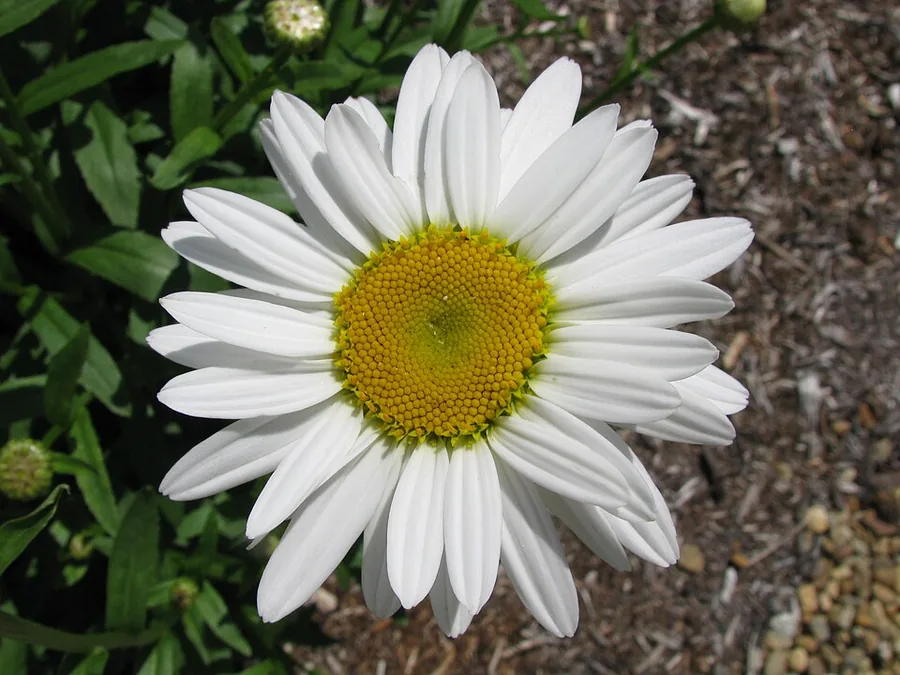
Up close, the Shasta daisy is the daisy every child draws: a ring of clean white ray petals around a raised golden eye, each bloom sitting face-up on a straight, upright stem. Below the flowers, the dark green foliage forms a low, tidy base. It came about as a garden hybrid in the aster family, refined from the wild oxeye daisy into a fuller, firmer flower, and the blooms keep coming from June into September.
The stems hold their flowers stiffly, which is why the plant reads as neat rather than sprawling in strong sun and free-draining ground. Starve it of light, though, and those same stems stretch thin and lean, the growth going weak and floppy with far fewer blooms to show. Wet winter soil is the real threat, rotting the crown from below.
Seen side by side, the cultivars differ most in scale and in the flower itself, from low mounds to tall stems and from a single flat ring of petals to shaggy double heads. It is a short-lived perennial, and an aging clump shows it, hollowing out at the center while fresh growth crowds the rim, which is the signal to divide it every couple of years.
Care
The short version: set it in full sun with sharp drainage, water only after the top half of the soil dries, snip the faded heads through summer, and divide the clump every 2 to 3 years to keep the crown dense and flowering.
Light
The white heads open fullest in full sun, six or more hours of direct light a day. A little afternoon shade is tolerated, but under deeper shade the stems draw up weak and leaning and the flower count drops sharply.
Water
Let the top half of the soil go dry to the touch before watering again, which usually falls around every 7 to 10 days. Once rooted the plant shrugs off drought, and the greater danger is soaked soil rather than dry, above all through winter when a wet crown rots.
Soil
Its roots take to average loam, clay, or sand without complaint, across a pH of 6.0 to 8.0. What they will not stand is standing water, which softens and rots the crown, so sharp drainage is the one hard rule.
Humidity
Plain outdoor air is enough, with no reading to track. Moving air is what counts, since foliage left crowded and damp holds the surface wetness that leaf spot and crown rot feed on.
Feeding
The plant asks little at the roots, so a light spring feed of balanced general-purpose fertilizer covers it. Push richer soil or heavier feeding and the stems grow soft and floppy, too weak to hold the heads upright.
Pruning
Snip off the spent heads as they brown and fresh buds keep rising through the season. Once the main flush fades, cutting the stems down to the low basal leaves clears the tired growth and stretches the life of this short-lived perennial.
Size & spacing
The plants stand 12 to 35 inches (30 to 90 cm) tall by cultivar, over a leafy clump 12 to 24 inches (30 to 60 cm) across. Set at that spacing, each keeps air around its foliage and stays clear of disease.
When to plant
The Shasta daisy moves through a temperate season. Seedlings begin indoors in late winter, the young plants go out once hard frost has passed, and the white heads open from June into September. Early spring, as the basal leaves push up fresh, is the time to lift and divide an established clump.
Northern hemisphere
Southern hemisphere
Typical months for a temperate climate: start earlier in warm zones, later where spring frosts linger.
- Sow: 6 to 8 weeks before the last spring frost
- Plant: Spring after danger of hard frost has passed
- Harvest: June to September
Hardiness
USDA hardiness zones: 5–9
Temperature: down to -29°C
Troubleshooting
Most of what troubles a Shasta daisy is written on the plant itself, in the color of the leaves and the state of the crown. A wilting stem, a spotted leaf, a hollow center: each points to a specific cause you can read and correct. Match the sign below and act before the damage spreads.
Wilting, yellowing, and stems that fold over
A daisy that goes limp and folds while its soil stays wet is rotting out of sight, at the roots and crown. In sodden ground, verticillium wilt or crown and root rot moves in, and a crown that has turned soft and brown is finished. Lift and bin the collapsed plants, correct the drainage, and split any firm crowns into ground that drains freely.
Fix:
- Remove and discard severely affected plants
- Improve drainage and avoid overwatering
- Divide and replant healthy crowns in a better-drained site
A hollow, dead crown ringed by fresh growth
A clump gone bare and woody at its center while green growth rings the outside has outgrown its space and needs breaking up. Dig it in early spring, cut out the dead, woody heart, and reset the living outer pieces so the flowering fills back in.
Fix:
- Divide the clump in early spring
- Replant vigorous outer divisions and discard the woody center
Dark lesions freckling the green leaves
Dark, spreading marks that widen in wet weather are fungal or bacterial leaf spot, and the lowest, oldest leaves show them first. Clearing it is simple work. Pull off the freckled leaves, keep water off the foliage, and thin the stand so air dries the leaves faster.
Fix:
- Remove and destroy affected foliage
- Avoid overhead watering
- Improve air circulation
Warped tips, a sticky sheen, or pale stippling
New tips curled and glazed with a sticky sheen give away aphids clustered on the softest growth. Leaves gone mottled and pale-stippled, or scored with faint pale trails, instead mean spider mites or leaf miners. Knock the aphids off under a hard stream of water, reach for insecticidal soap only when they swarm, and strip away the tunneled leaves.
Fix:
- Hose off aphids with a strong stream of water
- Apply insecticidal soap if infestation is heavy
- Remove and destroy mined leaves
Toxicity
For all its clean looks, the Shasta daisy is not fully harmless to animals. As a relative of the toxic chrysanthemum it carries pyrethrin-like sesquiterpenes in its tissues, so a pet that bites the leaves or flowers may drool, vomit, or come up in a rash. The reaction stays mild and the bitter sap turns most animals away fast, but curious pets and small children are best kept from chewing it.
Toxic to
Cats · Dogs · Horses · Rabbits · Livestock · Birds · People
Cats Mild
A cat that bites into the leaves may drool, gag, or bring its meal back up, and the sap can leave the mouth or skin reddened and sore. The sharp bitterness usually turns a cat away before it swallows enough to do harm.
Dogs Mild
A dog that eats a few of the flower heads can end up drooling, queasy, and passing loose stools. Handling the cut, sap-wet stems can also raise a mild, itchy rash on dogs with thin skin.
Horses Mild
A horse will rarely take the bitter leaves, but a mouthful snatched in grazing can bring drooling and a short bout of digestive upset. Sap smeared on the muzzle may leave the skin faintly sore.
Rabbits Caution
The same pyrethrin-like compounds in the tissue make this a poor plant for rabbits, so it belongs out of their reach. Their familiar greens are the safer thing to set in front of them.
Livestock Caution
Cattle, goats, and sheep almost always graze around the bitter plant, but one hungry enough to eat a large amount could suffer a mild digestive upset. Keeping it clear of overgrazed paddocks removes the risk.
Birds Caution
Birds find little to eat here, and the irritant compounds make it wise to keep cage birds away from the cut flowers. Wild birds taking seed from the spent heads come to no harm.
People Caution
No part of the Shasta daisy is meant to be eaten, and its sap can leave sensitive skin flushed and itchy after handling. Small children are best kept from chewing the petals, though a single stray one is harmless.
Most pets ignore the bitter foliage; a nibble may cause mild stomach upset or skin irritation rather than serious harm.
Helpline numbers

United States
ASPCA Animal Poison Control: (888) 426-4435 (fee applies)
Poison Control: (800) 222-1222



Canada
Poison Centres: 1-844-764-7669
Varieties
The cultivars pull the same white daisy in different directions, changing its height and reworking the flower head. These are the ones worth knowing by their looks.
Becky
A tall cultivar rising 3 to 4 feet on stems so rigid they hold themselves upright unstaked, each topped by a broad 3 to 4 inch white flower ringing a yellow center disk.
Crazy Daisy
A double-flowered form packed with frilled, slightly shaggy ray florets that pile the head fuller and looser than a plain single daisy.
Snowcap
A low, compact cultivar rising only 15 to 18 inches, its short stems suited to the front of a border or a container.
How to propagate
More plants come readily from a single clump or a packet of seed, one route holding a cultivar's exact look and the other filling a bed fast.
DivisionEasy
Early spring, every 2 to 3 years · One growing season to re-establish and resume strong flowering
Division renews an aging clump and is done in early spring every 2 to 3 years. Cut away the woody, hollowed center and reset the vigorous outer pieces into well-drained soil, where they take a full season to root in and return to strong flowering.
SeedEasy
Start indoors 6 to 8 weeks before the last spring frost, or sow outdoors in spring · Often blooms the first or second year from seed depending on sowing time
The species and many cultivars sprout readily from seed, started indoors 6 to 8 weeks before the last frost or scattered outdoors in spring, and often flowering in their first or second year. The named cultivars, being hybrids, do not come true from seed and are held to type by division.
Myths
Shasta daisies are completely safe and a pet can eat them freely.
The plant sits in the same family as the toxic chrysanthemum and holds the same pyrethrin-like sesquiterpenes, so a pet that chews the leaves or petals may drool, vomit, or break out in a rash. The bitter Shasta daisy is a mild irritant, not a safe mouthful, though it stays far gentler than a true mum.
Shasta daisies are long-lived perennials that never need attention.
In fact they are short-lived, and a clump thins and hollows fast without division every 2 to 3 years. Sharp drainage and a hard cut-back after bloom are what carry them on, so a little work keeps the flowers coming for several more years.