Ornamental · Cyperaceae
Sedge
Carex
Fine, arching blades and solid, three-sided stems give sedge a texture no true grass can copy.
Partial shade
Every 3–10 days
USDA 3–9
6–35 in · 15–90 cm
Overview
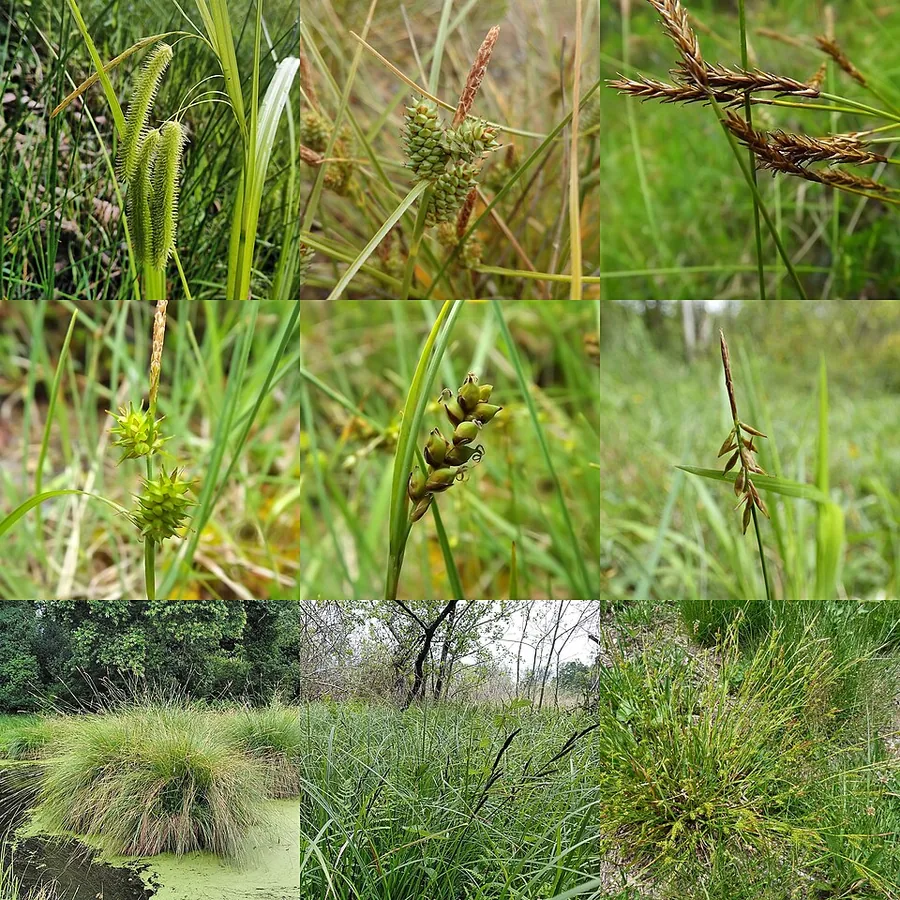
Up close, sedge reads as a fountain of narrow, grass-like blades springing from a tight crown. The genus Carex runs to roughly 2,100 species, from low tufts only a few inches high to arching clumps that lift to a couple of feet. The blades carry the color, ranging through fresh green, clear gold, crisp white-edged forms, and deep bronze and copper.
Look closer at the stem and the real character shows. A sedge stem is solid and sharply triangular, with three distinct edges you can feel between finger and thumb, nothing like the round, hollow, jointed stem of a grass. The blades themselves are slim and grass-like, with margins that can feel rough or even sharp when drawn the wrong way.
Season to season the clump holds a neat, arching form. Fresh blades push up from the center in spring, and by winter the oldest outer leaves have dried to brown and gone tattered at the tips while the crown stays green at its heart. Growth is slow, so the shape stays tidy and legible rather than sprawling.
Care
The short version: get to know the plant first, because sedges split by species, some craving wet soil and some dry shade. Read its blades and crown, give it the moisture it wants and a spot from full sun to deep shade, tidy it once a year, and the clump keeps its shape on its own.
Light
Sedge grows across the full range from full sun to full shade, though the blades hold their best color and fullness in partial shade. Under strong sun the foliage draws harder on water, so a sun-grown clump needs steadier moisture to stay full and green rather than stressed.
Water
The species sets the pace. Moisture-loving kinds such as Carex elata, oshimensis, and morrowii want soil kept moist to wet, their blades staying fullest with wet feet, especially in sun, while dry-shade types like Carex pensylvanica hold up in dry to medium soil. Water every 3 to 10 days to match the plant, and go light, since an over-watered sedge shows stress in its foliage fast.
Soil
Most ornamental sedges root best in rich, organic soil that stays moist, while the dry-shade sorts take leaner, drier ground. A pH of 5.5 to 7.0, slightly acidic to neutral, suits nearly every garden soil.
Temperature
Across the genus the blades endure 19°F to 84°F (-7°C to 29°C). That cold tolerance lets the green or evergreen foliage stand through the season long after softer plants have browned and collapsed.
Humidity
Ordinary outdoor air is all the blades ask for, so there is no level to track. Moisture at the roots shapes the foliage far more than the air around it.
Feeding
Sedge takes little feeding. A light spring feed of balanced or slow-release fertilizer is plenty, and often skippable in good soil. Overfeed it and the clump shows stress rather than fuller, greener blades.
Pruning
One yearly cleanup keeps the clump crisp. In late winter or early spring, comb out or shear off the old, brown, tattered foliage so the fresh blades stand clear. Never cut evergreen or semi-evergreen types to the ground, since the crown is slow to rebuild after a hard cut.
Repotting
Divide a potted or crowded clump every 2 to 3 years. The signs sit in the plant itself: a dead, hollow center in the crown, roots pressed against the container, and blades that thin and lose their color.
Size & spacing
A sedge clump stands 6 to 35 inches (15 to 90 cm) tall, its spread roughly matching, from a low cushion to a tall arching mound. Space each by that mature width so the blades meet in a carpet or stand apart as single mounds.
When to plant
Sedge is a hardy perennial, its blades enduring cold to USDA zone 3. Set it out in spring or early fall once the soil is workable, and watch the foliage do the work from spring into summer. Any flowers stay modest and easy to miss, since the leaves, not the bloom, are what the eye lands on.
Northern hemisphere
Southern hemisphere
Typical months for a temperate climate: start earlier in warm zones, later where spring frosts linger.
- Sow: Late winter to early spring (8-10 weeks before last frost); seed of many species germinates slowly and erratically
- Plant: Spring or early fall once soil is workable
- Harvest: Spring to early summer (foliage is the main ornamental feature)
Hardiness
USDA hardiness zones: 3–9
Temperature: down to -40°C
Troubleshooting
Sedge shows most of its troubles right on the blades and at the crown, and nearly all of them come from a species set in the wrong ground. Watch the color and texture of the foliage for the early signs below, and act before the change spreads through the clump.
New blades thin and pale soon after planting
Blades that thin and fade in the first season almost always mean a species and site mismatch, not chance. A moisture-lover in dry ground, or a dry-shade type left wet, loses vigor and the clump grows sparse. Identify the species, move it to ground that matches its moisture and light, and let it rebuild over a slow first season.
Fix:
- Identify the species and its preferred moisture/light range
- Move or replant to a matching site, or amend soil and adjust irrigation
- Provide consistent moisture for sun-grown, moisture-loving species
- Be patient through slow establishment
Orange specks on the blades or a dark, soft crown
Small orange pustules or dark, sunken spots freckling the blades are rust or leaf spot fungi, while a crown gone soft and blackened marks rot in soaked ground. Open the clump so air moves through, water at the base to keep the blades dry, and strip off the marked leaves. For a rotting crown, sharpen the drainage and cut the water back, unless the sedge is a wetland type built for saturated soil.
Fix:
- Improve air circulation and avoid overhead watering
- Remove and discard affected foliage
- Correct drainage and reduce watering if crown rot is present
- Hose off or treat aphids if present
Brown, dried-out old leaves at the clump's edge
Outer leaves that turn brown and brittle are normal aging, not disease. They dry from the tips over winter while the crown stays green and pushes fresh blades in spring, so the color returns from the center out. In late winter, comb the dead leaves free by hand or rake, shear the deciduous types, and lightly groom the evergreen ones.
Fix:
- In late winter or early spring, comb out dead foliage with gloved hands or a rake
- Shear deciduous types back; only tidy (do not scalp) evergreen types
- Remove debris to let new growth emerge
Toxicity
Sedge is not poisonous, which makes it safe around pets and children. Carex is absent from the ASPCA's list of toxic plants. The only physical cautions are the leaf margins, which can be sharp enough to nick skin, and the fine pollen, which may set off allergies in sensitive people.
Safe for
People · Cats · Dogs · Horses · Rabbits · Livestock · Birds
Cats Safe
Sedge holds no poison for cats. A cat that chews the coarse blades may bring them back up later, since the rough texture unsettles the stomach, but nothing in the plant is harmful.
Dogs Safe
Dogs are safe with it too. Swallowing the tough, fibrous blades may leave a dog with mild stomach upset, never poisoning.
Horses Safe
Horses take no harm from Carex, which grows wild through the pastures and wet meadows where they graze on grassy foliage like it.
Rabbits Safe
Rabbits can crop the blades freely, since sedge is simply harmless green forage to them.
Livestock Safe
Cattle, goats, and sheep browse the foliage safely. Native sedges grow across rangeland and wet meadows, and none has a record of poisoning stock.
Birds Safe
Birds face no danger from sedge. Many wild species strip the seed, and backyard poultry pick over the blades without harm.
People Safe
For people there is no poisoning risk. The blade margins can be sharp enough to slice a fingertip, and the powdery pollen may trigger allergies, but neither has to do with toxicity.
Leaf edges and stems can be slightly rough or sharp, and pollen may bother allergy-prone people. Pets that nibble foliage may vomit from the roughage even though the plant is not poisonous.
Varieties
Across thousands of species, a few stand out for the color and texture of their foliage. These are the ones to know by name, described by how their blades actually look up close.
Carex morrowii 'Ice Dance'
Dark green blades carry a clean white stripe along each margin, and running rhizomes carry the plant outward into a low, spreading sheet of foliage.
Carex morrowii 'Variegata'
A Japanese sedge whose green blades are outlined in white along their length, the whole clump staying tight and upright rather than running.
Carex oshimensis 'Evergold'
Arching blades bear a bright gold band down the center with a thin green edge on each side, the boldest coloring of the group up close.
Carex pensylvanica
A slim native sedge reaching only about 8 inches, its fine green blades forming a soft, low turf that holds up in dry to medium shade.
Carex elata 'Aurea'
Bowles' golden sedge glows in near-solid golden-yellow, its arching blades brightest standing in wet ground or right at a pond's edge.
Carex flagellifera / Carex buchananii
These New Zealand sedges wear leathery, reddish-brown blades in tones of bronze and copper, a coppery, weathered look unlike any green sedge.
How to propagate
Sedge multiplies readily, one method far surer than the other. Here is what each involves and the season to do it.
DivisionEasy
Spring or early fall · One growing season
Division is the surest way to increase a clump. Working in spring or early fall, lift an established plant and tease its crown into sections, each carrying a fan of blades, live roots, and a scrap of crown; reset them and they knit into full clumps within one growing season.
SeedModerate
Late winter to spring · One to two seasons; slow and erratic
Seed is possible but slow to reward you. Sown from late winter into spring, it sprouts unevenly over one to two seasons, and many named cultivars will not come true from seed, so a gold or bronze parent can throw plain green seedlings. Division or nursery plants build a full stand of blades far faster.
Myths
Sedge is just an ornamental grass to look at.
The two share a grassy silhouette, but sedges are their own family, the Cyperaceae, not true grasses. The proof is in the stem: a sedge stem is solid and three-sided, with edges sharp enough to feel when you roll it, while a grass stem is round, hollow, and jointed. That built-in difference is why so many sedges hold their blades in shade and moist or wet ground where a true grass would thin and fail.