Ornamental · Cyperaceae
Papyrus
Cyperus papyrus
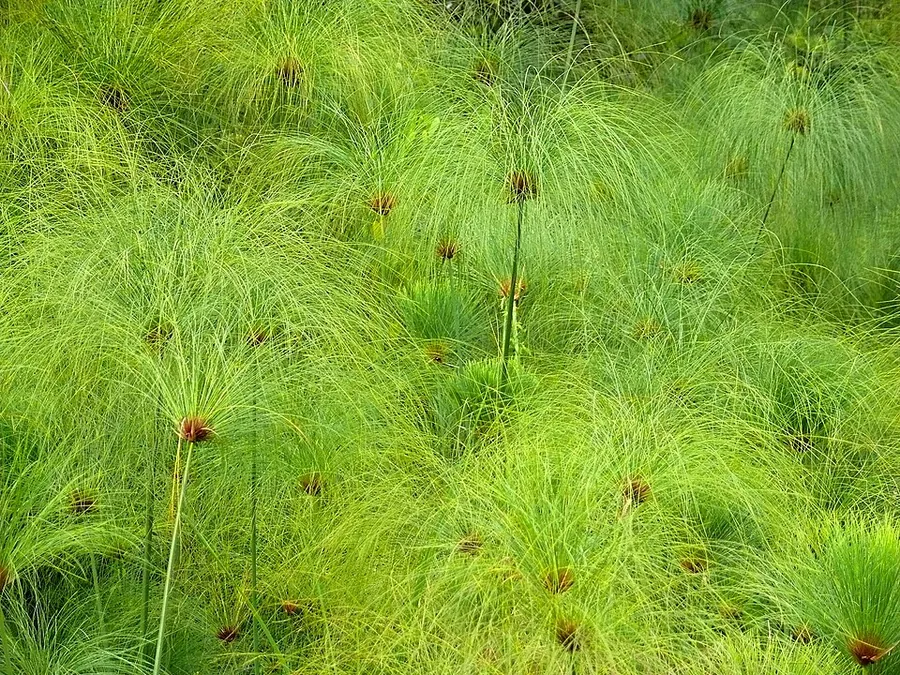
In full sun above wet ground, papyrus unfurls tall triangular stems that burst into fine green ray-heads all summer.
Full sun
Every 0–1 days
61–95°F · 16–35°C
USDA 9–11
Overview
Papyrus is the plant that gave the ancient world its paper, and up close it earns the name. Tall, leafless, three-sided stems rise smooth and green from a wet base and split at the top into a fine spray of thread-like rays, a radiating mop-head that looks like green fireworks caught mid-burst. It belongs to the sedge family, not the grasses, and it grows fast into a dense clump of these arching stalks at a pond edge or in a pot standing in water.
It is a marginal aquatic at root, native to the wet margins of the Nile, and it lives or dies by one thing: water. The roots must stay soaked or submerged, never dry. Given that and full sun, the fleshy green stems climb to 5 to 8 feet (150 to 240 cm) in a single warm season, rising faster than almost anything else grown at the waterline and thickening into a tall screen of ray-tipped stalks.
The plant is tender. Papyrus keeps its green through winter outdoors only in zones 9 to 11, so beyond that most gardeners grow it as a summer feature and either bring it in for the cold months or start fresh in spring. Come July to September, the thread-like rays carry small greenish-brown flower clusters, the same fine-spun silhouette that has stood in water gardens for thousands of years.
Care
The short version: full sun and constantly wet feet. Stand the pot in shallow water or set the clump at a pond margin, keep the soil from ever drying, feed through summer, and bring it in before frost where winters turn cold.
Light
Give papyrus full sun and the stems rise straight, thick, and deep green. In partial shade the stalks come up weaker and stretched, paler and softer, and they lean and flop far more easily.
Water
Water is the one detail the plant cannot forgive. Papyrus is a bog aquatic that must never dry out, so keep the soil soaked to boggy or stand it in shallow standing water up to about 6 inches deep. In a pot, set the container in a water-filled saucer or sink it in a pond, since a dried-out root zone browns the stems and is the main reason these plants fail.
Soil
Root it in rich, fertile clay or loam held wet to boggy. The plant is happiest with its base in saturated ground or standing water at a pond or water-garden margin, and it takes a wide pH range from 6.0 to 8.0.
Temperature
Papyrus holds its green and grows fast between 61°F and 95°F (16°C to 35°C). It has no tolerance for frost, which blackens the stems, so cold is the other main threat alongside drought.
Humidity
High humidity suits it, which fits a plant that grows with its base in water. There is no figure to meet outdoors, but indoors the fine rays welcome damp air, and the water-filled saucer beneath the pot supplies it.
Feeding
Feed through the warm growing season, about monthly in summer, with a balanced fertilizer or aquatic plant tabs. That steady feeding drives the fast flush of tall new stems.
Pruning
Cut dead, browned, or frost-damaged stems right to the base, where they meet the rhizome, and snip off the spent flower heads on the rays. Thinning a congested clump now and then opens the stand so the green stalks stay upright.
Repotting
The woody rhizome of this vigorous clump-former fills a pot fast, so step it up every 1 to 2 years in spring. Roots and rhizomes bulging the container, smaller new stems, or a clump crowding the rim all show it has outgrown its space.
Size & spacing
Expect a clump of tall stalks 5 to 8 feet (150 to 240 cm) high spreading 2 to 4 feet (60 to 120 cm) wide. Give it that much room at the waterline so the arching, ray-tipped stems fill out without crowding their neighbors.
When to plant
Papyrus runs on warmth and will not take a frost. Start seed or wake divisions from late winter to spring, set plants out into warm water and soil once the last frost has passed in late spring, and watch the small greenish-brown flower clusters open along the thread-like rays from July through September.
Northern hemisphere
Southern hemisphere
Typical months for a temperate climate: start earlier in warm zones, later where spring frosts linger.
- Sow: Late winter to spring, started warm in wet soil.
- Plant: After all danger of frost has passed and water and soil are warm, late spring.
- Harvest: July to September, greenish-brown flower clusters on the thread-like rays.
Hardiness
USDA hardiness zones: 9–11
Temperature: down to -7°C
Troubleshooting
Nearly every papyrus problem traces to water or cold, and the stems tell the story before anything else does. Watch the tall green stalks and their fine ray heads, since browning, leaning, and frost-blackening all show there first. Match what you see to the notes below and act while the clump can still recover.
Stems and their bract heads browned and drooping
When the green drains from the stems and the thread-like ray heads turn brittle and brown, the plant is showing drought stress, the most common way papyrus dies. As a bog aquatic, it browns from the tips down and folds over the moment the soil dries or the standing water sinks below the roots. Returning it to shallow standing water or soaked soil revives it, and the dead stems, cut to the base, give way to bright new green.
Fix:
- Move the plant back into shallow standing water or keep soil saturated at all times
- Stand container pots in a water-filled saucer or sink them in a pond
- Cut off fully browned stems at the base to let fresh growth emerge
Blackened stems and a dying clump after a freeze
Stems that darken to black and slump after a cold night carry frost damage. Papyrus is tender, holding up outdoors only to about zones 9 to 11, so a freeze turns the once-green stalks black and can finish the clump. Where the plant cannot stay out, container specimens come inside before the first frost, the pot set in a water-filled saucer by a bright window in a cool 60°F to 65°F (16°C to 18°C) room, with the rhizome kept clear of freezing.
Fix:
- Move container plants indoors before frost; set the pot in a water-filled saucer near a bright sunny window in a cool 60 to 65 degrees F room
- Treat as an annual and replant in spring where it cannot be overwintered
- Cut back cold-damaged stems and protect the rhizome from freezing
Tall stems flopping or leaning over
The tall, top-heavy stems bow and lean when wind pushes against the mop-headed tips, or when weak, stretched growth from too little light leaves the stalks soft and pale. A pot too small for the clump lets the whole stand tip. Full sun and shelter from strong wind firm the three-sided stems, a larger, heavier container steadies the base, and a stake holds the tallest stalks that still lean.
Fix:
- Site plants in full sun and out of strong wind
- Pot into a larger, heavier container to anchor the clump
- Stake or support the tallest stems if needed
Sticky residue, fine webs, or insects dotting indoor stems
Out in the garden the stems stay clean, but a plant carried inside for winter can gather spider mites, aphids, or mealybugs in the dry, still air. Fine webbing threads across the ray heads, or small cottony white clusters dot the stems and bracts. Rinsing or wiping lifts most of them off, insecticidal soap clears a stubborn film, and brighter light with moving air keeps the stems from drawing more.
Fix:
- Rinse or wipe off pests and improve air flow
- Treat with insecticidal soap if infestation persists
- Improve light and airflow to reduce stress
Toxicity
Papyrus is not toxic. The tall green stems and airy seed heads hold nothing that appears on the ASPCA's poisonous-plant lists, and none of it will harm cats, dogs, or other animals. At most, a pet that chews a mouthful of the fibrous stem may have a brief, mild stomach upset.
Safe for
People · Cats · Dogs · Horses · Rabbits · Livestock · Birds
Cats None
Non-toxic to cats. A cat that bites into the fibrous green stem may have a brief spell of mild stomach upset and nothing worse.
Dogs None
No toxin sits in the stems or seed heads to harm a dog. A curious chewer gets a little passing stomach upset at most.
Horses None
No poisoning risk to horses, since nothing in the tall green stalks or ray heads is harmful to them.
Rabbits None
Rabbits can nibble the foliage without harm, though the tough stems are not part of their usual diet.
Livestock None
Cattle, goats, and sheep grazing near a papyrus stand meet no toxic threat in its green growth.
Birds None
Harmless to birds, which may perch on the arching stems or pick at the airy, thread-like seed heads.
People None
Not poisonous to people. The stem's pith is famous as the source of ancient Egyptian paper rather than as anything to eat.
No special handling required; keep curious pets from chewing large amounts of foliage to avoid minor stomach upset.
Varieties
The wild species grows huge, so most gardeners grow one of the dwarf forms or a close umbrella-sedge relative, each with its own crown of rays or bracts. These are the ones you will meet by name.
'King Tut' / 'Prince Tut' (Cyperus papyrus dwarf selections)
These dwarf cultivars carry the same sharp triangular stems topped with a firework-burst of thread-like rays as the wild plant, held on stalks of about 4 to 5 feet rather than the towering 15.
'Baby Tut' / 'Little Tut' (Cyperus involucratus)
A compact umbrella-sedge selection of roughly 1.5 to 2 feet whose crown is not the fine mop-head of true papyrus but a whorl of broader, leaf-like arching bracts.
Umbrella palm / umbrella sedge (Cyperus alternifolius / Cyperus involucratus)
A smaller relative of 1.5 to 4 feet crowned by 20 to 25 broad, leaf-like bracts that whorl out flat like the ribs of an umbrella, unlike the fine thread-like rays of papyrus.
Dwarf papyrus (Cyperus prolifer)
A miniature so close in look to true papyrus that it is often mistaken for it, though it spreads fast by rhizome and has turned invasive in Florida.
How to propagate
Papyrus multiplies easily from its woody rhizome, and most gardeners simply split an existing clump rather than start from the fine seed.
DivisionEasy
Spring · A few weeks in warm, wet conditions
Division is the fast, reliable way to make more papyrus. In spring, the tough woody rhizome is lifted and pulled apart into pieces, each a knot of pale roots and stem bases, then set into wet, boggy soil or shallow water, where it puts out fresh green shoots within a few weeks of warmth.
SeedModerate
Spring · Several weeks to months
Papyrus also grows from its fine seed, sown in spring across warm, wet soil, where the first thread-thin shoots break the surface slowly. Establishment drags out over several weeks to months, which is why most gardeners reach for division instead.
Myths
Papyrus is a grass.
It has the tall, reedy look of a grass, but papyrus is a sedge in the family Cyperaceae, and the proof is in the stem: solid and sharply three-sided, not the round, hollow, jointed stem of a true grass. This is the ancient Egyptian paper plant, and its soft inner pith was sliced and pressed into the first papyrus sheets. Roll a stem between your fingers and feel the ridges: sedges have edges, and papyrus is a sedge.