Ornamental · Goodeniaceae
Fan Flower
Scaevola aemula
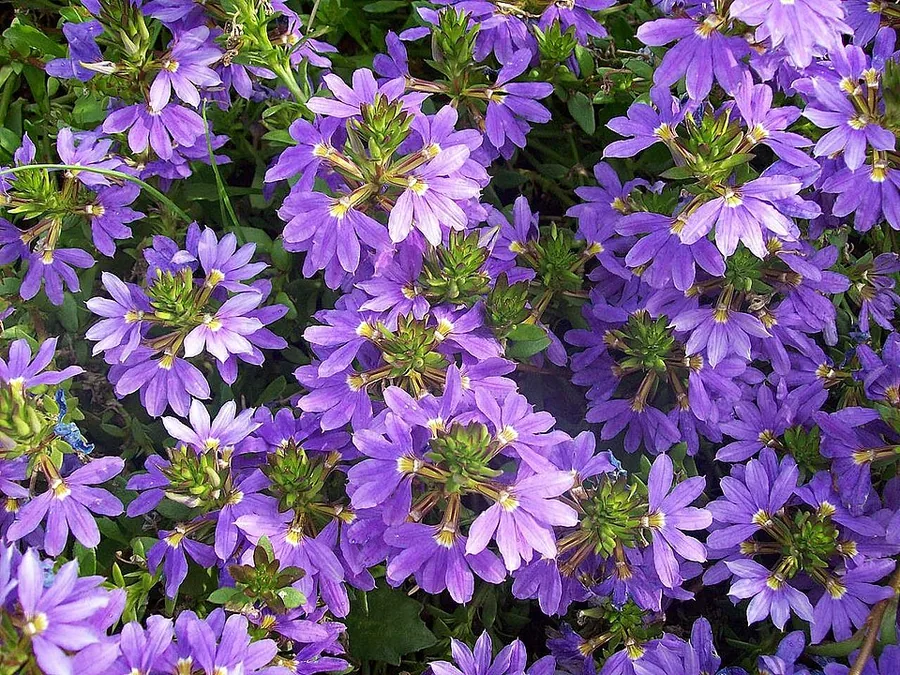
Each bloom flares into a one-sided fan of cool blue, strung down long trailing stems.
Full sun
Every 3–7 days
64–95°F · 18–35°C
USDA 10–11
Overview
Look closely and every flower flares to one side, its petals spread into a small one-sided fan. These little fans line up along long, trailing stems, and their color runs from cool blue through violet, with the occasional bloom in soft pink. The plant is native to Australia, and it carries these fan-shaped flowers steadily across the whole season.
In most gardens fan flower lives a single season as a warm-season annual. It is a tender perennial that stands the winter only in zones 10 and 11, so elsewhere it grows from spring through to the first frost. Across that stretch the stems lengthen and trail, building the low, spreading shape the plant is known for.
Up close, the plant keeps itself neat: as each fan fades, it drops on its own, so the stems stay clean without spent blooms clinging on. The care behind that fresh look is simple, just full sun, soil that drains, and a regular feed. The one thing its roots cannot take is soggy soil.
Care
The short version: set it in full sun with well-drained soil, water when the soil surface dries, and feed a balanced fertilizer every couple of weeks in the growing season.
Light
Fan flower opens the most fans in full sun. It takes a little afternoon shade, but in deep shade the stems grow long and bare between the leaves and carry only a scattering of flowers.
Water
Water it every 3 to 7 days in the growing season, letting the top of the soil dry between drinks. The plant holds up through a dry spell far better than through wet roots, so keep it on the drier side.
Soil
Root it in average, well-drained loam with a little organic matter. It takes a pH anywhere from 6.0 to 8.0, but what its roots need most is soil that lets water pass through.
Temperature
It runs warm, comfortable from 64°F to 95°F (18°C to 35°C), and holds its flowers through summer heat. Frost is the end of it, which is why cool regions grow it for one season only.
Humidity
No set humidity matters to it, since ordinary outdoor air is enough. The fans hold up even through a humid, muggy summer.
Feeding
Feed it a balanced liquid fertilizer every couple of weeks while it grows to keep new fans forming. High-phosphorus blends do not suit it.
Pruning
It needs almost no cutting. When the stems stretch long, a pinch of the leggy tips brings the plant back to a fuller shape, and since the fans drop on their own, deadheading is never part of it.
Size & spacing
The plant stands 9 to 18 inches (23 to 46 cm) tall and spreads 12 to 24 inches (30 to 61 cm) across, wider than it is high. That low, trailing spread is what sends the flowered stems spilling over a basket rim or wall.
When to plant
Fan flower is all warmth and no frost tolerance, so most gardens grow it as a summer annual. Seed goes in indoors 6 to 8 weeks before the last frost, and the young plants move outside once the soil warms to 65°F (18°C). From there the fans open in summer and keep coming until the first frost ends them.
Northern hemisphere
Southern hemisphere
Typical months for a temperate climate: start earlier in warm zones, later where spring frosts linger.
- Sow: 6 to 8 weeks before the last frost date
- Plant: In spring after the last frost when soil temperatures reach 65°F (18°C)
- Harvest: Summer through first frost
Hardiness
USDA hardiness zones: 10–11
Temperature: down to -1°C
Troubleshooting
Fan flower is easy to grow, and its handful of problems nearly all come from too much water or too little sun. The clues show on the roots, stems, and flowers, so a close look usually catches trouble early. Match what you see below and act on it.
Wilting, yellowing leaves over soft, brown roots
When the leaves go limp and yellow and the roots turn soft and brown to the touch, the trouble is root rot. It sets in where the soil stays wet, since roots left underwater lose their air and break down. Cut the watering back, improve the drainage or move the plant into a fast-draining mix, and clear away any plant that has already gone limp beyond saving.
Fix:
- Reduce watering frequency
- Improve drainage or replant into well-drained media
- Remove severely affected plants
Cottony white tufts and a sticky glaze on the stems
Small mealybugs gather where the leaves meet the stems, showing as cottony white tufts with a sticky glaze left behind. Wash them off with a strong jet of water, then dab the survivors with insecticidal soap or horticultural oil. A look over new plants before they join the rest, plus space for air to move, keeps them from settling in.
Fix:
- Wash off with a strong spray of water
- Spot-treat with insecticidal soap or horticultural oil
Sparse fans on long, bare stems
Few flowers on long, bare stems point to too little light or too little feeding. Starved of sun or food, the plant stretches, leaving wide gaps between leaves and only a scattering of fans. Move it into full sun, feed it through the season, and pinch the stretched stems to draw out fresh, branching growth.
Fix:
- Move to a full-sun location
- Fertilize regularly during the growing season
- Pinch back leggy stems to encourage branching
Toxicity
Fan flower is not toxic. Nothing in its fan-shaped flowers or its foliage will poison a cat, dog, rabbit, bird, grazing animal, or child, so it is safe to grow wherever pets and children roam.
Safe for
People · Cats · Dogs · Horses · Rabbits · Livestock · Birds
Cats None
Cats are safe with fan flower. A bite of a fan or stem will not poison them, though any plant eaten in quantity can leave a cat with an upset stomach.
Dogs None
Dogs are safe around it as well. A chewed stem does no more than bring on mild, passing stomach upset.
Horses Safe
Horses can graze beside it unharmed, since fan flower holds nothing poisonous to them.
Rabbits Safe
Rabbits are safe in the foliage, and a stray bite of leaf or stem does no harm.
Livestock Safe
Cattle, goats, and sheep can share a pasture with it safely, since it carries no compounds known to harm grazing stock.
Birds Safe
Birds face no danger from it, with nothing toxic in either the fans or the leaves.
People Safe
Fan flower is not poisonous to people. It is grown for its flowers, not for eating, so it stays off the plate.
Varieties
Fan flower comes in a few named selections, set apart mostly by the exact color of the fans and how far the stems trail. These are the ones you will see most.
Blue Wonder
Blue Wonder carries an unbroken run of cool blue to violet fans down long trailing stems, a shape made for spilling from a basket.
New Wonder
New Wonder trails strongly and covers itself in a heavy show of blue-lavender fans.
Pink Charm
Pink Charm is a dwarf, standing only about 4 inches tall and 5 inches wide, with fans in soft pink.
How to propagate
Fan flower is easy to multiply, either from a cutting of an existing plant or from seed.
Stem cuttingsEasy
During the growing season · A few weeks to root
The simplest way is a stem cutting taken while the plant is growing, which puts out roots in a few weeks and grows into a copy of the parent. Seed is the other route, sown indoors 6 to 8 weeks before the last frost.
Myths
Fan flower must be deadheaded to keep flowering.
Each spent fan falls away by itself, so there is no picking off of faded flowers to do. Fan flower is self-cleaning, and the only trimming it ever needs is an occasional pinch of a stem grown too long.
Fan flower wants rich soil kept wet all the time.
It is the reverse. The plant shows its best in well-drained soil and takes heat and a dry spell once it is established. Left sitting wet, the roots rot, and that is the fastest way to lose it.