Tree · Fagaceae
Northern Red Oak
Quercus rubra
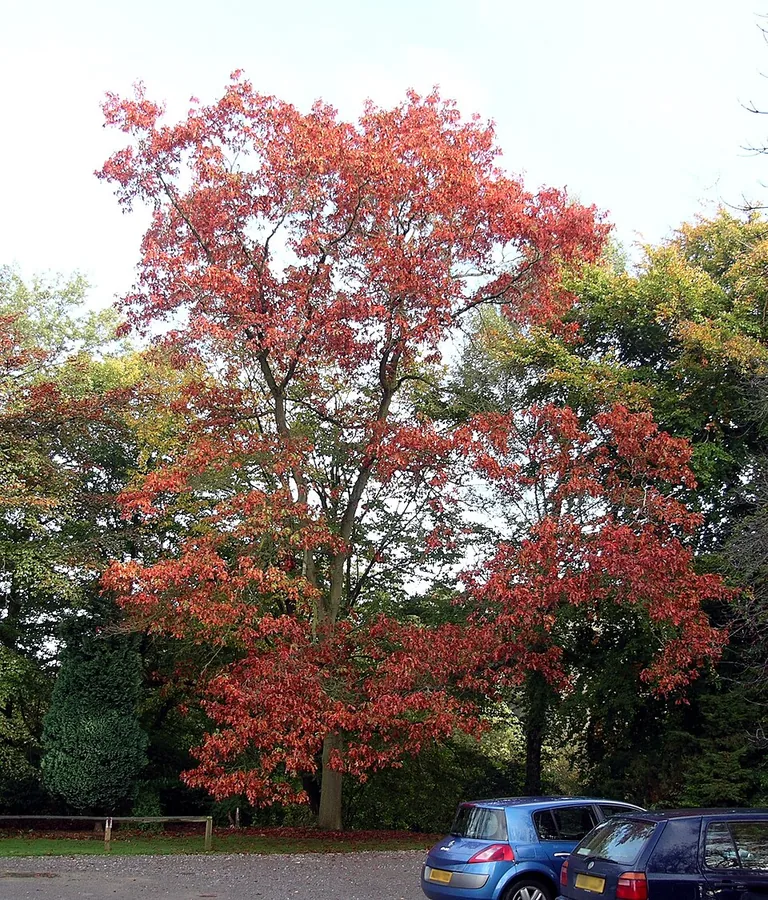
Broad, bristle-tipped foliage that shifts to russet and brilliant red, carried on long, pale-ridged bark.
Full sun
Every 7–14 days
USDA 3–8
50–75 ft · 15.2–22.9 m
Overview
Northern red oak carries broad leaves cut into pointed lobes, and each lobe ends in a fine bristle tip that places the tree in the red oak group. Up the trunk, the bark rises in long, pale ridges. Part of the beech family and native across eastern North America, it forms a wide, rounded crown and reaches 50 to 75 feet (15 to 23 m).
In spring the tree hangs slack strings of yellow-green catkins, small and easy to miss among the opening leaves. Through summer the lobed leaves stay green, then, as the nights cool, they shift into a deep russet and brilliant red across the whole crown. Acorns follow, green at first and ripening brown over two growing seasons before they drop in fall.
Red oak puts on height faster than most oaks, filling out its rounded crown while still young. The green, unripe acorns and the soft new spring leaves are where the bitter tannins gather most thickly, sharp and astringent to the taste. Because those parts carry the heaviest tannin load, the tree is kept clear of grazing animals.
Care
The short version: full sun and deep, acidic, well-drained soil bring out the densest, most even crown, with steady water through the first few years while the taproot drives down, after which the tree carries itself.
Light
In full sun the leaves crowd close and the crown fills into a broad, even dome. Young trees hold up in partial shade, though the canopy grows thinner and looser there than in the open.
Water
Young trees drink steadily through the first few years while the roots push down, and the top half of the soil should go dry to the touch between waterings. Once the deep roots are set the tree runs drought tolerant, drawing on rain alone through all but the driest spells.
Soil
The roots want deep, fertile, well-drained soil on the acidic side, a pH of 4.5 to 7.0, ideally a moist loam or sandy loam. Where the ground turns alkaline, the leaves pale into iron chlorosis, yellow between still-green veins.
Temperature
The wood and buds ride out winter cold to -40°F (-40°C) and take summer heat to about 100°F (38°C) without scorching. That hardiness carries the tree across much of the temperate zone.
Humidity
Open outdoor air suits the foliage, so no humidity target applies. Air moving through the canopy keeps the leaves dry and slows the fungi that blotch and spot them.
Feeding
A settled oak feeds itself from deep soil and rarely shows hunger. Only on truly poor ground does a balanced slow-release tree fertilizer in early spring earn its place.
Pruning
Cut only in bare winter, and never from April through June, when fresh, pale wounds draw the beetles that carry oak wilt. Take out the dead, damaged, or crossing branches and leave the rest of the limbs to their own shape.
Repotting
This is a tree that ends up forest-tall, so pots are only a beginning. Move it while young, before the deep taproot thickens and dives, and give it a permanent place with room for the roots.
Size & spacing
At full size the crown lifts to 50 to 75 feet (15 to 23 m) and reaches 40 to 65 feet (12 to 20 m) from branch tip to branch tip, a wide canopy that needs open ground clear of walls and wires.
When to plant
The tree's calendar is written on the plant itself. Yellow-green catkins open in spring, green acorns swell and brown over the seasons before dropping in fall, and only in leafless winter is pruning safe from oak wilt. Sow acorns in autumn or set out young saplings in early spring.
Northern hemisphere
Southern hemisphere
Typical months for a temperate climate: start earlier in warm zones, later where spring frosts linger.
- Sow: Stratify acorns over winter (60-90 days cold-moist) and sow in deep containers in late winter to early spring
- Plant: Plant acorns in fall or transplant young saplings in early spring
- Harvest: Inconspicuous yellow-green catkins in spring; acorns mature over two growing seasons and drop in fall
Hardiness
USDA hardiness zones: 3–8
Temperature: down to -40°C
Troubleshooting
Most of red oak's troubles are written across its leaves, in changes of color and texture easy to read up close. Oak wilt is the grave one; the rest are surface blemishes or pass on their own. Match the look of the leaf below to what stands in front of you.
Leaves bronzing inward while the top of the crown browns off
This is oak wilt, a fungus that plugs the vessels carrying water up the trunk, and red oaks stand nearly defenseless. The green dulls, then a bronze or tan tide creeps in from the leaf margins, and the leaves wilt and drop as the highest branches go bare, sometimes in a single summer. A lab confirms it, the tree comes down at once, and the roots grafting it to nearby oaks are cut so the fungus cannot travel below ground.
Fix:
- Remove and properly dispose of infected trees promptly
- Sever root grafts between adjacent oaks to limit underground spread
- Avoid wounding or pruning healthy oaks April-June
Brown, ragged blotches spreading along the leaf veins
Oak anthracnose stains the leaves after a long cold, wet spring. Brown, dead patches spread along the veins and out to the margins, the youngest leaves crumple and twist, and a few thin twigs die back, though the tree itself holds firm. Rake off and destroy the fallen, spotted leaves, cut away the dead twigs, and thin the canopy so air can move and dry the foliage.
Fix:
- Rake and destroy fallen infected leaves
- Prune out dead twigs
- Apply labeled fungicide early in the season before bud break only in severe cases
Leaves chewed to lace and stripped by crawling caterpillars
The spongy moth caterpillar, once the gypsy moth, eats the leaves down to a skeleton of veins and can leave the crown bare by late spring. A strong oak answers by unfurling a whole fresh set of leaves, so the bare look rarely lasts. Scrape the crusted egg masses off the bark in winter, ring the trunk with a sticky band or pick the caterpillars off in small numbers, and water the tree while it refills its crown.
Fix:
- Hand-pick or use sticky bands on trunks for small infestations
- Apply Bacillus thuringiensis (Bt) to young larvae
- Support tree vigor with water during defoliation years
The newest leaves paling yellow between green veins
This yellowing is iron chlorosis, and it sets in where alkaline soil keeps the roots from lifting iron. The blade of the leaf fades to pale yellow while the veins stay a clear green, sharpest on the tender new growth. Work the pH down slowly with elemental sulfur and feed a fading tree chelated iron, but a tree set on acidic ground from the first never pales this way.
Fix:
- Lower soil pH with elemental sulfur over time
- Apply chelated iron as a soil drench or foliar spray
- Improve soil drainage and aeration
Toxicity
The bitterness in this tree is chemical. Its leaves, buds, and green acorns are laced with tannins, astringent enough to pucker the mouth, and in horses and livestock they injure the kidneys badly enough to kill. Raw acorns stay harsh until leached, so grazing animals, pets, and small children are kept away from the fallen leaves and acorns.
Toxic to
Cats · Dogs · Horses · Rabbits · Livestock · Birds · People
Cats Mild
A cat that mouths a leaf or acorn tends to come away with a sour stomach, bringing up its food, passing loose stools, and turning from its bowl. The amount a cat swallows is rarely enough to do lasting harm, though loose acorns are worth sweeping from any spot a cat haunts.
Dogs Mild
Dogs crack acorns between their teeth more than any other pet, and the result is vomiting, runny stools, and a listless appetite. Swallowed whole, a mass of acorns can wedge in the gut and block it, so they are best raked from a yard a dog noses through.
Horses Severe
Oak hits horses the hardest. Chewing the young leaves, the buds, or the green acorns brings on gripping belly pain, constipation that breaks into bloody diarrhea, a dull and heavy look, frequent urination, dark urine, jaundice yellowing the eyes, and kidney damage that can kill.
Rabbits Toxic
A rabbit's small gut cannot break down the tannins packed into oak leaves and acorns, so none of the tree belongs near a hutch. Even a mouthful can leave a rabbit hunched, off its food, and plainly unwell.
Livestock Severe
Cattle, sheep, and goats that crop the young leaves, buds, or green acorns can raise raw ulcers along the gut and shut their kidneys down as the tannins gather. Enough of it kills, and stock will nose out fallen acorns after a storm shakes them loose, so a fence stands between them and the tree.
Birds Caution
Wild jays and woodpeckers crack and cache acorns as daily food, but the raw tannins gripe the guts of backyard poultry and cage birds. Pet birds are kept clear of the leaves and the green acorns.
People Caution
Raw acorns taste bitter and dry the mouth with tannin, unfit to eat straight from the shell. A long soak and leaching in running water draws the bitterness out, and small children are kept from slipping acorns or leaves into their mouths.
Keep livestock and horses away from oak leaves, buds, and fallen green acorns; pick up acorns where pets forage. Most poisoning occurs when animals eat large amounts.
Helpline numbers

United States
ASPCA Animal Poison Control: (888) 426-4435 (fee applies)
Poison Control: (800) 222-1222



Canada
Poison Centres: 1-844-764-7669
Varieties
Almost every red oak is the plain species, but two selections stand out for the color of their leaves.
Aurea
Aurea unfolds its spring leaves in a bright golden yellow that deepens to green as they harden, a color rarely seen since the tree is hard to buy.
Splendens
Splendens was chosen for the clean, brilliant red that floods its leaves in fall.
How to propagate
Each acorn holds a single seed that will sprout only after a cold, damp winter has worked on it.
SeedModerate
Collect ripe acorns in fall; sow outdoors immediately or stratify over winter and sow in spring · Germinates the spring after cold stratification; several years to establish a sapling
Each ripe acorn carries one seed that will not stir until the cold has soaked into it. Gather the brown acorns in fall and either press them into outdoor soil at once or hold them through 60 to 90 days of cold, moist stratification near 32°F to 40°F (0°C to 4°C) before sowing in spring. A pale root pushes out the following spring, and several years pass before the seedling stands as a sapling, so set it where it will stay, since the thick deep taproot resists being moved once past youth.
Myths
Every fallen leaf and browned acorn stays as poisonous as the last, all year round.
The tannins run strongest in the tender young leaves and buds of spring and in the hard green acorns before they ripen. The brown, curled leaves of fall hold far less, and a dangerous dose means a full belly, not one bitter bite. The real hazard rides on timing and amount, not on the plain sight of an oak.
Red oak grows too slowly to be worth planting for shade.
In truth it is one of the swifter oaks, thickening its trunk and lifting its crown at a moderate to fast pace. A long-lived native, it more than earns its keep as a shade and street tree, and the crown fills in sooner than the old warning claims.