Houseplant · Arecaceae
Pygmy Date Palm
Phoenix roebelenii
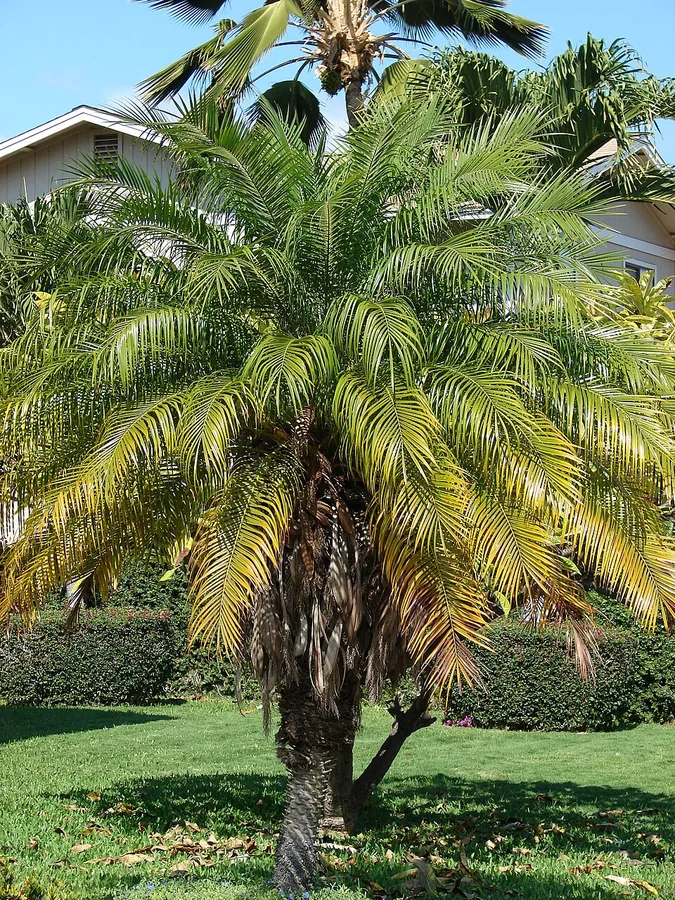
Fine, feathery fronds arch from a slender trunk, giving this small palm its soft, plume-like shape.
Bright indirect
61–81°F · 16–27°C
USDA 10–11
5–7 ft · 1.5–2 m
Overview
Up close, the pygmy date palm is all fine texture and gentle curves. From a single slim trunk, the fronds arch outward and split into many narrow leaflets, so the whole crown reads as soft and feathery rather than broad and flat. Grown indoors it stands only about 5 to 6.5 feet (150 to 200 cm), a compact frame that keeps every plume-like frond within easy view.
The plant fills out slowly, adding its arching fronds a few at a time and holding a steady, uncrowded silhouette for years. On a female plant, small flowers give way to clusters of little purple drupes, each a small, rounded fruit. Split one open and the single seed inside is what a grower sows to raise another palm.
The most striking detail sits low on each frond. There, near the base, the lowest leaflets are not soft blades at all but stiff, needle-sharp spines, hard and rigid to the touch and easily long enough to pierce skin. The rest of the plant is harmless to taste, so it is these spines, and their surprising firmness, that define how the palm feels in the hand.
Care
The short version: those fine, feathery fronds hold up best in bright, indirect light, with soil kept slightly moist but never soggy, average warmth and humidity, and a light seasonal feed. The stiff spines at the frond bases mean gloves whenever you reach in.
Light
The fronds keep their full, feathery body in bright, indirect light, the kind an east-facing window casts. The palm tolerates partial sun and medium indirect light, but in a dim spot the new leaflets stretch out thin and lose their color, and the crown looks sparse.
Water
The mix should stay slightly moist through the growing season, never sodden, since a pot left standing in water rots the roots. Fluoride and salts in tap water leave their mark as browned leaflet tips, so low-mineral water keeps the blades clean-edged.
Soil
The roots take hold in a porous, well-drained mix loaded with organic matter. Coarse or fine, the texture matters little, since clay, loam, and sand all suit it, and it holds across a pH of 6.0 to 8.0.
Temperature
The palm holds its form in ordinary warmth of 61°F and 81°F (16°C to 27°C). Cold drafts and the chill off a winter windowpane can mar the fronds, so keep it away from both.
Humidity
Average household humidity suits the fronds, with no set level to reach. When the air runs very dry the leaflet tips brown and crisp, and a little added moisture softens that edge.
Feeding
Feeding belongs to spring and summer, while new fronds are forming. A slow-release palm fertilizer carrying micronutrients, such as 12-4-12 or 8-2-12, given two or three times over the season, is enough. Too much salt in the soil scorches the leaflet tips brown.
Pruning
Only the fronds that have died or browned all the way through should be cut, and the single growing crown at the center is left untouched, since cutting it kills the stem. Gloves come first, because the lowest leaflets have hardened into very sharp spines.
Repotting
The palm sits content while slightly root-bound, its roots packed tight, and rarely asks for a larger pot. Repot only once roots coil around the inside or push out the drainage holes, water sluices straight through, or the stems crowd and growth slows.
Size & spacing
59–79 in (150–200 cm) tall
Troubleshooting
Trouble on this palm writes itself across the fronds, in browning tips, yellowing blades, or a dusting of specks. Those visible changes are the earliest read on what is wrong, and they show before a frond is lost. Match the look below to its cause, then act.
Yellowing fronds above a wet, sour-smelling base
Fronds fading to yellow above a damp, sour base signal root rot, set off by a mix so wet the roots cannot breathe. Lift a little soil and the roots show brown and soft, giving off an off smell. Let the soil dry somewhat between waterings, move the palm into a porous mix that drains freely, and keep the pot out of any pooled water.
Fix:
- Allow the soil to dry slightly between waterings
- Repot into a porous, well-drained palm mix with drainage holes
- Never let the pot stand in water
Sticky sheen, fine specks, or round spots on the blades
A sticky film, a fine dusty speckling, or small round marks reveal scale insects and thrips, at times joined by a fungal leaf spot. Look along the leaflets for hard little brown bumps, a powdery stippling, or circular discolored lesions. Wipe the scale off with horticultural oil or insecticidal soap, move air across the fronds, and cut away any leaf too far gone.
Fix:
- Wipe off or treat scale with horticultural oil or insecticidal soap
- Improve air circulation and avoid wetting foliage to limit leaf spot
- Remove and discard severely affected fronds
Dry brown tips crisping the leaflet ends
The browning is leaf-tip burn, and on a palm it usually follows fluoride and salts in tap water or too rich a feed. It marks the oldest leaflets first, their tips going dry and brittle, and soil that is parched or salt-crusted deepens the color. Switch to low-fluoride water, flush the pot at intervals to wash out the salts, and feed with a lighter hand.
Fix:
- Water with low-fluoride water and leach the pot periodically to flush salts
- Maintain slightly moist soil during the growing season
- Reduce fertilizer rate and follow a slow-release palm fertilizer schedule
Toxicity
There is nothing poisonous hidden in this palm's tissue. The ASPCA lists the pygmy date palm as non-toxic to cats, dogs, and horses, so a bitten leaflet does no chemical harm. The danger is the one you can see and feel: the sharp, rigid spines at the base of each frond can drive into skin, so keep the plant clear of traffic and wear gloves to handle it.
Safe for
People · Cats · Dogs · Horses · Rabbits · Livestock · Birds
Cats None
No part of this palm will poison a cat. The single hazard is physical: a cat brushing the low frond bases can catch itself on the stiff, sharp spines, so stand the pot where nothing knocks against it.
Dogs None
A dog takes no toxic harm from any part of the plant. A nose pressed to the lower leaflets can still meet the hard basal spines, and that sharp jab is the only thing to prevent.
Horses None
For a horse there are no toxic compounds in the plant at all. As a small indoor palm, it seldom stands anywhere a horse can reach.
Rabbits None
Nothing in the palm poisons a rabbit. Keep a loose rabbit away from the spiny frond bases, since those low spines pierce just as sharply at floor level.
Livestock None
Grazing animals face no poison from this plant. The spines are the whole of the danger, and only where a stem sits within reach.
Birds None
A pet bird meets no toxic effect from the fronds. The sharp basal spines still call for care around a bird that perches on or clambers through it.
People None
The plant poisons no one, and a female specimen even ripens small edible drupes. The spines are the catch, stiff and sharp enough to draw blood and now and then to seed an infection, so wear gloves to handle it and hold children back.
Although non-toxic, the lower leaflets near the frond base are modified into very sharp, stiff spines that can cause painful puncture wounds and occasional infections; wear gloves and supervise children and pets around the plant.
Varieties
This palm is sold as the species itself, and it comes in one of two physical forms. The shape of the trunk is what tells them apart.
Phoenix roebelenii (single-trunk form)
This is the form built on one slim, solitary trunk, grown as a single specimen instead of the multi-stemmed clump of several trunks common at garden centers.
How to propagate
New plants begin as a single seed, drawn from the palm's own purple drupes. That seed grows slowly, so raising one is a long, patient watch.
SeedModerate
Sow fresh, cleaned seed when warm; germination is slow and uneven · Several months to germinate and one or more years to develop into an established plant
A new palm begins inside the small purple drupes a female plant carries in warm weather. Clean the seed from the fruit and sow it fresh, then watch and wait, since it germinates slowly and unevenly, taking several months to push up a first shoot and a year or more to fill out into an established plant. No cutting will root from this palm, so the seed is the only beginning it offers.
Offsets & pupsModerate
Growing season, when basal suckers are large enough to separate · Several months to root and establish after division
A palm that pushes up basal suckers at its foot can sometimes be split in the growing season, once each offshoot has swelled large enough to part cleanly from the parent. Every division then spends several months growing roots before it stands on its own. Seed, even so, remains the usual start for new plants.
Myths
The pygmy date palm is a poisonous plant for cats and dogs.
In fact the ASPCA lists Phoenix roebelenii as non-toxic to cats, dogs, and horses, so a chewed leaflet carries no poison. The harm here is in the spines, not the sap: those hard, sharp basal spines can drive a puncture wound that sometimes turns infected, which is the real thing to watch.