Houseplant · Arecaceae
Majesty Palm
Ravenea rivularis
Give it steady moisture, bright light, and humid air, and this riverbank palm unfurls arching, feathery green fronds.
Bright indirect
Every 4–7 days
64–84°F · 18–29°C
USDA 10–11
Overview
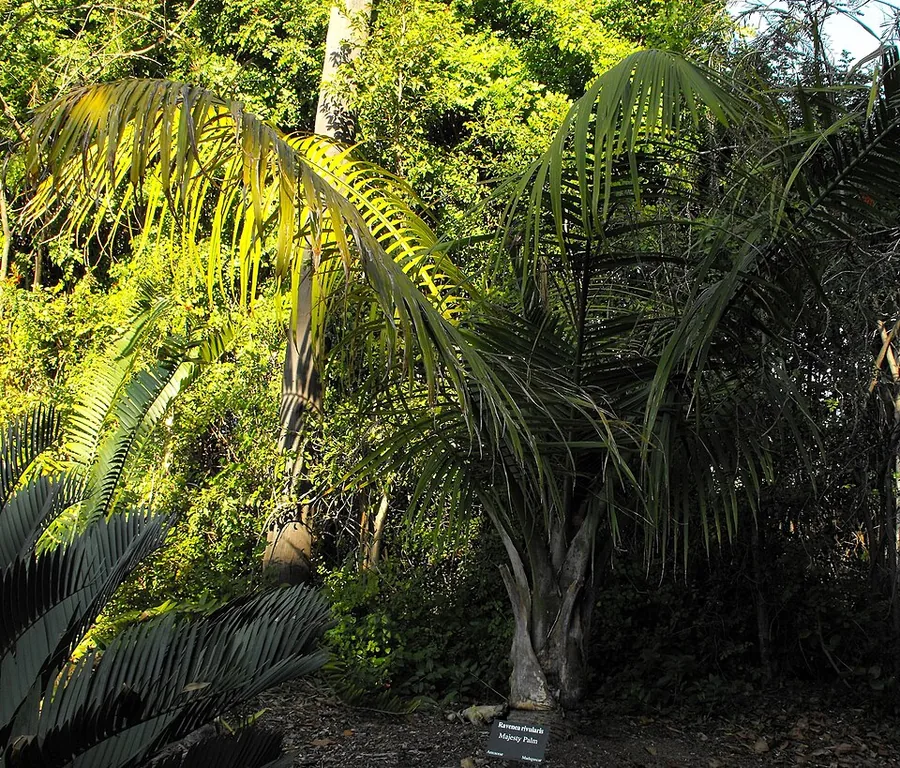
The majesty palm carries its greenery on long, arching fronds that rise from a single upright trunk and curve outward at their tips. Each frond splits into rows of narrow, tapering leaflets that run down a central rib, giving the whole leaf a soft, feathery outline. That fine-cut, plume-like foliage traces back to the riverbanks of southwest Madagascar, where the palm grows in damp, seasonally wet ground, and in the wild it can climb to great heights on that single stem.
Up close the leaflets are slim and firm, coarse and fibrous to the touch rather than soft, and they hold a steady green when the plant is watered well. This is a thirsty riverbank palm that wants its soil kept evenly moist and the air humid, and the leaves register any shortfall at once. Given bright indirect light and water before the soil dries, the fronds stay full and their green stays even. Let the soil dry in parched indoor air, and the fine leaflet tips crisp to brown.
Kept as a floor plant, it holds a manageable size while the fronds keep their arching sweep. The ASPCA lists it as non-toxic to cats, dogs, and horses, which sets it apart from the dangerous sago palm it is often mistaken for. Steady moisture and humid air keep those feathery fronds at their fullest.
Care
The short version: bright indirect light, soil kept evenly moist but never soggy, and humid air keep its fronds full and green. Feed it lightly through the growing season, keep it warm, and cut only the fronds that have browned all the way through.
Light
The majesty palm holds its green best in bright, indirect light, the glow near a window where harsh midday sun never lands on the leaflets. It takes partial shade and a little gentle sun, but direct rays scorch brown patches into the fronds, and deep shade thins the leaflets and pales their color.
Water
This thirsty riverbank palm wants its soil kept consistently moist, more than most palms, so the fronds stay full and firm. Water roughly every 4 to 7 days, before the soil dries out, but never leave the roots waterlogged. Soggy soil in a pot without drainage rots the roots and yellows the leaves.
Soil
The palm roots into a rich, organic loam or clay-based mix that holds moisture against those thirsty roots yet still drains. It takes plenty of dark, organic matter and a wide pH span from 6.0 to 8.0, so ordinary potting soil with good drainage suits its fibrous root ball.
Temperature
The fronds stay supple in the warm range of 64°F to 84°F (18°C to 29°C). Cold drafts and chilly windowsills stiffen and mark the leaves, so keep the trunk and fronds clear of doors and AC vents in winter.
Humidity
Humidity shows straight away in the leaflets. The palm wants high humidity, and dry indoor air is what turns those fine green tips brown and papery. Cluster it among other plants, set the pot on a pebble tray, or run a humidifier close to the fronds.
Feeding
The palm greens up on light feeding through the spring and summer growing season, about once a month. A balanced or palm-specific fertilizer with micronutrients keeps the fronds a deep, even green, and feeding stops through the dim, slow months of winter.
Pruning
Only the fronds that have browned all the way through, dead or damaged, come off, cut close to the base of the leaf. Each stem pushes new fronds from a single crown at its tip, so that growing point must never be cut or wounded, or the trunk stops sending up leaves.
Repotting
The palm needs a larger pot every 2 to 3 years, or sooner when pale roots circle the base and water races straight through. Spring is the time to lift it. Roots poking from the drainage holes and soil that dries almost as soon as it is watered are the tells.
Size & spacing
Indoors the trunk lifts the crown to about 5 to 10 feet (1.5 to 3 m) tall while the arching fronds fan 3 to 6 feet (90 to 180 cm) across. Give it open floor so those long leaves can curve out into the room instead of scraping a wall.
Troubleshooting
Most majesty palm trouble writes itself across the fronds, where the fine green leaflets are quick to show stress. It usually traces back to dry soil, dry air, or the pests those conditions invite, all of which mark the leaves before anything else. Match the look below to what you see, then act while it still helps.
Fine webbing and speckled fronds
Look closely and the green loses its evenness, turning dusty and finely speckled, with pale flecks scattered across the leaflets and thin webbing strung along their undersides. That mottled surface is the calling card of spider mites, drawn to the hot, dry air a majesty palm resents. Tap a frond over white paper to see the specks crawl, then rinse the fronds clean, raise the humidity, and follow with insecticidal soap or horticultural oil if any cling on.
Fix:
- Rinse or wipe the foliage to physically remove mites
- Raise humidity to discourage them
- Treat with insecticidal soap or horticultural oil as needed
Brown, crispy frond tips and yellowing leaves
The trouble reads plainly on the leaflets, where the fine green tips turn dry, papery, and brown and the older fronds fade toward yellow. On a majesty palm this thirsty riverbank palm, that browning means the soil dried too far or the air around the leaves is parched, and the lowest fronds crisp first. Even soil moisture, higher humidity from a pebble tray or humidifier, and bright indirect light let fresh green leaflets push up.
Fix:
- Keep the soil consistently moist and water before it dries out
- Raise humidity with grouping, a pebble tray, or a humidifier
- Move to bright indirect light
- Feed lightly during the growing season if growth is pale
Toxicity
Good news for a home with pets and children. The majesty palm is non-toxic to cats, dogs, and horses, with no poison in any part of the plant. The leaflets are coarse and stringy, so a pet that chews a mouthful might get a passing stomach ache, but nothing in those fronds can poison them.
Safe for
People · Cats · Dogs · Horses · Rabbits · Livestock · Birds
Cats None
The ASPCA lists the majesty palm as non-toxic to cats, so a batted or bitten frond carries no poison. The leaflets are tough and stringy, and a cat that chews through several might feel a brief stomach upset that settles by itself.
Dogs None
The plant holds nothing poisonous for dogs. The fronds are fibrous and coarse under the teeth, so a determined chewer risks only mild, short-lived stomach upset.
Horses None
The ASPCA marks this palm safe for horses. A grazed frond, however fibrous, holds no toxin to worry over.
Rabbits None
Nothing in the plant harms rabbits, keeping it safe for them. The leaflets are so coarse and stringy that most rabbits nose past them without a bite.
Livestock None
Goats, sheep, and cattle meet no poison in this palm, and this tropical houseplant rarely turns up where grazing animals could reach its fronds.
Birds None
The fronds carry no toxic compounds, so a pet bird can grip the leaf ribs and pick at them without risk.
People None
The majesty palm poses no poisoning hazard to people, children included. Its fibrous leaves are not meant for eating, but a curious taste does no harm.
How to propagate
The majesty palm is one of the harder houseplants to multiply at home, because it grows as a single smooth trunk from one point and cannot be cloned the way trailing, leafy plants can.
SeedDemanding
Sow fresh seed in warm, humid conditions; germination is slow and erratic · Several months to a year or more for seedlings to establish
New plants come from seed alone, and the process rewards patience. Fresh seed set in warm, humid conditions sends up its first thin, grass-like leaves slowly and unevenly, and several months to a year or more pass before a seedling stands firm. The majesty palm rises as a single smooth trunk from one growing point, so it cannot be divided. The full, bushy specimen in a shop is usually several seedlings crowded in one pot, and their trunks can be teased apart, though that separates individual palms rather than dividing one.
Myths
The majesty palm is the same as the sago palm and just as dangerous to pets.
The look of two feathery, frond-topped plants hides a real gap between them, though they share only the word palm. The majesty palm (Ravenea rivularis) is a true palm, and the ASPCA lists it as safe for cats, dogs, and horses. The sago palm (Cycas revoluta) is a cycad, not a palm at all, and it is severely poisonous to pets. Read the species on the label rather than trusting the feathery shape.