Houseplant · Arecaceae
Parlor Palm
Chamaedorea elegans
Give it low light and steady moisture, and the parlor palm thrives where fussier plants sulk.
Bright indirect
59–86°F · 15–30°C
USDA 10–12
2–7 ft · 0.6–2 m
Overview
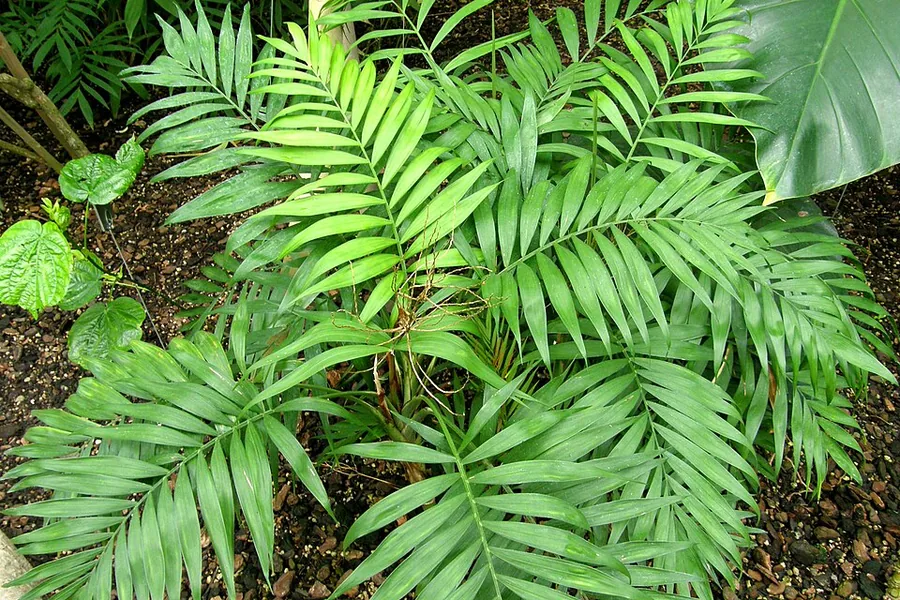
The parlor palm earned its name in Victorian parlors, holding its green through dim corners and dry air that finished off showier plants. It belongs to the palm family and grows in the wild as an understory plant in the forests of Mexico and Guatemala, shaped by deep shade and soft, filtered light. Up close the plant is all soft, arching fronds, each one a slender stalk lined with narrow leaflets that ripple when the air stirs.
This is a slow, compact palm, reaching only about 2 to 6 feet (60 to 200 cm) over many years. Each thin stem lifts a single tuft of those arching fronds, and because one stem alone looks spare, growers pot several seedlings together so the overlapping leaflets fill in as a soft green mound. Give a mature plant enough light and it pushes up loose spirals of small yellow flowers in spring, later giving way to small black fruit.
For all that delicate look, little troubles it. The plant takes low light, average humidity, and the odd missed watering in stride, and it is non-toxic, safe around cats, dogs, or small children who may reach for the thin green leaflets. Only soggy soil and bone-dry air mar the foliage, browning the tips or dulling the green.
Care
The short version: the parlor palm wants bright indirect light yet holds its soft green in low light, water once the surface dries and never leave it in standing water, keep it in ordinary room warmth, and feed lightly in spring and summer only.
Light
The parlor palm shows its best green in bright, indirect light, yet it holds that soft color through low light and shade that would strip most plants. Direct sun scorches the thin fronds, bleaching and crisping the leaflets. A north or east window bathes it in the gentle light it prefers.
Water
Water it thoroughly once the soil surface dries to the touch, then pour off anything left standing in the saucer. Soggy soil and a poorly draining mix rot the roots faster than anything, so the soil is best kept a touch dry rather than wet. No calendar rules it; the drying surface is the cue.
Soil
The parlor palm roots into a porous, humus-rich mix that drains freely. The dark, crumbly organic matter grips just enough moisture without turning to muck around the roots. A pH from 6.0 to 7.5 keeps it settled.
Temperature
Plain room warmth suits it, anywhere from 59°F to 86°F (15°C to 30°C). Cold drafts and the dry breath of a heating vent both stress the tender fronds. Frost blackens the foliage outright, so it stays indoors through the cold.
Humidity
Average household humidity is enough, so there is no figure to chase. Even so, dry air browns the leaflet tips and draws in spider mites, so a little added moisture in winter keeps the green clean. A gravel-and-water tray or a light misting lifts the humidity around the fronds.
Feeding
The plant feeds only while growing in spring and summer, taking a slow-release palm fertilizer two or three times across the season. Nothing goes on in winter. A light touch matters, since surplus fertilizer leaves salts that scorch the fine leaflet tips brown.
Pruning
Pruning stays light. A whole dead or damaged frond is cut away at its base, but a stem is never topped. Each slim stem grows from one point at its tip, so cutting the crown kills that stem instead of branching it.
Repotting
The parlor palm is repotted only every few years, or once its stems crowd the pot, since it prefers to sit a little pot-bound. Roots circling the pot or slipping out the drainage holes, soil that dries very fast, and stalled growth mark the moment to move it up.
Size & spacing
Expect a mature height of 2 to 6 feet (60 to 200 cm) and a spread of 2 to 3 feet (60 to 90 cm), gained slowly over years. Grown in a pot, it needs no garden spacing, only room for the arching fronds to spread their leaflets.
Troubleshooting
The parlor palm rarely falters, and when it does, the fronds show it first. Two marks are worth reading up close: brown, crisp leaflet tips, and a dull, speckled bronzing across the green. Spotted early on the foliage, both are easy to reverse.
A stippled, bronzed cast dulling the green fronds
In warm, dry air, spider mites settle along the undersides of the fronds, so small they read as little more than moving dust. Their feeding pricks the surface into a fine stipple, and the once-clear green fades to a dull, bronzed haze laced with faint webbing. Wiping each frond with a damp cloth, misting often, and lifting the humidity strip the mites away and let the green return.
Fix:
- Rinse or wipe foliage with a damp cloth and mist regularly
- Raise humidity to discourage mites
- Move plants outdoors in summer for natural predator control or treat as needed
Brown, crisp tips edging the slender leaflets
Dry indoor air is the usual reason the leaflet tips go brown and papery, though a buildup of fertilizer salts or soil that lurches between bone-dry and soaked can etch the same mark. The very point of the leaflet turns brown and brittle while the green holds along the rest of the blade, and the oldest, lowest fronds carry it first. Raising the humidity, easing off the feeding, flushing the pot to rinse the salts, and holding the soil evenly moist stop the browning from creeping further.
Fix:
- Raise humidity with a gravel-and-water saucer or room humidifier
- Reduce fertilizer rate and flush the pot with water to leach accumulated salts
- Maintain even soil moisture, watering thoroughly when the surface dries
Toxicity
For homes with pets, the plant is easy company, because the parlor palm is non-toxic across the board, from its slender stems to the thin green leaflets. The ASPCA lists it as safe for cats and dogs, and no known toxins reach other animals or people. The one caveat sits in the fruit, whose pulp can irritate skin, so gloves belong on hand for any seed processing.
Safe for
People · Cats · Dogs · Horses · Rabbits · Livestock · Birds
Cats None
The ASPCA lists the parlor palm as non-toxic to cats. A cat that bites through a thin green leaflet takes no poison from it.
Dogs None
No known toxin runs through the fronds for dogs. A dog that swallows a mouthful of any greenery may get a brief upset stomach, but not from any poison here.
Horses Safe
The soft green foliage carries no known toxic compound, so a horse that browses the fronds comes to no harm.
Rabbits Safe
A rabbit can chew clean through the slim leaflets safely, since the plant holds nothing poisonous to them.
Livestock Safe
Cattle, goats, and sheep run no poisoning risk from the fronds, because the parlor palm is not a toxic plant.
Birds Safe
The arching fronds and the small black fruit carry no known toxin, so pet birds are safe among them.
People Safe
The plant itself is non-toxic to people. Only the fruit pulp is a concern, since it can irritate skin during seed processing, so gloves help for that.
Gloves are advised when handling Chamaedorea fruits during seed processing because the fruit pulp can contain skin irritants.
Varieties
The parlor palm is grown almost entirely as the true species, without the cultivar breeding behind so many other houseplants. In practice there is one green form to know.
Chamaedorea elegans (species)
This is the true compact species with a single slender stem, and growers pot several seedlings together so their overlapping fronds read as one full, bushy crown.
How to propagate
Growing more parlor palms rewards patience over skill. New plants rise from seed or from splitting an established clump of slim stems, and neither comes quickly.
SeedDemanding
Sow fresh seed in warmth; germination is slow and erratic · Seed may not begin germinating for several months and can continue sporadically for over a year
Most of these palms begin as seed, and the seed tests every ounce of patience. Sown fresh and kept warm, it may sit still for several months, then germinate in slow, scattered bursts that carry on for over a year. The pulp around the fruit can irritate skin, so gloves go on before cleaning it.
DivisionModerate
When repotting a multi-stemmed clump · Several weeks to re-establish after separating clumps of seedlings
A pot packed with several seedlings can be teased apart at repotting, each slim stem lifted with its own roots. The separated pieces take a few weeks to knit back in. A lone single-stemmed plant will not divide, since its one growing point cannot be split into more.
Myths
Parlor palms are poisonous to cats and dogs.
The ASPCA lists Chamaedorea elegans as non-toxic to both cats and dogs, right down to the thin green leaflets a pet is most likely to reach. A nibbling pet is in no danger from this palm, which is why it turns up on so many pet-safe plant lists.
You can keep a leggy parlor palm short by cutting off the top of the stem.
Each slender stem grows from a single point right at its tip, so cutting that crown away leaves nothing behind to branch. Removing the top simply kills that stem. A full, bushy shape comes from a clump of several seedlings, not from shortening the stem.