Houseplant · Arecaceae
Lady Palm
Rhapis excelsa
Slim dark canes, broad glossy fans, and safe around pets: the lady palm is one of the easiest indoor palms to grow.
Bright indirect
55–81°F · 13–27°C
USDA 9–11
4–15 ft · 1.2–4.6 m
Overview
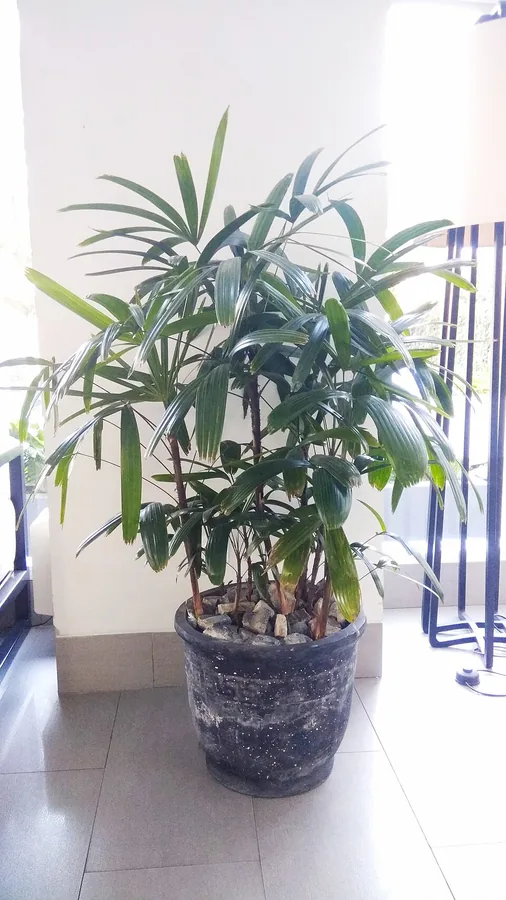
The lady palm is a clumping fan palm from the shaded forests of southern China and Vietnam, and every part of it reads that woodland origin. Its canes are slim and upright, closer to green bamboo than to a trunk, and each one is sheathed in a coat of coarse dark brown fiber that gives the stem a rough, matted texture right up to the crown.
At the top of each cane spreads the plant's signature feature: broad, glossy green fans, split into thick leaf segments that fan out from a single point like fingers on an open hand. The blades are stiff and leathery, deeply ribbed along their length, and blunt at the tip. This is a slow-growing palm, so those fans hold their shape and shine for years, and the clump thickens quietly from the base into a dense stand of canes, reaching around 6 feet indoors.
Flowering is a rare, quiet event on an indoor plant. When it does come, in spring, it amounts to tiny yellow flowers so small and dull they are easy to miss against the foliage. The lady palm is grown for its leaves, not its bloom, and it is non-toxic to people and pets, so nothing about handling those broad fibrous fronds gives cause for worry.
Care
The short version: give it bright indirect light, though it holds its color in shade and low light, and keep the soil evenly moist through the growing season and drier in winter. Feed it lightly, let it take ordinary room humidity, and keep it a little root-confined; it grows slowly and asks for very little.
Light
Lady palm keeps its deepest green in bright indirect light, yet it is one of the rare palms that also holds up in medium light, partial shade, and even true low light. Keep it clear of harsh direct sun, which scorches and bleaches the glossy fronds. In a dim corner it simply slows down, without losing its health.
Water
Through spring and summer, keep the mix evenly moist and water freely, letting the surface dry a little between thorough soakings. Ease off in winter, and never leave the pot standing in water. A couple of times a year, drench it heavily to flush out the fertilizer salts that crisp the leaf tips.
Soil
Root it in a rich, porous, well-drained mix full of organic matter; an African violet type blend suits it well. It leans acidic, a pH of 5.0 to 6.0, so keep it out of limey or heavy soils.
Temperature
Ordinary room warmth suits it, ideally 55°F to 81°F (13°C to 27°C). Bring it indoors before the cold sets in, since the fronds will not take temperatures near freezing.
Humidity
Average household air is enough, so there is no number to chase. The palm tolerates dry rooms, and the only sign it wants more moisture is crisp brown leaf tips, which a little added humidity helps prevent.
Feeding
This slow grower needs barely any feeding. A balanced liquid or slow-release fertilizer at low rates, only through the spring and summer growth, is plenty. Overfeeding does more harm than good and is the usual cause of browned tips.
Pruning
Cut any dead or damaged canes and fronds away right at the base. Never cut the growing tip of a living cane, since a topped cane will not regrow; the clump renews itself from new shoots at the soil.
Repotting
Repot only every 2 to 3 years, and only once roots have filled the pot. The plant prefers to sit a little root-confined, so there is no need to move it into a much larger container.
Size & spacing
Indoors it usually reaches around 6 feet, though the species runs 4 to 15 feet (1.2 to 4.5 m) tall and spreads 6 to 15 feet (1.8 to 4.5 m) wide as the clump of canes fills out. Leave it room so the broad fans can arch without crowding.
Troubleshooting
The lady palm is rarely much trouble, and the few faults it shows are written plainly across its broad fans. Two are worth learning to read: browning at the leaf edges and the marks of pests. Match what you see below and step in early, while the fix is still simple.
Sticky sheen, yellow flecks, or raised bumps along the fronds
Small, hard bumps pressed into the dark fibrous leaf bases are almost always scale insects, the chief pest of lady palms, and their color blends into the fiber. A dusty webbing over yellow-flecked, dull fronds tells of spider mites instead, drawn in by warm, dry air. Set the plant apart from the rest, wipe the scale off and treat with horticultural oil or insecticidal soap, and rinse the fronds to wash the mites away.
Fix:
- Isolate the plant from other houseplants
- Wipe or wash off scale and treat with horticultural oil or insecticidal soap, repeating as needed
- Raise humidity and rinse foliage to discourage spider mites
- Inspect new growth and leaf bases regularly
Dry, brown tips edging the older lower leaves
Those crisp brown edges on the oldest fans usually trace to fertilizer salt buildup left in the mix by heavy feeding, and the lowest leaves brown first. Parched air or thin watering can scorch the tips more evenly across the plant. Drench the pot a couple of times to rinse the salts away, cut back the feed, and hold the soil at a steady, even moisture.
Fix:
- Drench the pot heavily and repeatedly to leach excess salts (do this about twice a year)
- Reduce fertilizer to low rates and only during active growth
- Keep the mix evenly moist and avoid letting it fully dry
- Trim only the dead tip tissue if desired
Toxicity
For a home with curious pets, the verdict is easy: the lady palm is non-toxic across the board. The ASPCA lists it safe for cats and dogs, and nothing in its stiff, fibrous fronds threatens horses, rabbits, livestock, birds, or people. A pet that bites through a tough leaf segment may get a brief, mild stomachache from the coarse fiber, and that is the worst of it.
Safe for
People · Cats · Dogs · Horses · Rabbits · Livestock · Birds
Cats None
The ASPCA lists this palm as non-toxic to cats. A cat that bites into the tough, fibrous leaf may get a mildly upset stomach from the coarse tissue, and it passes on its own.
Dogs None
Safe for dogs by the ASPCA. A dog that chews down a mouthful of the leathery fronds may drool briefly or pass a soft stool, but nothing worse.
Horses Safe
No toxin here can harm a horse. The stiff, deeply ribbed fronds are too fibrous to be worth grazing and pose no poison to one that tries.
Rabbits Safe
Nothing in the plant is poisonous to rabbits, though a big helping of the thick, leathery leaves may loosen the gut for a day.
Livestock Safe
Cattle, goats, and sheep are unharmed by it. The broad, fibrous fronds carry no toxin, only tough tissue that is hard to digest in quantity.
Birds Safe
A safe plant near pet birds. The glossy foliage holds no compound that would trouble them.
People Safe
The plant is not poisonous to people, part of why the palm is such a common houseplant. The fronds are grown to be looked at, not eaten, so there is no reason to taste them.
Varieties
Lady palm is usually sold as the plain green species, but a couple of forms stand out by leaf and cane, and are worth knowing by name.
'Variegata'
Fine creamy white stripes run the length of its green leaf segments, and it grows more slowly than the plain form while needing less light and less feeding.
Rhapis humilis (reed rhapis / slender lady palm)
A close relative whose canes rise taller and more slender, each fan split into a greater number of narrow leaf segments than R. excelsa carries.
How to propagate
The easiest way to make more lady palm is to divide an established clump, since it keeps pushing up fresh green shoots from the base. Seed is possible too, though it is a slow, patient route.
DivisionEasy
Spring · Several months to root and resume active growth
Division is the usual way to make more of this palm, and it follows the way the clump throws up new shoots from the base. In spring, lift a rooted sucker with as much root as you can save, spare the parent from injury, and pot the sucker just large enough to hold its roots. Give it several months to root down and push out fresh growth before you expect much.
SeedModerate
When ripe seed is available · Slow; germination and growth take a long time
Seed is possible but a long, patient job. The plant is dioecious, so a male and a female are both needed before any viable seed forms, and even then the germination and early growth crawl across many months.
Myths
Lady palm needs constant high humidity to survive indoors.
The palm holds its deep green in ordinary household air and asks for very little humidity. A damp room pleases it, but dry air shows itself mainly as crisp brown leaf tips, not a dying plant, so there is no need to crowd it with humidifiers.
A cut or topped lady palm cane will branch and regrow from its cut.
Each slim cane rises from a single growing tip, and cutting that tip ends the cane for good. The clump renews itself from fresh offshoots at the base instead, which is why spent canes are cut low and new green shoots are left to push up on their own.