Ornamental · Primulaceae
Primrose
Primula vulgaris
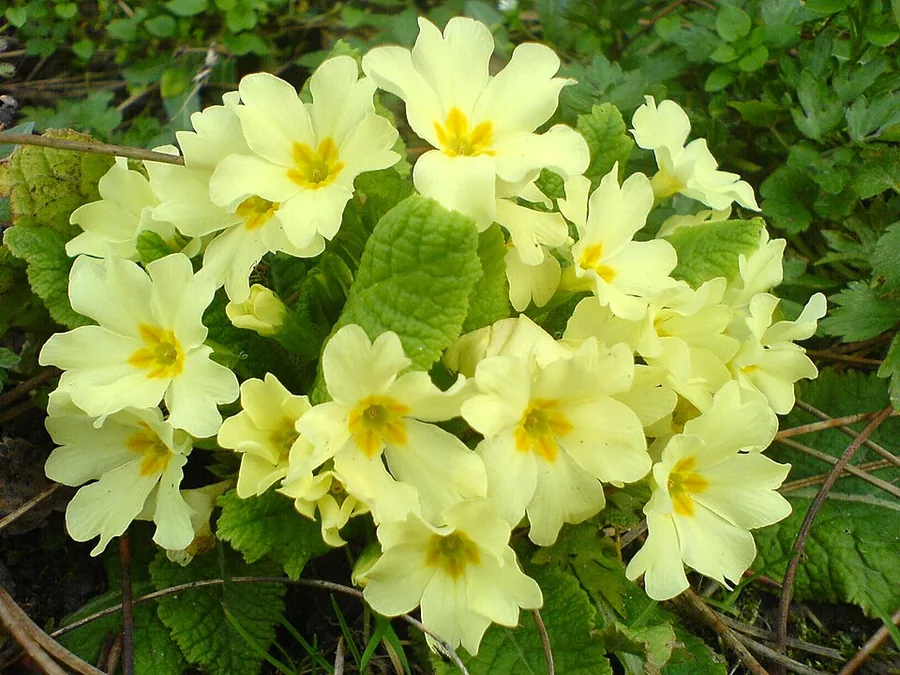
A low rosette of wrinkled, spoon-shaped leaves, set with inch-wide flowers on short stalks.
Partial shade
Every 2–4 days
USDA 4–8
3–6 in · 8–15 cm
Overview
Up close, primrose sits as a low, tight rosette of leaves that press almost flat to the soil. Each leaf is wrinkled and crinkled across its surface and shaped like a rounded spoon, its texture puckered rather than smooth. From the center rise short, slender stalks, each lifting a single flower clear of the foliage in early to mid spring.
The wild flower opens a soft, pale yellow, its face barely an inch across and giving off a faint, light fragrance. The bloom sits shallow and open on its short stalk, held just above the leaves. Against the muted green of the puckered foliage, that quiet yellow reads as the first real color of the season.
The garden hybrids keep the same low rosette and wrinkled leaves but trade the pale yellow for stronger color, showing up in blue, red, pink, purple, white, and gold. Many carry a contrasting eye at the center, a small ring of a second color where the petals meet. The plant stays short throughout, a compact cushion of leaf and flower rather than anything tall or reaching.
Care
The short version: this low, wrinkle-leaved rosette wants cool partial shade and rich soil kept evenly moist, one spring feeding, and dividing every few years, and it answers with inch-wide flowers on short stalks each spring.
Light
Primrose holds its color best in partial shade; full sun bleaches and scorches the wrinkled leaves and cuts the flowering short. It stays green and full in deep shade or a little morning sun, but the broken light beneath a deciduous tree suits the low rosette best.
Water
The puckered leaves wilt and go limp fast when the soil dries, so keep it consistently moist. A drink every 2 to 4 days in warm weather keeps the rosette firm, and a spring mulch laid around the crown holds the moisture and cools the roots.
Soil
Primrose roots run through organically rich, well-drained loam that stays damp without standing wet. Compost dug in before planting gives the crown the moist, open ground it needs; in thin or fast-draining soil the leaves thin out and the plant weakens.
Temperature
The plant is built for cold, its low rosette hardy to -29°F (-34°C) and firmest below 75°F (24°C). It holds through hard frost, but the leaves slacken and brown as summer heat climbs, so cool shade keeps the foliage fresh longer.
Humidity
Ordinary outdoor air suits primrose, with no set level to reach. Moist soil matters more than moist air for the crown, and open airflow around those tightly packed leaves keeps off the mold and rot they can trap.
Feeding
One feeding in spring, as the new leaves unfurl, keeps the rosette dense and the flowers coming. A balanced fertilizer or compost worked into the soil around the crown supplies it, and that single feeding carries the plant through bloom.
Pruning
Deadhead the spent flowers as their short stalks fade, and pull away any leaf that has gone tattered or browned. Dividing the crown in spring after bloom both cleans up the clump and renews the tight rosette.
Repotting
Over the years the rosettes multiply into a congested mat, and the crowded center throws fewer flowers. Lift and divide every 2 to 3 years in spring after flowering, pulling the packed crown into separate rooted rosettes.
Size & spacing
Everything stays close to the ground: the rosette rises only 3 to 6 inches (8 to 15 cm) and spreads 3 to 9 inches (8 to 23 cm) across. Set close together, the low cushions of wrinkled leaf press into one another as an edging or a shady groundcover.
When to plant
The short flower stalks push up from the leaf rosette on the cool side of the year. Seed is slow to wake and is sown in late winter for that chilly start, young plants go out in spring after hard frost, and the flowers open in early to mid spring, a low scatter of color close to the ground before summer heat.
Northern hemisphere
Southern hemisphere
Typical months for a temperate climate: start earlier in warm zones, later where spring frosts linger.
- Sow: Late winter (seed can be slow and benefits from a cold/chilling period)
- Plant: Spring, after frost danger eases, into cool moist soil
- Harvest: Early to mid spring (around April)
Hardiness
USDA hardiness zones: 4–8
Temperature: down to -34°C
Troubleshooting
Look closely and the early signs of trouble show right on the plant: chewed edges on the leaves and petals, a softening at the crown, or a fine stippling across the wrinkled foliage. The cool, damp shade primrose grows in draws slugs, rot, and mold, so read those signs on the leaves, flowers, and crown and act early.
The rosette collapses over soft, brown roots and crown
When the ground stays waterlogged, the roots and crown turn soft and brown with root rot, and the leaves flatten and collapse. In the cool, damp air that follows, gray mold furs over the crowded crown in gray. A plant rotted at the root will not come back, so pull it and discard it, then open up the drainage and the spacing around the survivors.
Fix:
- Remove and discard severely affected plants
- Improve drainage and avoid waterlogging
- Increase spacing and airflow to reduce humidity around foliage
Ragged-edged holes bitten through leaves and petals, with slime trails
The chewed, ragged holes in the leaves and petals mark slugs and snails, which gather in the cool, moist shade around the low rosette. They feed by night and tuck into leaf litter by day, leaving silvery slime trails over the foliage. Pick them off in the evening, clear the litter, and cut back the watering so the ground beneath the leaves dries a little.
Fix:
- Hand-pick slugs and snails in the evening
- Remove leaf litter and debris that provide daytime shelter
- Reduce excess moisture and improve airflow around plants
Curled new leaves, stippled foliage, and fine webbing
Fresh leaves that pucker and curl point to aphids clustered on the soft new growth. A dry, dusty stippling across the older leaves, with fine webbing strung between them, marks red spider mites in warm, dry air. Rinse both off with a hard spray of water, treat any that cling with insecticidal soap, and keep the plant cool and moist.
Fix:
- Rinse foliage with a strong spray of water
- Treat persistent infestations with insecticidal soap
- Maintain adequate humidity and moisture to discourage spider mites
Toxicity
Primrose is only mildly toxic, so a nibbled leaf usually means no more than a brief upset stomach for a pet. The sharper point is on the foliage itself, since the leaves carry primin, a contact allergen that can redden and itch sensitive skin. Handle the plant in gloves and keep pets from grazing on it.
Toxic to
Cats · Dogs · Horses · Rabbits · Livestock · Birds · People
Cats Mild
A cat that bites into the wrinkled leaves usually ends up with a queasy stomach and some vomiting. The upset stays mild and passes on its own once the plant is out of reach.
Dogs Mild
A dog that chews the foliage may vomit or turn off its food for a while. The signs stay mild, though a large mouthful is worth a call to the vet.
Horses Mild
A horse that crops a mouthful of primrose can pick up mild stomach upset. The reaction is minor, but the plant is best kept clear of paddocks and reach.
Rabbits Caution
The compounds that trouble cats and dogs can leave a rabbit with loose stools or a sour stomach, so the leaves make no safe nibble. Keep primrose away from a rabbit's run.
Livestock Caution
Cattle, goats, and sheep seldom crop primrose, but a curious mouthful can bring mild digestive upset. Fence it off from grazing animals to be safe.
Birds Caution
Little suggests birds feed on primrose, and it is no safe forage either. Keep it clear of pet birds and poultry that peck at greenery.
People Caution
The trouble for people is in the touch of the leaves, not the taste. The foliage carries primin, a contact allergen that can leave sensitive skin red, itchy, or blistered, so wear gloves and wash your hands after handling the plant.
Toxic principle is listed as unknown; signs are mild. Separately, primrose species (notably Primula obconica) contain primin, a contact allergen that can cause skin irritation or allergic dermatitis in some people, so wear gloves when handling and wash hands after contact.
Helpline numbers

United States
ASPCA Animal Poison Control: (888) 426-4435 (fee applies)
Poison Control: (800) 222-1222



Canada
Poison Centres: 1-844-764-7669
Varieties
From the pale, wrinkle-leaved wild plant to the strong-colored, eyed hybrids, primrose shows two clear looks. These are the two you will see most.
Primula vulgaris (common species)
In the wild species, pale yellow flowers barely an inch across, each faintly scented, rise one to a short stalk above a flattened rosette of wrinkled, spoon-shaped leaves.
Polyanthus and modern hybrids
The hybrids swap that pale yellow for saturated blue, red, pink, purple, white, and gold, many marked with a contrasting eye at the throat, and they stock most of the bedding and pot displays sold.
How to propagate
More primrose comes either from splitting the rooted crown of an established clump or from its slow-starting seed.
DivisionEasy
Spring, after flowering · One growing season
Division splits the packed crown into separate rooted rosettes and keeps an old clump from crowding itself out. In spring, once the flowers fade, lift a mature plant, break the tangled crown into rooted pieces, and set them back at once. Each piece roots down and fills out over a single growing season.
SeedModerate
Late winter to spring · Several months to a year to reach flowering size
Seed is the slow way in. Sown in late winter or spring, it is slow to break and wants cool conditions to do it. A seedling spends several months to a year building up to flowering size, and seed of the wild species runs far truer to type than seed off the hybrids.
Myths
Any plant sharing the primrose name must be the same underneath.
The name covers plants of very different make. ASPCA lists this one, Primula vulgaris with its wrinkled rosette, as toxic to cats, dogs, and horses, while Cape Primrose, a Streptocarpus and no relation, sits on its non-toxic list for the same animals. What a plant is called says nothing about the risk, so the botanical name is what to read.