Bulb · Primulaceae
Florist's Cyclamen
Cyclamen persicum
Keep it cool, bright, and watered from below, and cyclamen lifts bright blooms all winter.
Bright indirect
Every 5–10 days
50–64°F · 10–18°C
420–540 days
Overview
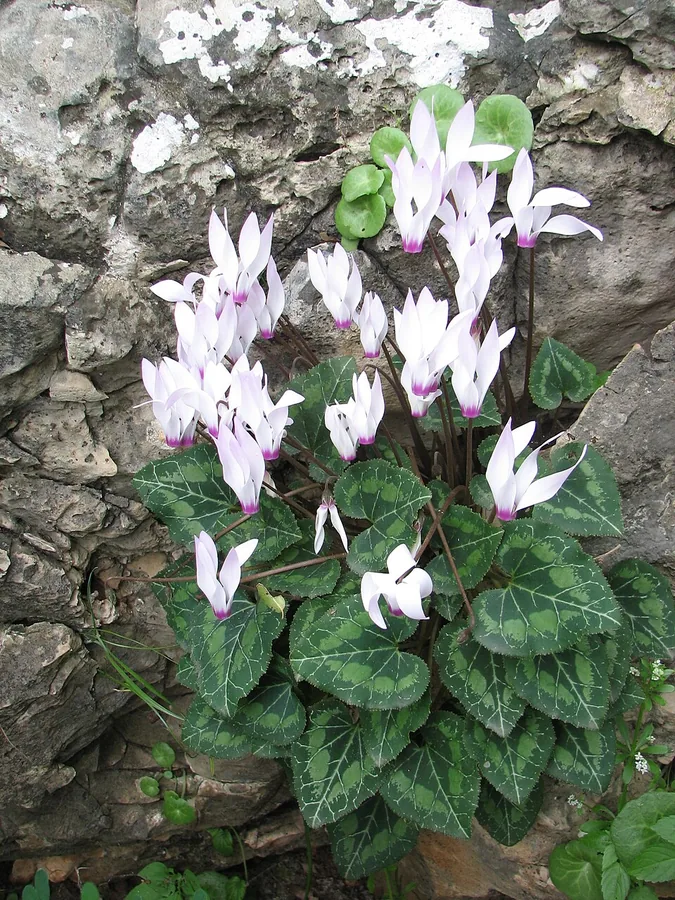
Cyclamen opens its flowers in the cold months, lifting blooms whose petals sweep up and back like small flames from late fall into spring. It sits in the primrose family and rises from a flat, round tuber at the soil surface, sending up heart-shaped leaves marbled in silver and green on slender pink-flushed stalks. The plant most people see is the florist's cyclamen, a tender hybrid grown in pots for winter.
Its needs run against the usual houseplant habit. Cyclamen wants things cool and bright, not warm and close, and the leaves go limp and the stems flag in a heated room the way other plants droop in a draft. Water it from below to keep the crown dry, give it a chilly window, and the flower stems keep rising for weeks.
By late spring the marbled leaves pale and soften, and a first-time grower often clears the plant out, certain it has died. It has not. The round tuber is sliding into dormancy for the summer, sitting bare and quiet until cooler days push fresh leaves up from its crown.
Care
The short version: keep it cool and bright, water from below whenever the surface dries so the crown stays dry, feed lightly through the growing season, and let the round tuber rest dry through its summer dormancy.
Light
Give cyclamen bright, indirect light, the kind that reaches a window but skips the midday glare. It takes a little partial sun or shade, yet direct sun bleaches and crisps the marbled leaves while deep shade leaves the flower stems few and short, so the soft middle keeps the foliage rich and the buds coming.
Water
Water only when the surface feels dry, every 5 to 10 days in the growing season, and always from below so the crown and the round tuber stay dry. Water held in the crown is what rots the plant from its center. Once the leaves yellow for summer, cut the watering back hard and let the tuber rest.
Soil
Set the tuber in a rich, light, well-drained loam loose enough to drain at once rather than hold a wet collar around its base. A pH from 5.5 to 7.0 suits it, covering the slightly acidic to neutral range.
Temperature
Temperature is the detail most people miss. Cyclamen wants it cool, between 50°F and 64°F (10°C to 18°C), and in a warm room the leaf stalks soften and flop and the flowers fade early. A bright, chilly windowsill holds the foliage crisp and upright.
Humidity
Aim for 40% to 60% humidity, the plain middle of an ordinary home. Misting only beads water in the crown and invites rot, so skip it, and where the air runs dry, stand the pot on a tray of damp pebbles to lift moisture around the leaves without wetting them.
Feeding
Feed monthly from fall through spring while leaves and buds keep pushing up, using a dilute balanced or low-nitrogen houseplant food. Stop feeding once the leaves yellow and the tuber pulls back into its summer rest.
Pruning
There is no real pruning here. Spent flowers and yellowing leaves twist off at the base with a gentle pull rather than a cut, lifting the whole stalk clean away so no wet stub is left to rot against the crown.
Repotting
Repot every 1 to 2 years after the summer dormancy, just as fresh leaves unfurl from the crown. Roots crowding the pot, the tuber spreading across the surface, or smaller leaves and fewer flowers all show it has outgrown its container.
Size & spacing
Cyclamen forms a low, rounded clump of leaves and flower stems only 6 to 9 inches (15 to 23 cm) tall and about as wide. That tight mound of marbled foliage and upswept blooms sits neatly on a windowsill or a tabletop.
When to plant
Cyclamen runs on a winter clock, the reverse of most plants. Seed sown in late summer pushes up its first flowers the following winter, and indoors those blooms keep rising from November into April before the tuber draws back into summer rest.
Northern hemisphere
Southern hemisphere
Typical months for a temperate climate: start earlier in warm zones, later where spring frosts linger.
- Sow: late summer
- Plant: after frost in zones 9-11 only
- Harvest: winter to spring (November to April)
Hardiness
USDA hardiness zones: 9–11
Temperature: down to -7°C
Troubleshooting
Most cyclamen trouble shows on the plant itself: limp warm-stressed leaves, a softening tuber, or new growth crimped by a mite too small to see. Learn to read a rotting tuber against a tuber simply going dormant, and you will know when to act. Match the look below, then step in early.
Pinched, puckered new leaves and warped buds
New leaves that open cupped and crimped, and buds that twist instead of swelling smooth, are the mark of cyclamen mites or the broad mites with them, both too small for the eye to find. They feed deep inside the folded growth before it expands, so each leaf and bud emerges scarred and stunted. Set the plant apart at the first warped leaf, and discard a badly distorted one before the mites travel to healthy growth close by.
Fix:
- Discard heavily infested plants to prevent spread
- Isolate affected plants immediately
- Apply a miticide labeled for cyclamen mites if treating
A mushy tuber and a crown sinking inward
When water lingers in the crown, tuber and crown rot takes over, turning the firm round tuber soft and brown and leaving the leaf stalks limp where they join it. A base that has gone mushy and smells sour is past saving. The cause is too much water, often poured straight onto the crown. Watering from below dries it out, any tuber turned to pulp comes out and goes in the bin, and the rest needs faster drainage and moving air.
Fix:
- Reduce watering and water from below
- Remove and discard severely rotted tubers
- Improve drainage and air circulation
Leaves fading to yellow and slackening
Leaves that pale from green to yellow in late spring or summer show natural dormancy, the tuber drawing back as its season ends, and the slackening foliage is nothing to fix. The same yellow creeping in during the winter growing season means the plant sits too warm or too wet. A cooler place near 65°F (18°C) and a lighter hand with water bring the green back.
Fix:
- During dormancy, reduce watering and rest the tuber in a cool spot
- During active growth, move to a cooler location and correct watering
Toxicity
Cyclamen is toxic, and the danger reaches past pets. Every part, from the marbled leaves to the buried tuber that holds by far the most, carries terpenoid saponins, and eating it brings vomiting and, in quantity, heart-rhythm trouble and seizures. Keep it out of reach of cats, dogs, horses, and small children, and wash your hands after handling the firm root.
Toxic to
Cats · Dogs · Horses · Rabbits · Livestock · Birds · People
Cats Severe
Even a small nibble of leaf leaves a cat drooling, vomiting, and loose with diarrhea. The firm tuber underground holds the most toxin, so a cat that bites into it can fall to an irregular heartbeat and seizures, and a large dose can be fatal.
Dogs Severe
A dog that crops the foliage drools heavily, throws up, and turns queasy. The most poison sits in the round tuber, so a dog that chews into that root risks heart-rhythm trouble, seizures, and at worst death.
Horses Severe
The saponins drive a horse into drooling, diarrhea, and colic, and with no way to vomit it cannot purge what it grazed. A large mouthful of the buried tuber can throw the heartbeat off rhythm and bring on seizures.
Rabbits Toxic
The same saponins run through every part of the plant and leave none of it safe for a rabbit, with the fleshy tuber the most loaded of all. A potted cyclamen stays out of reach, its leaves never within a nibbling stretch.
Livestock Toxic
Cattle, sheep, and goats that crop cyclamen swallow the same gut-churning toxin, and the buried tuber packs the steepest concentration. The plants belong well clear of any grazing mouth.
Birds Toxic
The saponins spare birds nothing, so a pet parrot or finch should never reach the marbled leaves or the tuber. The plant sits where no inquisitive beak can pry at it.
People Caution
No part of cyclamen is fit to eat, and swallowing the leaves or stems brings vomiting and a turned stomach, with the tuber the most dangerous of all. Handling that tuber can redden and irritate the skin, so hands are washed afterward and it stays from children.
The tuber/root is the most toxic part. Keep plants out of reach of pets and children, and wash hands after handling as the tuber can cause contact dermatitis.
Helpline numbers

United States
ASPCA Animal Poison Control: (888) 426-4435 (fee applies)
Poison Control: (800) 222-1222



Canada
Poison Centres: 1-844-764-7669
Varieties
Cyclamen ranges from a tender pot plant with upswept petals to a hardy creeper of the woodland floor. These two are the ones most often seen.
Cyclamen persicum (florist cyclamen hybrids)
These tender hybrids lift large petals that sweep sharply upward and backward in violet, lavender, pink, rose, red, and white, and many carry a darker stain of color at the very throat of the bloom.
Cyclamen hederifolium
Its leaves take the broad, angular outline of ivy, and this hardy species endures real cold to creep across the ground outdoors rather than stand upright in a pot.
How to propagate
Cyclamen is slow to multiply and asks for patience either way. Seed is the route nearly everyone takes, with division a long shot best left to the determined.
SeedModerate
Late summer · About 12-18 months to first bloom
Seed is the dependable way to raise more cyclamen, each tiny seed swelling slowly into a tuber. Sow fresh seed in late summer and the plants flower the following winter, though they take 12 to 18 months from sowing to that first bloom, so patience is part of it.
DivisionDemanding
During dormancy · Variable
The firm tuber can be cut apart during summer dormancy, but it seldom pays off. The raw cut faces tend to rot before they root, and recovery drags on for an unpredictable stretch, which keeps growers on seed instead.
Myths
Cyclamen is safe around pets because it is sold as a common houseplant.
A pretty, familiar plant on the shelf gives no sign of whether a pet can safely chew its leaves. Cyclamen is toxic to cats, dogs, and horses, and the swollen tuber in particular can cause an irregular heartbeat, seizures, and death if a pet eats enough. Keep it well out of reach of animals and children.