Ornamental · Portulacaceae
Moss Rose
Portulaca grandiflora
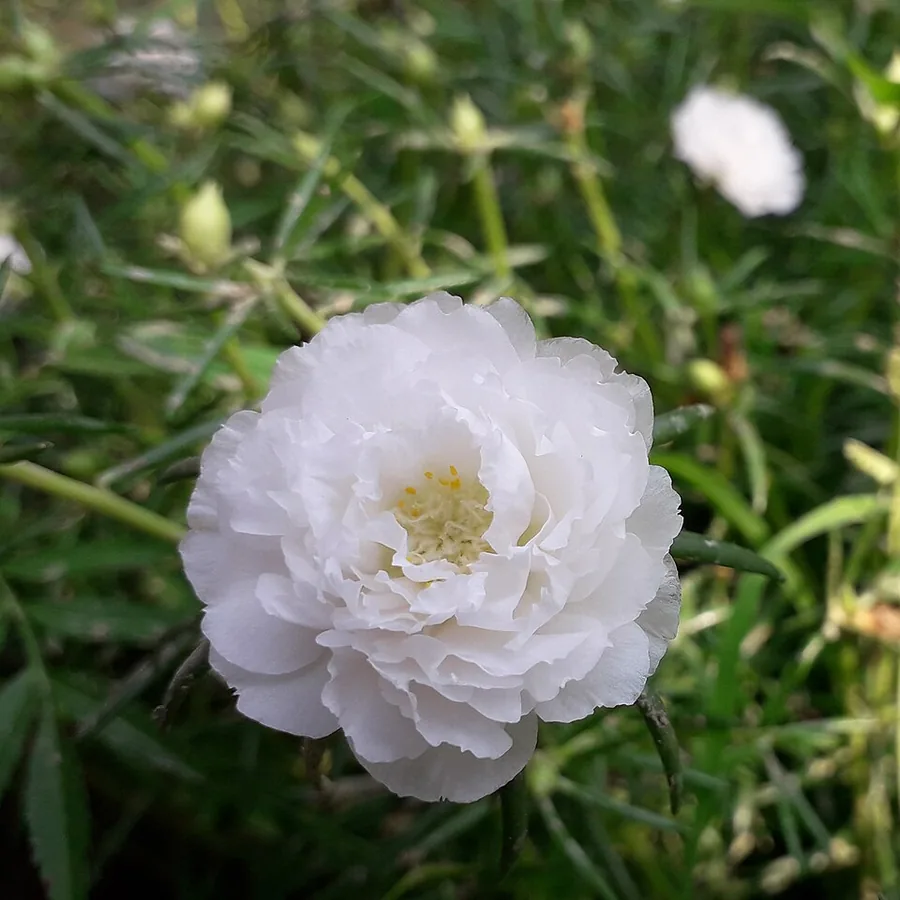
Fleshy, needle-thin leaves and ruffled, rose-shaped flowers pack a low, spreading mat of moss rose.
Full sun
Every 7–14 days
59–95°F · 15–35°C
USDA 2–11
Overview
Up close, moss rose reads as a true succulent. Its leaves are slim and needle-like, plump and fleshy to the touch, set along low stems that creep and spread rather than climb. The whole plant hugs the ground in a soft mat, built to hold water through heat and drought, and it stays compact where other annuals would sprawl.
The flowers steal the eye. Each one is ruffled and layered, and the fullest forms double up into tight rosettes, close copies of miniature roses. The color runs hot and saturated across pinks, oranges, reds, yellows, and clean whites. In strong, direct light the petals spread wide and flat; in shade or under cloud they furl shut again, the closing habit that earned the name eleven o'clock plant.
For all that color, the plant itself stays small and close-knit. It rises only a few inches and fans out into a low, ground-covering mat of fine foliage. When conditions turn wet, that firm, fleshy structure gives way: the stems soften, darken, and slump where they were once plump and upright.
Care
The short version: moss rose is a low, fleshy-leaved succulent that wants full sun and dry, sandy, quick-draining soil. Water only once the ground dries, feed lightly, and let the heat keep its stems firm and its flowers open.
Light
Moss rose wants full, direct sun, 6 or more hours a day. The petals respond directly to it, spreading open under strong light and staying furled in shade. The brighter the position, the more of those flat, open faces it shows.
Water
Under its fleshy skin the plant stores its own water, so the soil should go fully dry between waterings, about every 7 to 14 days. Standing wet turns the firm stems soft far faster than any dry spell or heat, so the roots are best left thirsty.
Soil
Set it into loose, sandy soil with sharp drainage, the grittier the better, and even thin, poor ground suits its succulent roots. A pH from 5.5 to 7.5 works, and the coarse texture underfoot matters more than any richness.
Temperature
Warmth keeps the stems plump and the flowers coming, and the plant holds up from 59°F to 95°F (15°C to 35°C). Frost collapses the soft tissue outright, so it stays out only once the cold has fully passed.
Humidity
Dry air suits the fleshy foliage, and there is no humidity figure to reach for. Low moisture and moving air keep the surfaces dry and hold off the rot that damp, unmoving air breeds.
Feeding
The plant flowers hardest when kept lean, so feeding is barely needed. Too much nitrogen swells the leaves and thins the flowers, and poor ground calls for none at all. Slightly richer soil takes just one light feed across the summer.
Pruning
A pinch to any stretched, leggy stem pushes the plant back into a denser, more rounded mound. The spent flowers drop and clear on their own, and the plant reseeds itself, so no deadheading is called for.
Repotting
Living just one season, moss rose seldom needs a bigger pot; the usual step is easing nursery starts into the ground at planting. In a container, roots wound tight against the wall or a mix that drains the instant it is wet show the plant has filled its space.
Size & spacing
This is a ground-level plant, just 4 to 8 inches (10 to 20 cm) tall, that spreads its fine stems into a mat 6 to 12 inches (15 to 30 cm) across. Spaced so the mats just touch, the fine foliage knits into a continuous low carpet while air still moves between the plants.
When to plant
Moss rose is a warm-season annual, fleshy and frost-tender, that holds back until real heat arrives. Seeds begin indoors in late winter, the young plants move outside once the soil warms and frost has gone, and the flowers keep coming from summer into the early days of fall.
Northern hemisphere
Southern hemisphere
Typical months for a temperate climate: start earlier in warm zones, later where spring frosts linger.
- Sow: 6 to 8 weeks before the last spring frost
- Plant: After all danger of frost has passed and soil has warmed
- Harvest: Summer through early fall
Hardiness
USDA hardiness zones: 2–11
Temperature: down to -46°C
Troubleshooting
The plant wears its troubles openly, in the look and feel of its stems and flowers. Nearly every problem comes down to overwatering or a shortage of sun, and both change the plant's appearance early. Match what you see below, and read the stems and blooms as the first clue.
Stems gone soft, black, and slumping at the base
When the once-firm stems turn soft, blacken, and slump at the base, the plant has root and stem rot. It follows overwatering or soil that will not drain. The base of the stem feels mushy and looks darkened while the ground around it sits wet for days. Cutting the water back, mixing coarse sand or grit through the soil, and pulling out anything rotted through are what turn it around.
Fix:
- Reduce watering and allow soil to dry
- Improve drainage with sandy or gritty soil
- Remove and discard severely rotted plants
A leafy plant showing almost no flowers
Plenty of green leaf and hardly a bloom usually means too little direct sun or too much nitrogen. The petals need roughly 6 hours of hard sun to open at all, and a rich feed swells the foliage while the flowers stay hidden. Moved into full sun and fed less, the plant puts its energy back into color.
Fix:
- Move to a full-sun location
- Stop or reduce fertilizing
Toxicity
Behind the bright flowers, moss rose is mildly toxic. Its fleshy leaves and stems carry soluble calcium oxalates, which usually bring only drooling and a queasy stomach, though a real mouthful can leave an animal weak and strain the kidneys. Keep it away from cats, dogs, horses, and other animals, and treat its edible relative purslane, which carries the same oxalates, as a green for moderation.
Toxic to
Cats · Dogs · Horses · Rabbits · Livestock · Birds · People
Cats Mild
In a cat, a small taste shows up as strings of drool and a queasy, unsettled stomach. A full mouthful brings heavier drooling and a visible weakness, and a large amount presses hard on the kidneys.
Dogs Mild
A dog that chews a stem or two mostly shows wet, drooling jaws and a churned-up stomach. A larger helping can leave it weak, with vomiting that comes and goes.
Horses Mild
In a horse, a small mouthful draws out slobber and dulls the appetite, little more. Steady grazing lets the oxalates gather, lock up the calcium in its body, and drain the animal into weakness.
Rabbits Caution
A rabbit should never reach it. The fleshy stems carry the same soluble oxalates that trouble other animals, and a rabbit's gut is too delicate to risk, so keep it far from any hutch or run.
Livestock Caution
Cattle, sheep, and goats seldom crop it on their own. On bare, overgrazed ground, though, a hungry animal may strip enough to set it drooling and turn it weak, so fencing keeps it out of reach where stock feed.
Birds Caution
Birds meet the same oxalates, whether they are kept or wild, so the plant is best positioned well clear of cages and pens.
People Caution
For people, the garden plant stays in the border and off the plate. Its close relative purslane turns up as a leafy green, but it holds the same oxalates in its fleshy leaves, so even that is eaten sparingly.
Common purslane (Portulaca oleracea) is eaten by people but also contains oxalates and should be consumed in moderation.
Helpline numbers

United States
ASPCA Animal Poison Control: (888) 426-4435 (fee applies)
Poison Control: (800) 222-1222



Canada
Poison Centres: 1-844-764-7669
Varieties
The named series differ most in the flower itself: how full and rounded the doubles are, how wide the color range runs, and how well the petals hold open in weaker light. The three below show that range clearly.
Sundial Series
A compact double whose tightly packed petals unfurl early each day and stay open in low light longer than most.
Margarita Series
A sturdy, heat-loving double that keeps throwing out full, rounded flowers in beds and pots through the peak of summer.
Happy Hour Series
A low, mounded series carrying large, many-petaled double blooms across a remarkably wide sweep of colors.
How to propagate
New plants come from two small starting points: seed almost too fine to see, and short lengths of the fleshy stem. Both take hold quickly and grow into the same low, flowering mat.
SeedEasy
Start indoors 6 to 8 weeks before last frost or direct sow after frost; self-sows readily · 2 to 4 weeks to germinate and establish
The seed is almost dust, so fine it barely shows against the soil, and it needs light to sprout, which means it lies on top of the ground rather than buried. A tray started indoors 6 to 8 weeks before the last frost, or a scattering onto warm ground once the cold breaks, is all it takes. Seedlings appear and settle over 2 to 4 weeks, and the plant then drops its own seed year after year.
Stem cuttingsEasy
During the active summer growing season · 1 to 2 weeks to root
A cutting is just a short length of the fleshy stem, taken while the plant is in full summer growth. The cut end is left to firm and callus for several hours, which keeps it from rotting, and then it slips into gritty soil. Fine new roots grip within 1 to 2 weeks.
Myths
Portulaca must be pet-safe, seeing as purslane is a vegetable on the plate.
The two share a family and little else where safety is concerned. The ASPCA lists Portulaca species as toxic to cats, dogs, and horses because of soluble calcium oxalates, and those same oxalates sit in the fleshy leaves of edible purslane. It belongs out of any pet's reach.
The flowers of moss rose hold open all day.
In truth, the petals spread only under bright, direct sun and draw closed again in shade, under cloud, and as the afternoon light drops. That opening and closing is what named it the eleven o'clock plant.