Houseplant · Bromeliaceae
Pineapple
Ananas comosus
Give it strong light, warmth, and a pot that drains fast, and a grocery-store crown turns into a houseplant that fruits.
Full sun
Every 7–14 days
55–90°F · 13–32°C
540–720 days
Overview
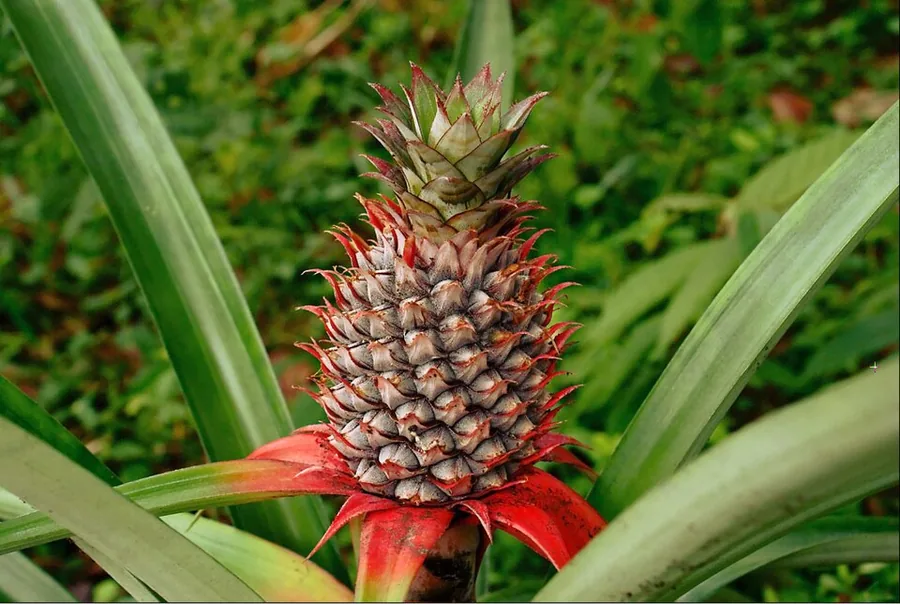
The pineapple is a bromeliad from tropical South America, built as a low fountain of long, arching leaves that spring stiff and sword-shaped from a tight central rosette, with the fruit rising on a stalk from its heart. Each blade is thick and leathery, edged in many forms with small, sharp, backward-hooked teeth, and the leaves cup inward so the rosette catches water in its center. It draws moisture through both its roots and that central cup, which is why a missed watering barely registers while wet roots do.
Fruit is slow to form. A plant takes 18 to 24 months to carry a crown to a ripe pineapple, and each rosette manages it just once before the offsets take over. The fruit itself is a knobbly, many-eyed body topped by its own tuft of stiff leaves, its flesh turning deep yellow and juicy as it ripens.
The foliage is the plant's real character. Blades run stiff and strappy, arching out and tapering to a firm point, some margins smooth and others toothed and spined. On the ornamental forms those long leaves carry lengthwise stripes of cream and green that often flush pink toward the edges, and the whole rosette holds its rigid, symmetrical shape even after a neglected week.
Care
The short version: the plant wants as much bright light as possible, ideally full sun, water only once the top half of the pot has dried, and a light, fast-draining mix. Keep it warm, feed it monthly through the growing season, and never let water stand in the central cup of the rosette.
Light
Pineapple wants as much light as possible, full sun where you can give it and a bright window at the least. Starved of light, the stiff blades slacken and pale toward a thin green, and fruit becomes a remote prospect.
Water
Let the top half of the pot dry before watering again, roughly every 7 to 14 days. As a bromeliad it takes a dry spell far better than soggy roots. Water pooled in the central cup of the rosette, especially in cool weather, is what turns the core to rot.
Soil
A light, fast-draining mix, sandy or loamy and rich in organic matter, lets water run straight through the coarse, wiry roots. Pineapple leans acidic, a pH of 4.5 to 6.5, the range its bromeliad roots prefer.
Temperature
Keep it warm, between 55°F and 90°F (13°C to 32°C), and treat 13°C as the floor. Cold paired with damp is what softens a firm, healthy core into rot, so a steady warm spot counts for more than an exact figure.
Humidity
Ordinary room humidity of 40% to 60% is enough for the leathery leaves, and no misting is needed. The plant holds up in plain indoor air.
Feeding
Feed monthly with a balanced soluble fertilizer through spring and summer while growth is active. Mature plants take well to a more nitrogen-rich feed when the aim is fuller, greener blades.
Pruning
Little is needed. Strip the dead and spent lower leaves, the browned, papery ones at the base, and once a plant has fruited, cut away the old fruiting stalk, since that rosette is finished and will not fruit again.
Repotting
Move it up a pot size every 2 to 3 years, or sooner when roots poke from the drainage holes, the tall rosette grows top-heavy, or water races through without soaking in. Its slow growth keeps this rare.
Size & spacing
Indoors the rosette reaches about 3 to 4 feet (90 to 120 cm) tall and fans out 24 to 35 inches (60 to 90 cm) across. Give the arching, spine-edged blades room so no one walks into their toothed margins.
Troubleshooting
Almost every mark that appears on a pineapple indoors traces back to water and light. A softened core, blades gone pale, or scorched tips cover most of what shows up on the plant. Match the look below and settle the cause before it spreads across the rosette.
A soft, sour-smelling core with central leaves that slide loose
This is crown or heart rot, the worst trouble the plant meets indoors, and it takes hold when water lingers in the central cup or the soil stays soaked through cool weather. The stiff inner leaves lose their grip, and the core beneath softens to brown, slimy tissue. Cut back the watering, move it into a fast-draining mix, and set it warm and bright with air stirring around it. Once that core turns to mush the plant seldom recovers, so the firm, healthy pups at the base become the next plant.
Fix:
- Reduce watering and improve drainage immediately
- Move to a warmer, brighter location with good airflow
- If rot is advanced the plant is usually unsalvageable; harvest any healthy offsets/pups to start over
Leaves fading from firm green to a pale, washed-out yellow
The stiff, strappy blades drain toward a thin yellow, and the cause is almost always too little light, with an underfed plant showing the same washed-out cast. The brightest window, or full sun, brings the deep green back, and a monthly balanced feed through the growing season restores the color. Roots left standing in wet soil bleed the same pallor into the leaves, so the drainage deserves a look.
Fix:
- Move to the brightest available spot or full sun
- Begin a regular balanced feeding schedule in the growing season
- Check that soil drains freely and is not constantly wet
Crisp brown tips and bleached patches across the blades
This is sunburn, and it prints itself onto the leaf as dry brown tips and bleached, straw-colored patches on the faces most turned to the sun. It shows up when foliage used to a window is thrown into fierce direct light with no time to adjust, and dry air over dry soil deepens the marks. Build the light up over a week or two, and hold the soil evenly moist through the heat, to keep the blades whole and green.
Fix:
- Acclimate gradually to stronger light over one to two weeks
- Maintain even soil moisture and moderate humidity
Toxicity
For a home with pets and kids the news is easy: pineapple is non-toxic, and the ASPCA lists it as safe for cats and dogs. The ripe golden flesh is a treat for people and a fine one for many animals. The only cautions are physical, the sharp spines lining the leaf edges and the tingle of bromelain in the firm unripe fruit, and neither is poisoning.
Safe for
People · Cats · Dogs · Horses · Rabbits · Livestock · Birds
Cats None
A curious cat is in no danger of poisoning from it. The hazard is only physical, in the stiff leaf margins lined with small hooked teeth that can prick a nose or paw, so keep the plant out of batting reach.
Dogs None
Dogs face no toxic risk, and a bite of the ripe fruit does no harm. A chewer meets only the tingle of bromelain in the firm unripe flesh and the sharp, toothed leaf edges.
Horses Safe
The plant is not poisonous to horses. It falls outside a horse's normal browse, and the rigid, spine-edged blades are far too stiff to make appealing grazing.
Rabbits Safe
Rabbits are safe with it, and a bit of the soft ripe fruit works as an occasional treat. The tough, leathery leaves with their toothed edges hold nothing a rabbit would want to gnaw.
Livestock Safe
Cattle, goats, and sheep take no poisoning from it. The coarse, fibrous leaves are too stiff to be worth eating, and the sharp marginal teeth are the only real caveat.
Birds Safe
Birds are safe with it, and many will pick at the juicy ripe flesh. Nothing here is toxic beyond the firm blades and their prickly edges.
People Safe
The ripe golden flesh is a kitchen favorite and completely safe to eat. The unripe fruit and its bromelain can leave the mouth tingling, and the spine-edged leaves can scratch, so the plant wants careful handling.
Leaf margins of many varieties bear sharp, recurved spines that can scratch or prick skin; unripe fruit and the bromelain enzyme can irritate the mouth if chewed, but neither constitutes pet poisoning.
Varieties
A handful of pineapple types come up again and again, differing in the spininess of their leaves and the size, shape, and color of their fruit. These are the ones worth knowing.
Smooth Cayenne
The dominant commercial type carries nearly spineless leaf margins and large, cylindrical fruit, a smooth-edged form that is easy to grow and handle.
Red Spanish
A Caribbean classic with sharply spiny leaves and squarish, aromatic fruit whose tough flesh ships and stores well.
Queen
A compact, spiny plant prized at home for its smaller fruit, notably sweet with deep yellow flesh.
'Variegata' / ornamental forms
Grown for its long leaves striped in cream and green that often flush rose pink toward the edges, this one earns its place for foliage rather than fruit.
How to propagate
Pineapple is among the most satisfying plants to multiply, since the stiff leafy tuft crowning a fruit you already bought is all it takes to raise a new one.
Offsets & pupsEasy
Any time during warm active growth; pups are best taken once they are several inches tall · 6 to 12 weeks to root well
The tuft of stiff, pointed leaves crowning a store-bought fruit twists free cleanly, and the slips and suckers that sprout around the base of a mature plant separate the same way once they stand several inches tall. Let the cut surface dry for a few hours, then bed it into a light, fast-draining mix and keep it warm and bright while pale new roots form over about 6 to 12 weeks. Held to warm, active growth, most of these firm little rosettes take.
Myths
A single pineapple plant fruits over and over from the same rosette.
Each rosette flowers and sets fruit a single time, and afterward the whole crown begins to slacken and fade. The next crop rises from the offsets it sends up around the base, the pups, slips, and suckers, each a small firm-leaved shoot that grows on to fruit in its own turn.
You have to start pineapple from seed to ever get fruit.
Almost no one goes that way. Pineapple grows from the leafy crown atop the fruit or from its basal offsets, both of which root faster and give a plant of known form, while seed stays with breeders chasing new varieties.