Houseplant · Bromeliaceae
Urn Plant
Aechmea fasciata
Brim the central cup and keep the light bright, and this silver-leaved bromeliad pays you back with months of color.
Bright indirect
Every 7–14 days
59–86°F · 15–30°C
USDA 10–11
Overview
The name comes straight from the leaves: stiff, silver-banded blades overlap so snugly that their bases form a watertight vase at the heart of the plant. Perched on tree limbs in the wild, this rosette gathers rainfall in that hollow and sips from the pool rather than the ground beneath it. Set it on a windowsill and it expects the very same ritual, which is what makes it odd at first and effortless once the rhythm is yours.
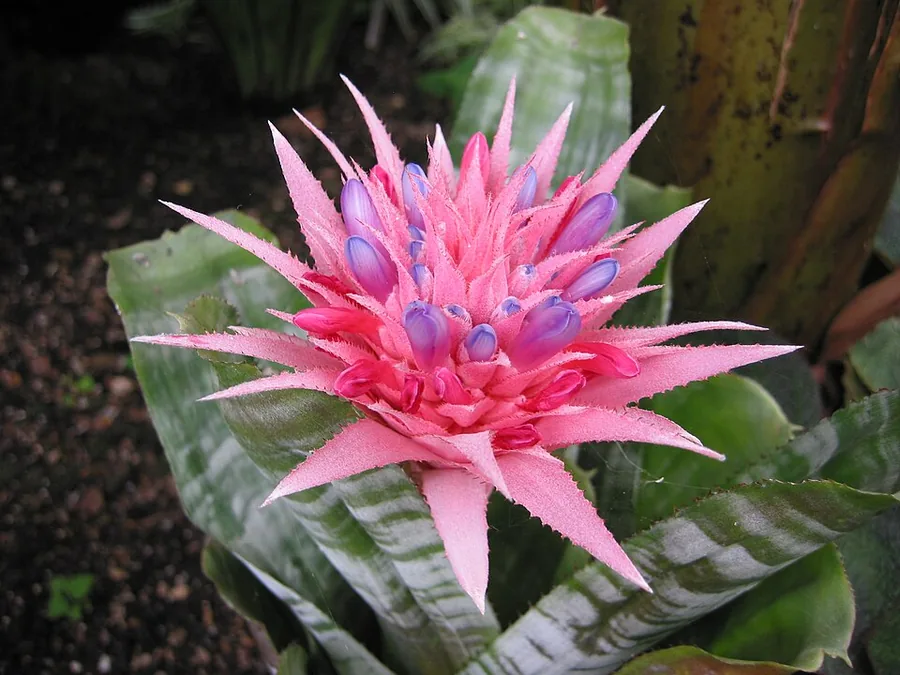
Then comes the flower. From the center of a grown rosette rises a pink bract spangled with violet blooms that ripen toward red, and that crown stays vivid for months on end. It is the payoff for waiting, because a rosette opens this display just once in its whole life before it begins to bow out.
The fading is less an end than a passing of the torch. As the mother weakens, a cluster of pups crowds in around her base, and every one swells into a plant of its own. Keep the light bright and filtered and the cup brimming, and one urn plant will spin out new rosettes for years.
Care
The short version: set it in bright, indirect light, keep the central cup brimming with fresh water, and let the potting mix dry between drinks. Park it somewhere warm and humid, feed at half strength across the growing season, and leave space between its spine-edged leaves and anything that might brush past.
Light
Stand the urn plant in bright, indirect light for the richest leaf color and the best chance at a flower. It scrapes by in partial shade or medium indirect light, yet a shortage of light is the single most common reason a strong rosette never blooms.
Water
Here is the habit that marks a bromeliad apart: brim the central cup with fresh water and keep it that way, while the potting mix is left to dry off in between. Tip it out and refill it from time to time so the pool never turns stale or stockpiles mineral salts. Where your tap runs hard, swap to rain or distilled water, and reckon on wetting the mix about every 7 to 14 days.
Soil
Pot it in a loose, fast-draining bromeliad mix, the acidic bark-based sort packaged for orchids. Its roots cling and anchor more than they drink, so they cannot bear to sit soggy, and an airy mix lets every drop drain straight through.
Temperature
Plain room warmth is all it asks, somewhere from 59°F to 86°F (15°C to 30°C). Hold it above 59°F (15°C) and clear of cold drafts, since a chilly, wet center is exactly what lets rot creep in.
Humidity
It prefers the air on the damp side, roughly 50% to 70% humidity. When a room runs dry, mist the foliage or rest the pot over a pebble tray to raise the moisture around its leaves.
Feeding
Feed it monthly across spring and summer with a balanced liquid fertilizer thinned to half strength or weaker. Water it into the mix or mist it across the leaves, but keep a light hand, because this bromeliad wants far less feeding than most houseplants.
Pruning
When the flower stalk and pink bract turn brown, clip them off, and tidy away any dead or damaged outer leaves. The mother rosette slowly winds down after blooming, so lift it out once the pups stand on their own. Pull on gloves first, since small spines run the length of the leaf margins.
Repotting
Move it up only on occasion, roughly every 2 to 3 years, mostly when you are potting on or splitting off pups. Look for roots poking from the drainage holes, a plant that has tipped top-heavy, or pups jostling for room, then shift it into fresh bromeliad mix.
Size & spacing
Grown indoors, the urn plant climbs to about 12 to 35 inches (30 to 90 cm) tall and fans out 12 to 24 inches (30 to 60 cm) wide. Its pace is slow, so whatever size it is when you buy it stays close to that for a long while.
Troubleshooting
Almost every urn plant problem begins at the cup or down in the roots, then surfaces in the leaves or the core. Train your eye to catch those first marks and you can move in before a minor stumble grows into real harm. Find the picture that matches yours below, then act while there is still time to turn it around.
A mushy, darkened heart that comes loose in the hand
That collapsing core is crown rot, set off by old water left to sour in the cup or by a plant kept cold and damp. Tip out the urn and rinse it clean, shift the rosette to a warmer and brighter spot, and lift out any sturdy pups if the mother has already turned to slush.
Fix:
- Drain and flush the cup, move to a warmer, brighter spot
- Reduce moisture and improve air circulation
- If the mother is collapsing, salvage healthy pups and discard the rotted rosette
A drooping plant whose roots have gone dark and soft
Behind the slump is root rot in waterlogged mix, the result of a medium that holds wet too long or drains at a crawl. Lift it into fresh, open bromeliad mix, snip back the slimy roots, and pour your water into the cup instead of drenching the soil.
Fix:
- Repot into fresh, fast-draining bromeliad mix
- Let the mix dry between waterings
- Trim away rotted roots
Tacky film with white fluff or shell-like lumps on the foliage
Those clues mark scale insects or mealybugs, settled in to feed where the leaves meet and along their hidden undersides. Lift each one off with a cotton swab carrying diluted alcohol, back it up with insecticidal soap, and set the plant apart from its neighbors until no pests remain.
Fix:
- Wipe pests off with a cloth or cotton swab dipped in diluted alcohol
- Treat with insecticidal soap or horticultural oil
- Isolate the plant until clear
A vigorous rosette that holds back its bloom
Usually the holdup is too little light, or simply a rosette that has not filled out yet. Carry it to a brighter window with filtered sun and let a young plant grow on, because each rosette flowers a single time and only once it reaches full size.
Fix:
- Move to a brighter spot with filtered light
- Allow the rosette to reach full size before expecting bloom
Brittle brown points crisping along the leaf margins
What you are seeing is the mix baked dry while the center cup ran empty, and parched indoor air plus hard tap water push it further. Top the urn back up, soak the mix, and pour rain or distilled water from then on so salt cannot crust at the edges.
Fix:
- Refill the central urn and water the mix
- Raise humidity by misting or using a pebble tray
- Flush the cup and mix with rain or distilled water
Toxicity
Pet owners can relax with this one. The ASPCA marks it non-toxic to cats and dogs, and no chemical poison is on record for the bromeliad. The lone thing to mind is the leaf edge, lined with small spines that can scratch, so stand the plant where pets and young children will not graze against it.
Safe for
People · Cats · Dogs · Horses · Rabbits · Livestock · Birds
Cats Safe
Listed by the ASPCA as non-toxic to cats, so a stolen bite from those arching silver leaves carries no poison.
Dogs Safe
A dog can lounge beside this rosette and even gnaw a leaf with nothing toxic to fear.
Horses Safe
For horses the urn plant holds no poisonous threat.
Rabbits Safe
No toxic danger reaches rabbits from it, though leafy greens belong as only a small slice of their diet.
Livestock Safe
Cattle, goats, and sheep may graze nearby without any risk of poisoning.
Birds Safe
Both pet birds and backyard poultry stay safe sharing space with it.
People Safe
Holding no toxins, the plant poses no poisoning hazard to children or inquisitive toddlers.
Leaf margins bear small spines/teeth that can scratch or prick skin, so handle the plant with care (gloves help). Any mild irritation from chewing would be physical/mechanical, not from toxins.
Varieties
A handful of named forms of Aechmea fasciata exist, each playing its own variation on leaf color or flower. The ones below are the likeliest to turn up in shops.
Aechmea fasciata var. purpurea
A purplish-red wash colors its foliage, deepening most across the leaf undersides.
'Primera'
A sturdy commercial form known for broad silver-banded leaves topped by an outsized pink flower head.
'Morgana'
A small, tidy selection valued for the deep rose-pink of its bracts.
How to propagate
After it flowers, the urn plant makes copies of itself at no cost through the pups it raises. No seed trays, no rooting powder to mess with, only a little patience and good timing.
Offsets & pupsEasy
After the mother rosette flowers and begins to decline, once pups reach about one-third to one-half the parent's size (roughly 6 in / 15 cm tall) · Several weeks to a few months to root and establish
Once the mother has flowered and begins to soften and decline, small offsets, the pups, push up around her base, and they are how the plant carries itself forward. Hold off until a pup grows to about a third or half the parent's size, near 6 inches (15 cm) tall, then ease it away with a cut or a twist and a few clinging roots. Set it into fresh bromeliad mix, hold it warm and bright with its cup kept full, and allow several weeks to a few months for it to root and find its feet.
Myths
The urn plant is poisonous to cats and dogs.
Aechmea fasciata sits on the ASPCA non-toxic list for cats and for dogs alike. The single risk worth noting is a scrape from those spine-edged leaves, never a poison hidden inside the tissue. No part of this bromeliad can poison a pet.
You should water only the soil and keep the central cup empty.
That hollow cup is the plant's own drinking vessel in the wild, and it likes to brim. Pour fresh water straight into the central urn and let the mix dry off between rounds. The cup stays full while the soil goes dry.
The whole plant dies right after it flowers, so it is a throwaway.
Only the rosette that flowered fades, and it does so unhurried over a long stretch. While it declines it throws up offsets, the small pups ringing its base, and each of those becomes a fresh plant. A single bloom leaves you the next generation.