Houseplant · Bromeliaceae
Blushing Bromeliad
Neoregelia carolinae
Keep its central cup full and give it bright, indirect light, and the blushing bromeliad flushes red at its heart with almost no fuss.
Bright indirect
Every 7–14 days
50–90°F · 10–32°C
USDA 10–11
Overview
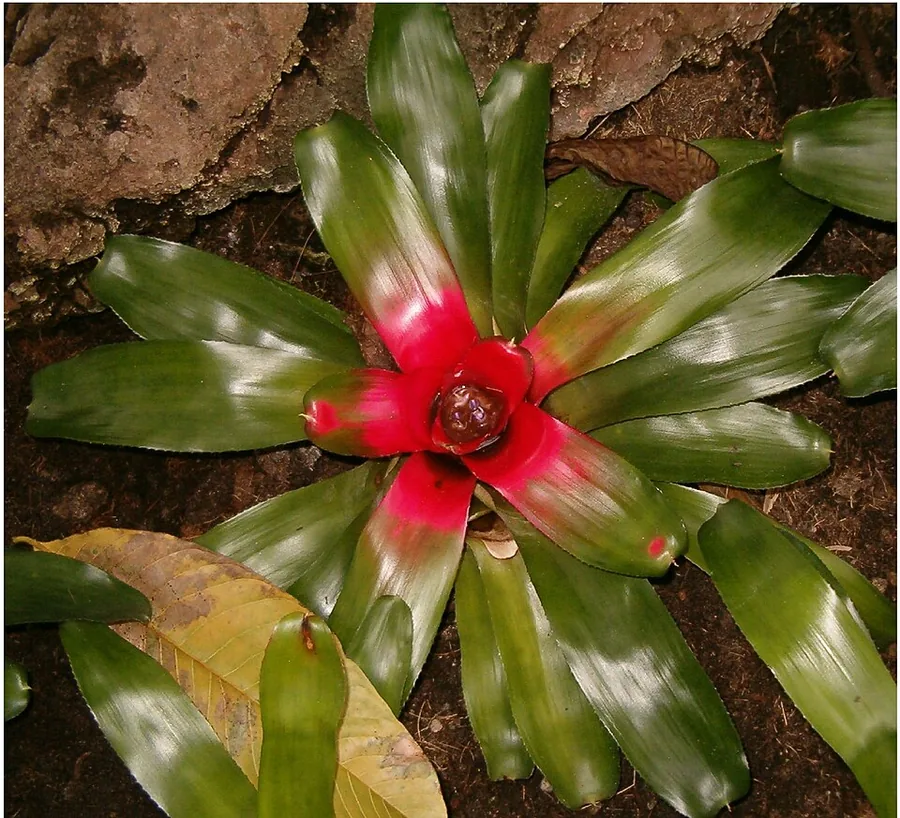
Neoregelia grows as a low, flat rosette of broad, strap-shaped leaves, each one thick and smooth with a glossy, almost polished surface. The leaves arch out from a tight center and overlap at the base to form a watertight cup. Their edges can carry a fine line of small teeth, and each blade tapers to a firm, pointed tip.
As the plant matures, the innermost leaves stop being plain green and flush bright red or pink, painting a vivid disc at the very heart of the rosette. Down in the central cup, small flowers open low and half-hidden among the colored leaves. This inner blush can hold its color for months, glowing against the darker green of the outer leaves.
In the wild it clings to tree branches as an epiphyte, its short roots gripping bark rather than digging into soil. Those roots stay thin and few, working more as anchors than as feeders, while the leaves and the cup take in water and nutrients. Each rosette blooms a single time and then slowly softens and pales, though a ring of small pups rises around its base to take its place.
Care
The short version: bright but indirect light, the central cup brimming with clear fresh water, and a coarse bark medium that goes just barely dry between soakings, all held in warm, humid air.
Light
In bright, indirect light the rosette stays low and tight and the center burns its deepest red. It takes partial shade or soft morning sun on the leaves, but harsh midday rays scorch the glossy blades, while too little light draws the leaves out long and thin and washes the blush back to green.
Water
Everything centers on the central cup, the watertight tank where the leaf bases overlap. It stays filled with fresh water, ideally rainwater or distilled, and is flushed weekly so the pool never clouds or stagnates. The bark mix around the roots dries slightly between waterings, every 7 to 14 days, since the thin roots rot in soggy media.
Soil
The roots sit in a loose, fast-draining epiphyte mix, such as equal parts peat, bark, and coarse sand, or an orchid bark medium. A slightly acidic pH of 5.0 to 6.5 suits them, and the coarse, chunky texture lets water drain fast past the shallow, thread-like roots.
Temperature
It is at ease in ordinary room warmth, roughly 50°F to 90°F (10°C to 32°C). A hard chill blackens the tender leaf bases, so cold drafts and frosty winter glass are best kept away from it.
Humidity
The thin-tissued leaves prefer humid air, around 50% to 70%, and drier rooms leave their tips crisping brown. Grouping it with other plants, standing it over a humidity tray, or running a humidifier keeps the moisture up.
Feeding
It feeds lightly from spring through summer while it grows, about once a month. A dilute balanced liquid fertilizer at quarter to half strength goes onto the mix or is misted over the leaves, and feed is kept out of the cup, where it settles and clouds the water.
Pruning
There is little to trim. Spent flowers and browned outer leaves are pulled away to keep the rosette clean. Since each rosette flowers only once and then slowly softens and pales, the dying mother plant is cut out once the pups have firmed up.
Repotting
The small, shallow root system rarely fills a pot, so repotting is uncommon. It moves on only when the pups crowd the pot or the top-heavy rosette tips its container, into a slightly larger pot with fresh bark mix.
Size & spacing
It stays low and compact, about 6 to 12 inches (15 to 30 cm) tall with a flat, spreading rosette 12 to 20 inches (30 to 50 cm) across. That wide, dish-shaped spread of leaves sits neatly on a shelf or tabletop.
Troubleshooting
Most trouble with this bromeliad shows up first on the leaves or at the base, and it traces back to water or light. A soggy mix softens the base to a pulp, harsh sun bleaches the glossy blades, and too little light drains the red from its center. Match what you see to the pictures below and adjust before it spreads.
A slimy, softened base and a slumping rosette
When the base goes soft and pulpy and the whole rosette sags outward, that is crown or root rot taking hold from a mix left soggy or cup water gone foul. Watering the mix stops until it dries, and the central cup is emptied and refilled with clean water. Where the rot stays down in the roots, a repot into a loose, fast-draining bark mix can bring the plant back to firm, upright leaves.
Fix:
- Stop watering the mix and let it dry
- Empty and flush the central cup with fresh water
- Repot into a loose, fast-draining bark mix if rot is limited to roots
Threadlike larvae twisting through the cupped water
Thin, dark larvae twisting through the water pooled in the tank are mosquitoes that bred there once it sat still too long. A flush of fresh water pushes them up and out of the cup. For a case that keeps coming back, a scatter of Bacillus thuringiensis israelensis (Bti) granules goes into the water, and steady flushing keeps it fresh so it never settles into a still, breeding pool.
Fix:
- Flush the cup with fresh water to dislodge larvae
- Apply Bacillus thuringiensis israelensis (Bti) granules to the cup for larval control
A glossy sticky film, cottony puffs, and beaded bumps studding the leaves
A tacky film on the leaves, tufts of white cotton in the leaf joints, or small raised bumps along the surface are mealybugs, scale, or spider mites, which read as cottony masses, hard brown bumps, or fine webbing and pale stippling. A cloth or cotton swab lifts them off the glossy blades, and insecticidal soap or horticultural oil finishes them. The plant stands apart from the others until the leaves come clean.
Fix:
- Wipe pests off with a cloth or cotton swab
- Treat with insecticidal soap or horticultural oil
- Isolate the plant until the infestation clears
Bleached or brown patches on the leaves
Dry, bleached-out patches and brown, papery blotches across the broad leaf surface are sun scorch from light hitting the foliage too hard and direct. Moving the plant into bright indirect light or partial shade halts the damage, and the crispest burned tips can be trimmed off. Harsh midday sun is what marks the glossy leaves this way.
Fix:
- Move to bright indirect light or partial shade
- Trim badly burned leaf tips if desired
Loose, drooping blades and a bleached crimson center
Leaves that grow long, thin, and loose while the heart of the rosette stays plain green rather than flushing are showing too little light. A brighter position with more indirect light draws the plant back into shape. Under good light the leaves firm up close and tight and the central blush colors in deep again.
Fix:
- Move to a brighter spot with more indirect light
Toxicity
For a home with pets, this is a non-toxic plant. The ASPCA lists the blushing bromeliad as safe for cats and dogs, and NC State Extension adds horses. The pointed leaf tips are stiff and the cup water is worth keeping fresh, but nothing in the plant is poisonous.
Safe for
People · Cats · Dogs · Horses · Rabbits · Livestock · Birds
Cats None
The ASPCA lists this bromeliad as safe for cats, so a nibble at a glossy leaf blade does no harm. A pet that eats a large amount of any houseplant may still have a brief stomach upset.
Dogs None
Dogs meet no toxic compounds in the broad leaves or the cup water. The leaf edges are firm and a little stiff, so a determined chewer is worth watching.
Horses Safe
NC State Extension lists it as non-toxic to horses, and it carries no poisoning risk in a barn or paddock.
Rabbits Safe
No known toxin in these thick leaves would harm a rabbit. It is not a forage plant, though, so it does not belong in their diet.
Livestock Safe
Cattle, goats, and sheep face no poisoning risk from this plant.
Birds Safe
The foliage holds nothing toxic to pet birds. The water pooled in the central cup is the one thing to keep clean and fresh.
People Safe
It is safe around children and safe to handle bare-handed. It is not grown to eat, and the stiff, pointed leaf tips are the only thing to note.
No special handling precautions for pets; the plant is non-toxic.
Varieties
A few Neoregelia forms turn up most often, told apart by the streaks, bands, and tips that mark their leaves. These are the ones worth knowing by name.
Neoregelia carolinae 'Tricolor'
Long stripes of green, cream, and pink run the length of each leaf, and the tight center flushes bright red as the plant comes into bloom.
Neoregelia carolinae 'Blushing Bromeliad'
The classic form, named for the inner leaves that flood with bright red and pink right before the flowers open.
Neoregelia spectabilis (Fingernail Plant)
A single bright red spot caps the end of each leaf like a painted fingernail, and felty silver bands stripe the underside.
How to propagate
Neoregelia makes its own copies as small pups, so growing more is mostly a matter of waiting for those offsets to swell and potting them up.
Offsets & pupsEasy
After the mother rosette flowers and the pups reach about one-third the size of the parent · Several weeks to a few months
Once the mother rosette has flowered and begun to fade, small pups push up in a ring around its base, each a tight little rosette in miniature. A pup is twisted free once it swells to about a third of the parent's size, then set into a loose, fast-draining bark mix. Over several weeks to a few months it roots down and firms up into its own plant.
Myths
Bromeliads sink into their host trees and feed on them as parasites.
Neoregelia are epiphytes, not parasites. A branch is only a foothold, and water and nutrients soak in through the leaves and the cup at the center. They pull nothing from the host and never harm it.
The water pooled in the cup can remain untouched indefinitely.
Sitting untouched, the water in the cup turns cloudy and stagnant and can breed mosquitoes, more so outdoors. A regular flush of fresh water keeps the cup clear, and Bti granules go in if larvae show.