Ornamental · Paeoniaceae
Peony
Paeonia lactiflora
Set the pink eyes shallow in full sun, leave them be, and a peony will outlast the gardener who planted it.
Full sun
Every 7–10 days
USDA 3–8
1–3 ft · 0.3–0.9 m
Overview
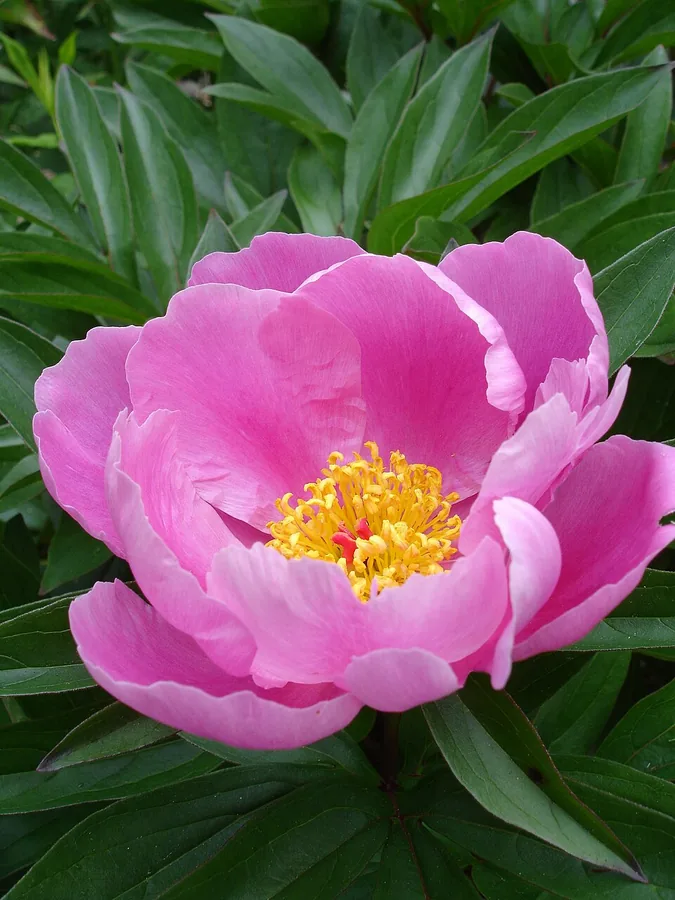
A peony rises each spring as reddish shoots that unfold into clean green, deeply cut leaves on upright stems, a herbaceous perennial that dies back to the ground each winter. In late spring the stems carry big, full flowers, rounded and heavy with petals, in soft pinks and clear whites, and many of them give off a real fragrance up close. A well-sited clump holds this same form year after year and outlasts the person who planted it.
The plant grows from thick, fleshy roots crowned with plump pink buds called eyes, and how deep those eyes sit decides everything. Buried too far down they stay closed and flowerless for years, but set near the surface, in full sun and soil that drains, they push up strong stems and full blooms. A peony sends its roots down and holds fast, so it resents being lifted and moved once it has settled.
This is a cold-hardy plant that wants a real winter freeze to set its round flower buds, which is why it thrives across USDA zones 3 to 8 and stalls where winters stay mild. The clump fills out slowly, one thick stem at a time, and the first full flowers can take a few years. Once the crown is established, though, few plants come back so faithfully for so many decades.
Care
The short version: a peony wants full sun, its pink eyes set only 1 to 2 inches deep in rich, free-draining soil, a deep drink about once a week through the growing season, and low nitrogen so the stems carry full flowers rather than a mass of leaves.
Light
A peony given full sun, at least 6 hours of direct light a day, carries strong stems, full flowers, and clean foliage that shrugs off most disease. It gets by in partial shade, but starved of light the stems run leafy and the round buds stall, one of the main reasons a healthy-looking plant never opens a flower.
Water
A peony takes a deep drink about once a week through the growing season, and the soil surface dries before the next. The fleshy roots rot in soggy ground, so drainage counts as much as the water. Water beading on the leaves feeds blight, so it goes to the base of the stems instead.
Soil
A peony sinks its thick roots into rich, well-drained soil loaded with organic matter. A pH between 6.0 and 7.0 suits it. The one thing it will not stand is a wet, poorly drained spot where those roots sit in water and turn soft.
Humidity
Ordinary outdoor air suits a peony, so there is no number to chase. Moving air matters far more, because still, damp air pooling among crowded leaves is what lets the gray fuzz of botrytis and the white film of powdery mildew settle on the plant.
Feeding
A peony takes a low-nitrogen balanced fertilizer in spring, in a light dose. Too much nitrogen throws the plant into lush green leaves at the cost of the round flower buds, the opposite of what the stems should be carrying.
Pruning
The stems cut clean to the ground in fall, and clearing that dead top is the single best move against the botrytis blight that overwinters on it. Spent, browning flowers come off through the season so the plant stays clean-looking.
Size & spacing
A mature peony forms a rounded clump 1 to 3 feet (30 to 91 cm) tall and about as wide. Each plant takes 1 to 3 feet (30 to 91 cm) of room so air moves through the leaves and the foliage dries fast enough to hold disease down.
When to plant
A peony works on a fall clock, when the top has died back and the thick roots sit dormant. The roots go in or divide in September or October so they knit into the soil before it freezes, then the round buds swell and split into full flowers from late spring into early summer, each plant flowering for about 2 weeks.
Northern hemisphere
Southern hemisphere
Typical months for a temperate climate: start earlier in warm zones, later where spring frosts linger.
- Sow: Not typically started indoors; propagated by division of dormant roots.
- Plant: Plant or divide roots in September to October so plants establish before winter.
- Harvest: Blooms late spring to early summer (May to early June); individual plants flower for about 2 weeks.
Hardiness
USDA hardiness zones: 3–8
Temperature: down to -40°C
Troubleshooting
Most of what goes wrong with a peony writes itself on the plant, either buried eyes that never send up buds or a damp, crowded clump where mold takes hold. A close look at the fat flower buds and the lower leaves usually names the cause before a season of bloom is lost. Match what shows on the plant below.
Black shoots and brown buds under a gray fuzz
In cool, wet weather botrytis blight blackens the young shoots at the base and browns the round flower buds so they never split open, and a soft gray fuzz of mold spreads over the rotting tissue. The browned buds and blackened stems come off the moment that fuzz appears. Every stalk cuts to the ground in fall so the fungus keeps no foothold over winter, with space between the clumps and water aimed low at the crown.
Fix:
- Remove and destroy withered buds, spent flowers, and blighted shoots
- Cut stalks to the ground in fall and remove all debris
- Improve air circulation and avoid overhead watering
Full green leaves with the flowers missing
A peony can push up thick, healthy foliage and still show no flowers, and the buried eyes are almost always the reason, since an eye set more than 2 inches down rarely blooms. Shade, a recent division, and a heavy nitrogen feed each add to the shortfall. In fall the crown lifts and the pink eyes reset only 1 to 2 inches beneath the soil, in a place that takes at least 6 hours of sun, with a young or freshly split plant given a few seasons before it flowers.
Fix:
- Replant in fall with buds only 1 to 2 inches below the soil surface
- Move to a site with at least 6 hours of direct sun
- Allow recently divided plants a few years to mature
- Avoid high-nitrogen fertilizers
A white powder dusts the green leaves late on
Late in the year, powdery mildew lays a chalky white film across the green leaf surfaces, thickest where shade and dead air let it settle, through late summer and fall. It seldom kills a peony, but the dusted foliage looks tired and the plant loses vigor as the coating spreads. The worst-coated leaves come off in autumn, the clump opens for moving air, and full sun keeps the film from taking hold.
Fix:
- Remove and destroy affected leaves in fall
- Improve spacing and air circulation
- Site plants in full sun
Toxicity
A peony is grown for its heavy, petal-packed flowers, never for eating, and it holds a compound called paeonol that concentrates in the woody roots and bark below the soil. It is only mildly toxic, but a pet or grazing animal that gnaws those roots or the ridged stems can end up with vomiting, diarrhea, and a dull mood. Cats, dogs, horses, and small children stay off the roots and stems.
Toxic to
Cats · Dogs · Horses · Rabbits · Livestock · Birds · People
Cats Mild
A cat that gnaws the woody roots or the ridged stems may drool, vomit, and turn from its food. The paeonol packs into the parts below the soil, so it takes a fair mouthful of that dense root to bring on a real reaction.
Dogs Mild
A dog that unearths the thick roots or chews the stems can show vomiting, loose stools, and a flat, low mood. Small nibbles of the leafy top pass without much fuss, since the toxin sits in the woody underground parts.
Horses Mild
A horse that reaches the roots can develop an upset stomach and diarrhea, often with a dull, listless look. The paeonol concentrates in the hard, woody root, so a large mouthful is what sets it off.
Rabbits Caution
The paeonol packed into those woody roots and stems makes peony a poor choice around rabbits, whose stomachs cannot empty an irritant. The roots and stems stay well out of a rabbit's reach.
Livestock Caution
Cattle, goats, and sheep seldom crop peony, yet the dense roots hold enough paeonol to upset a grazing animal that does chew them. A fence keeps the woody crown apart from pasture.
Birds Caution
Little is recorded about birds and peony, and the paeonol in the plant gives no reason to assume the roots or stems are safe. Curious pet birds stay away from it.
People Caution
No part of a peony is food, and the woody roots in particular can bring on nausea and stomach upset if chewed or swallowed. It is grown for the flowers, and small children stay off the stems and roots.
Keep pets from chewing roots and stems; gastrointestinal upset is most likely with large ingestions.
Helpline numbers

United States
ASPCA Animal Poison Control: (888) 426-4435 (fee applies)
Poison Control: (800) 222-1222



Canada
Poison Centres: 1-844-764-7669
Varieties
Peony cultivars number in the thousands, and they split apart most in the shape and color of the flower. A few old favorites are worth knowing by name.
Sarah Bernhardt
A late double packed with soft pink petals, it carries a real fragrance and opens after most peonies have finished.
Do Tell
A Japanese form built from a ring of broad, pale pink guard petals around a dense, ruffled center of deep rose-pink.
Festiva Maxima
An old double heaped with fragrant white petals, streaked here and there with a fleck of crimson deep at the center.
How to propagate
A peony is slow to share, but the method reads plainly off the plant: the dormant clump lifts to show its eyes, splits, and the eyes reset shallow.
DivisionModerate
September to October while dormant · Several years to reach full bloom after dividing
In September or October, while the peony sits dormant, the whole clump lifts to show a mass of thick, fleshy roots studded with the plump pink eyes. A clean cut splits it so each piece keeps 3 to 5 of those eyes on a firm length of root, and the eyes reset only 1 to 2 inches deep. The fresh divisions spend the next few years thickening their roots before they carry full bloom, so they settle in undisturbed.
Myths
Peony buds cannot open unless ants crawl over them.
The ants track across the round, sticky buds for the sweet nectar beading on their surface, and that is all they take. The tight buds swell and split into full flowers on their own, and the ants leave the petals unmarked as they feed. A peony bud opens on its own, ants or not.