Tree · Oleaceae
Olive
Olea europaea
Give it full sun, lean soil, and a dry root run, and the olive thrives for generations.
Full sun
Every 14–30 days
USDA 8–11
20–49 ft · 6–15 m
Overview
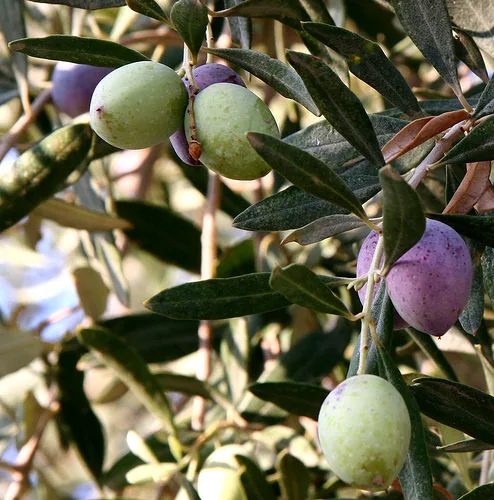
The olive is a slow-growing evergreen that holds its leaves through the year and settles into the hot, dry country of the Mediterranean, where few other trees fruit. Centuries of slow growth thicken and gnarl its wood, and a single tree can stand for hundreds of years. Its evergreen, long-standing frame is what the eye returns to first.
Along the twigs and branches sit the small evergreen leaves, and after the late-spring bloom the tree sets its fruit, each olive built around a hard, stony pit at its core. The crop ripens through fall, but straight off the branch the flesh is harsh, and the wood itself grows dense and slow on the poor, rocky ground the tree favors.
Look closely at what the fruit becomes and one detail stands out. Raw, the olive is too bitter to eat and must be cured before the flesh turns good, a change worked on the fruit rather than seen on the branch. The tree needs a touch of winter chill to flower well, so its blooms belong to warm-temperate gardens rather than the tropics.
Care
The short version: full sun, sharp drainage, and lean soil, with deep but infrequent watering once the tree is established. Skip the rich feeding and the standing water, and prune in late winter to keep the branching canopy open.
Light
The olive is a sun lover and wants full sun all day to load its branches with fruit. It will take a little partial sun, but shade draws the growth out lanky and thin, with only a sparse crop, so the brightest spot brings out its fullest, evergreen canopy.
Water
Once its roots run deep, the olive is genuinely drought tolerant and prefers a deep soak every 14 to 30 days to constant sips. The soil dries right out between waterings. Soggy, waterlogged ground around the roots is what rots the wood of a tree that could otherwise stand for centuries.
Soil
Drainage matters far more to the olive than richness. It sinks its roots into well-drained sandy loam and takes the poor, rocky, and chalky ground of its homeland across a wide pH of 6.0 to 8.5. Only heavy soil that holds water tight around the roots turns it against thriving.
Temperature
The olive stands up to real heat, to about 100°F (38°C), its leaves holding through a dry Mediterranean summer. Its wood is tender to cold, taking only brief dips to around 19°F (-7°C) before it is damaged, so it belongs where winters stay mild.
Humidity
Dry air suits the olive, and its foliage stays cleanest in low humidity around 20% to 50%. Damp, still air settles into the leaves and invites the sooty fungal spots, so open airflow does more for the canopy than any moisture around it.
Feeding
The olive is a light feeder whose lean growth suits the thin ground it comes from. One balanced, nitrogen-rich feed in spring is all its slow frame asks for the year. More than that forces soft, leafy shoots instead of fruit.
Pruning
Prune in late winter to early spring, thinning the branches into a loose, open vase so light and air pour into the center of the crown. Out come the suckers, the dead wood, and the crossing limbs. An open frame both fruits better and dries fast, denying the fungal spots the still, shaded air they need.
Repotting
A container olive needs fresh root room every 2 to 3 years. Roots winding around the pot or pushing out the drainage holes, water sliding straight through, and new shoots that stall all mark a tree that has filled its container.
Size & spacing
Left to grow, the olive rises to 20 to 50 feet (6 to 15 m) with a broad, spreading crown of evergreen branches. Give it room to match, around 15 to 30 feet (4.5 to 9 m) of clearance, since this slow, long-lived frame widens for decades.
When to plant
The olive keeps a slow Mediterranean rhythm you can read on the tree itself. Set young ones out in spring once frost has passed and the soil has warmed, watch the small flowers open in late spring, and gather the ripening fruit through fall, from September into November.
Northern hemisphere
Southern hemisphere
Typical months for a temperate climate: start earlier in warm zones, later where spring frosts linger.
- Plant: spring after the last frost once soil has warmed
- Harvest: blooms late spring; fruit harvested fall (September to November)
Hardiness
USDA hardiness zones: 8–11
Temperature: down to -12°C
Troubleshooting
Most olive trouble shows up on the wood and the leaves after wet weather and wounds, whether it is a rough gall on a branch or a dark spot mottling the foliage. Catch the early marks and a dry-season pruning often settles things. Match what you see below, then act before it spreads through the canopy.
Dull, browning leaves on one wilting flank
Leaves that turn dull and brown while a whole limb droops on one side reveal verticillium wilt, a soilborne fungus. It invades the wood's water channels, and a wilting branch cut open shows the vascular tissue stained dark within. Nothing cures it, so the dead wood is removed, watering is held back, and olives are never replanted where the disease has already struck.
Fix:
- Remove and destroy dead wood
- Avoid overwatering
- Do not replant olives where the disease is known
Rough woody galls knotting the twigs and branches
The rough, tumor-like lumps swelling along the twigs, branches, and trunk are olive knot, a bacterial disease. It slips in through pruning cuts, frost cracks, and leaf scars, and it spreads worst after wet weather. Cut the knotted wood out on a dry day, working well below each gall, and wipe the tool clean between cuts. A copper spray after pruning or a frost seals the fresh wounds.
Fix:
- Prune out infected wood in dry weather well below the galls
- Disinfect tools between cuts
- Apply a copper bactericide after pruning or frost injury
Small stings and pale maggots inside the fruit
Small puncture marks freckling the skin and cream-colored maggots tunneling the flesh are the mark of the olive fruit fly, its larvae feeding deep inside the developing fruit. Slice a suspect olive and the pale grubs or their exit holes show plainly. Baited traps hang out near harvest, fruit is picked on time, every windfall is cleared, and approved bait sprays or kaolin clay come in only where infestation runs heavy.
Fix:
- Harvest promptly
- Sanitize fallen fruit
- Use approved bait sprays or kaolin clay where infestation is heavy
Dark peacock-eye rings mottling the leaves
Dark, sooty circles ringed by a soft yellow halo, each one like the eye on a peacock's feather, spread across the lower leaves as olive peacock spot, a fungus that takes hold through cool, wet weather before the leaves yellow and fall. Pruning opens the canopy so air moves through the crowded inner branches, and the fallen, spotted leaves are raked away, since the spores overwinter there. A copper fungicide in fall, ahead of the rains, holds it back.
Fix:
- Improve air circulation through pruning
- Apply a copper fungicide in fall before rains
- Rake and remove fallen infected leaves
Toxicity
For a home with animals, the olive tree is non-toxic and safe around pets, livestock, and people, and the fruit is edible once cured. The one real hazard sits at the fruit's center: the hard, stony pit, which can choke a pet or block the gut if swallowed whole, so keep fallen fruit picked up.
Safe for
People · Cats · Dogs · Horses · Rabbits · Livestock · Birds
Cats None
The olive tree itself is safe for cats and carries no toxicity. The single hazard is the small hard pit inside each fruit, which can lodge in the gut if swallowed, so fallen fruit is best swept up.
Dogs None
Dogs face no poisoning from an olive. The stony pit is the real risk, a hard little core that can choke or block the gut if gulped, and the salt-heavy cured olives are best kept away too.
Horses Safe
The olive's foliage is non-toxic to grazing horses. Only the fallen fruit needs minding, since the hard pit at its center is a choking hazard if swallowed.
Rabbits Safe
The plant holds nothing toxic to rabbits. The dense, woody pit is far too large and hard for them to manage, so dropped fruit is best kept clear of the hutch and run.
Livestock Safe
Goats, sheep, and cattle can browse around olives with no poisoning risk. The stony pits are the only concern, since a swallowed one can lodge or choke.
Birds Safe
Olives carry nothing toxic to birds, and wild ones strip the fruit readily. The hard pit is the catch, dense enough to choke a smaller bird that tries to swallow it whole.
People Safe
Cured olives are a safe kitchen staple, while the fruit fresh off the tree is far too bitter for the mouth. The hard pit at the core should not be bitten, and small children should be kept from swallowing one.
The hard fruit pit is a choking and gastrointestinal obstruction hazard if swallowed, and cured table olives are very high in salt, so neither should be offered to pets.
Varieties
Olive cultivars split mainly into those grown for oil and those grown for the table, with a few bred to drop little or no fruit at all. These are the names you will meet most often.
Arbequina
A small, self-fertile Spanish cultivar that bears cold better than most and takes readily to oil pressing or a container.
Mission
A cold-hardy California cultivar whose fruit works two ways, cured for the table or pressed for oil.
Manzanillo
A widely grown table olive with a plump, rounded fruit prized above all for canning.
Frantoio
The classic Italian oil cultivar behind so much rich, fruity olive oil.
Swan Hill
A near-fruitless, low-pollen cultivar planted where dropped fruit and allergens would otherwise be a nuisance.
Companions
How to propagate
Most olives are grown from cuttings or grafts so the young tree keeps the exact character of its parent, since seedlings are slow and rarely true to type.
Stem cuttingsModerate
Late spring to summer · 2 to 3 months to root
A semi-hardwood cutting, its stem firm but not yet fully woody, copies a named olive true to the parent. Taken from late spring through summer and set under mist with bottom heat, the cut base pushes out fresh roots in about 2 to 3 months.
GraftingDemanding
Spring · One growing season
Grafting joins a prized cultivar's shoot to a tough seedling or clonal rootstock, binding the two stems until they grow as one. Worked in spring, the union callouses over and takes hold across a single growing season.
SeedDemanding
Fall · Several years to fruiting
The hard stone at a fruit's core is slow and unpredictable to grow from, and its seedlings stray from the parent cultivar, so seed mainly raises rootstock. Sown in fall, a seed-grown tree waits several years before it carries any fruit.
Myths
Olives can be picked and eaten straight off the tree.
Bite a fresh olive off the branch and the flesh floods the mouth with a harsh bitterness that comes from a compound called oleuropein. Only after the fruit is cured in brine, lye, or salt does that bitterness leach away and the olive turn good to eat.
Olive trees never need cold weather.
The olive is tender to frost, yet it still needs a stretch of winter chill to flower and set fruit reliably. Where the winter stays too warm, the tree stands green and healthy but carries only a scattering of olives.