Shrub · Oleaceae
Privet
Ligustrum vulgare
A dense wall of small oval leaves and white flower spikes that ripen to dark berries, fast to grow but poisonous and quick to escape.
Full sun
Every 7–14 days
USDA 4–8
10–15 ft · 3–4.6 m
Overview
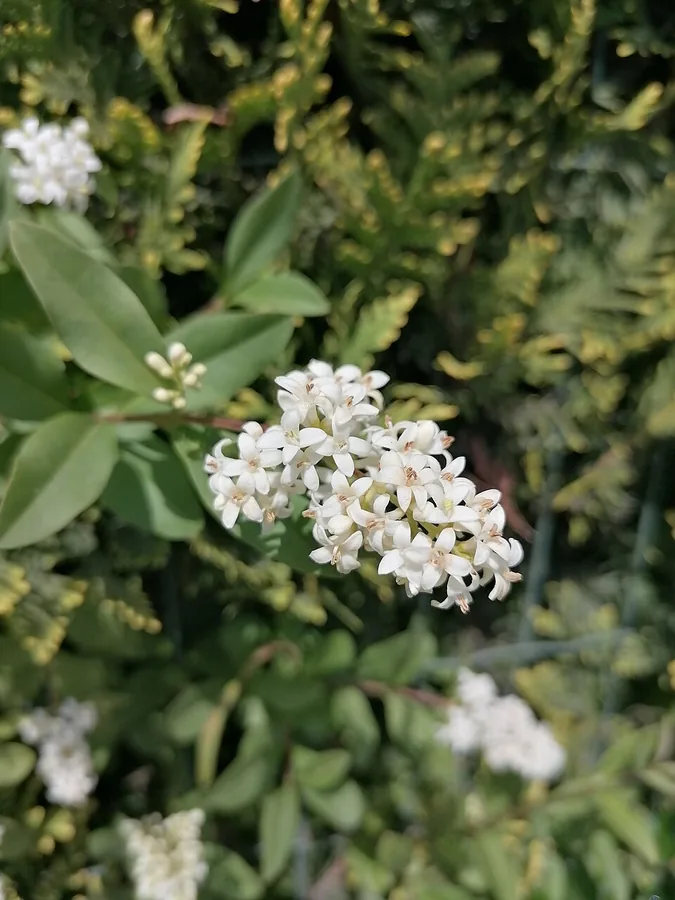
Privet builds itself from small, oval leaves packed close along fast-growing stems, a shrub in the olive family that fills out into a dense, leafy mass. The foliage greens up early and clings on late into the season, and in late spring the branch tips lift spikes of white flowers. As those fade, tight clusters of dark berries form and deepen along the stems, hanging on where the flowers stood.
Behind that leafy face is a plant that will not stay contained. Birds strip the dark berries and drop the hard seed through woods and along field edges, where privet thickens into dense, tangled thickets that close over the ground and shade out native plants. Several species are listed or regulated as invasive, and common privet ranks as a significant threat in some regions.
The same berries that color the stems are dangerous. The leaves and, most of all, the ripe dark fruit are toxic to pets, livestock, and people, so the plant is one to place with care, shear before the berries form, and clear the cuttings away from grazing animals.
Care
The short version: grow privet in full sun to part shade in any well-drained soil, water new shrubs until the roots take and then little more, and shear the leafy growth to shape in late spring once the white flowers fade.
Light
In full sun privet packs its small oval leaves tightest, building a solid, unbroken face of foliage. It still leafs out in partial sun and partial shade, but deep shade stretches the growth thin and opens bare gaps between the stems.
Water
New plantings need steady moisture until their roots grip the soil, and after that the leaves stay firm on moist to occasionally dry soil with little help. Let the top half of the soil dry between waterings, about every 7 to 14 days while the roots spread.
Soil
Privet sinks its roots into clay, loam, or sand alike, provided the water drains away. A pH between 6.0 to 7.5 matches most ordinary ground, so the leafy top rarely wants for anything below it.
Temperature
The foliage holds through hard cold, down to about -29°F (-34°C), and through summer heat that climbs to 100°F (38°C). That span across the thermometer keeps privet green where many shrubs would brown and drop.
Humidity
Ordinary outdoor air keeps the leaves healthy, so there is no level to watch. What the foliage wants is moving air around it, since still, crowded growth traps moisture on the leaves and invites spotting and mildew.
Feeding
The dense leaves usually feed themselves in ordinary soil. Where growth looks thin and pale, a balanced granular fertilizer in spring greens it back up, but a heavy hand only forces soft, sappy shoots that pests settle on.
Pruning
Cut privet hard and it answers with fresh leaves, taking heavy shearing right back to bare wood. Shape the leafy sides in late spring once the white flowers brown, or clip through the season, and cutting before the berries form keeps the dark seed off the stems.
Repotting
Privet rarely sits in a pot, so repotting seldom comes up. In a container, the sign to size up is roots circling the walls or creeping out the drainage holes while water slips straight through the tired soil.
Size & spacing
Unsheared, the leafy stems climb to 10 to 15 feet (3 to 4.5 m) and fan out 8 to 15 feet (2.4 to 4.5 m) across. Set for a hedge, the plants stand closer than that full spread so their foliage knits into one green face.
When to plant
Privet marks the season by its own growth. New plants settle in during spring or fall, the white flowers open around June, and once those spikes brown and drop, the shrub is ready for its shaping cut, best made before the dark berries set.
Northern hemisphere
Southern hemisphere
Typical months for a temperate climate: start earlier in warm zones, later where spring frosts linger.
- Plant: Spring or fall
- Harvest: White flowers in late spring to early summer (around June)
Hardiness
USDA hardiness zones: 4–8
Temperature: down to -34°C
Troubleshooting
Most of privet's troubles show first on the leaves, and the plant is tough enough that they rarely run deep. Look for chewed or spotted foliage and small sap-feeding insects clinging to the stems, with root rot in wet ground the one hidden problem that reaches the whole shrub. Match the look of the damage below and act early.
Limp, yellowing leaves over waterlogged roots
When the leaves go limp and yellow on a normally solid privet, the trouble sits underground as root rot in soil that stays wet. Lift the base and the roots come up dark, soft, and slippery, breaking apart in the sodden earth. Dry the site out and cut back the watering, though a shrub rotted this far seldom regreens and is best pulled and replaced on drier ground.
Fix:
- Improve drainage and stop overwatering
- Remove severely affected plants
- Replant in well-drained soil
Dark leaf spots, dying twigs, and sunken bark
Dark blotches on the leaves, browning twigs, and sunken, cracked patches on the stems read as anthracnose or twig blight, while a fine white powder dusted over the foliage is powdery mildew. Cut the marked wood out and burn it, then thin the crowded stems so light and air reach in. Water at the roots, not the leaves, and clear the fallen foliage where the spores overwinter.
Fix:
- Prune out and destroy infected twigs and branches
- Improve air circulation by thinning the canopy
- Avoid overhead watering and clean up fallen leaves
Cottony white specks and a sticky shine on the leaves
A dusting of cottony white insects and a wet, sticky shine on the foliage point to whiteflies or white peach scale drawing sap from the leaves. A hard jet of water knocks the pale whiteflies loose, and horticultural oil or insecticidal soap brushed over the leaf undersides smothers the rest. Keep on until the sticky honeydew and the sooty black film it feeds dry up and flake away.
Fix:
- Spray foliage with a strong jet of water to dislodge whiteflies
- Apply horticultural oil or insecticidal soap, coating undersides of leaves
- Repeat applications per label until populations decline
Scalloped bites along the leaf edges
Smooth, scalloped notches bitten into the leaf margins are the mark of a weevil, the ligustrum or Japanese kind, chewing the edges by night while pale larvae rasp at the roots. Shake the dark adults onto a cloth at first light, and reach for a labeled insecticide only when the notching spreads across the foliage. A vigorous, well-watered plant carries the ragged edges without weakening.
Fix:
- Handpick or shake adults onto a cloth in early morning
- Apply a labeled insecticide if damage is heavy
- Maintain plant vigor with proper watering
Toxicity
Every part of privet carries poison, and the ripe dark berries hold the most. Leaf and fruit alike contain cardiac glycosides, saponins, and protoanemonin, and swallowing the berries brings vomiting and diarrhea, with incoordination and heart effects after a larger dose. A big feed can be fatal to horses and other livestock, so keep the fruit and the leafy prunings away from animals and small children.
Toxic to
Cats · Dogs · Horses · Rabbits · Livestock · Birds · People
Cats Mild
A cat that mouths the leaves or the dark berries usually drools, turns from its food, and sinks into an upset, loose stomach. The signs stay mild in most cases, though the ripe berries pack the heaviest dose of toxin and pull curious cats in first.
Dogs Mild
Dogs drool, cramp in the belly, and pass loose stools, and often droop and dull once the upset sets in. A muzzle full of dropped berries or a mouthful of fresh clippings is the usual way in.
Horses Severe
Privet strikes horses hard. Colic grips the gut, drool runs, and the animal turns dull and unsteady on its feet, and a large feed of leaves or dark berries can kill outright. Treat the first signs as an emergency.
Rabbits Toxic
The same glycosides that fell larger animals leave privet unsafe for rabbits, souring the gut and draining their energy. The leaves and berries are never fit to offer, not even a shred.
Livestock Severe
Cattle, goats, and sheep double up with gut pain and colic after grazing the foliage and fruit, and a heavier feed turns deadly. Keep privet clear of pasture and bag the clippings rather than dropping them where stock can reach.
Birds Toxic
Wild birds gulp the dark berries whole and pass the hard seed clean through, the very trick that scatters privet so far, yet the leaves and fruit are no food for a caged bird. Keep pet birds well away from any trimmings.
People Caution
No part of privet belongs in the mouth. The dark berries carry the sharpest risk, bringing vomiting and diarrhea, and after a larger dose, unsteadiness and effects on the heart. Keep the fruit out of reach of small children.
Keep berries and prunings away from pets and grazing animals; clip flower panicles before berries form to limit fruit on the plant.
Helpline numbers

United States
ASPCA Animal Poison Control: (888) 426-4435 (fee applies)
Poison Control: (800) 222-1222



Canada
Poison Centres: 1-844-764-7669
Varieties
Privet spans a group of close relatives, and they part ways most clearly in their leaves: some small and semi-evergreen, some large and glossy, one washed in gold, and each carrying its own reputation for spreading.
Ligustrum sinense (Chinese privet)
A semi-evergreen privet whose small leaves cling through much of the year, now highly invasive across the eastern and southern US and knotting into dense thickets from bird-sown seed.
Ligustrum japonicum (Japanese / wax-leaf privet)
A warm-climate privet set apart by large, thick, glossy evergreen leaves, its shine giving it the wax-leaf name, and it too has escaped into the wild across parts of the southern US.
Ligustrum lucidum (glossy privet)
A tree-sized glossy-leaved privet, listed as a noxious weed in California and naturalized through much of the South.
Ligustrum × vicaryi (golden privet)
A privet grown for foliage washed in bright golden-yellow, a color that burns brightest in full sun.
How to propagate
Privet roots itself almost anywhere its stems can reach, from cut pieces, from the seed inside its dark berries, and from low branches that touch down, which is why its leafy growth keeps appearing well past where it was planted.
Stem cuttingsEasy
Softwood cuttings in late spring/early summer or hardwood cuttings in late fall to winter · 4 to 8 weeks to root
A cut length of privet stem pushes roots almost on its own. Soft green tips taken in late spring or early summer, or firm bare wood from late fall into winter, sit in soil and root within 4 to 8 weeks. That readiness to root from a bare stem is much of how the plant spreads so far.
SeedEasy
From ripe black berries in fall · Germinates readily; seed is abundantly bird-dispersed
Split a ripe dark berry in fall and the seed inside sprouts with ease. Privet self-sows in drifts, and birds carry that seed far from the parent, the main engine of its invasiveness. Snipping the white flower spikes before they set fruit is the surest way to keep new seedlings from crowding in.
LayeringEasy
Spring through summer · Several weeks to months
A low branch left against the soil roots along its underside, taking several weeks to a few months to anchor. Fresh shoots also push up from the roots as suckers, so a single shrub slowly widens its leafy footprint on its own.
Myths
Privet is a harmless ornamental hedge you can plant anywhere.
Those tidy leafy walls do not stay put. Birds carry the seed from the dark berries deep into woods and field edges, where privet knots into dense thickets that bury native growth, and several species are listed or regulated as noxious weeds. Check local rules before planting, and look hard at a native hedge instead.
Privet berries must be safe because the birds eat them.
Watching birds strip the dark fruit says nothing about the danger it holds. Birds pass the seed unharmed and sow it everywhere, yet the berries and leaves are toxic to pets and livestock, packed with cardiac glycosides, saponins, and protoanemonin that birds alone shrug off.