Herb · Lamiaceae
Rosemary
Salvia rosmarinus
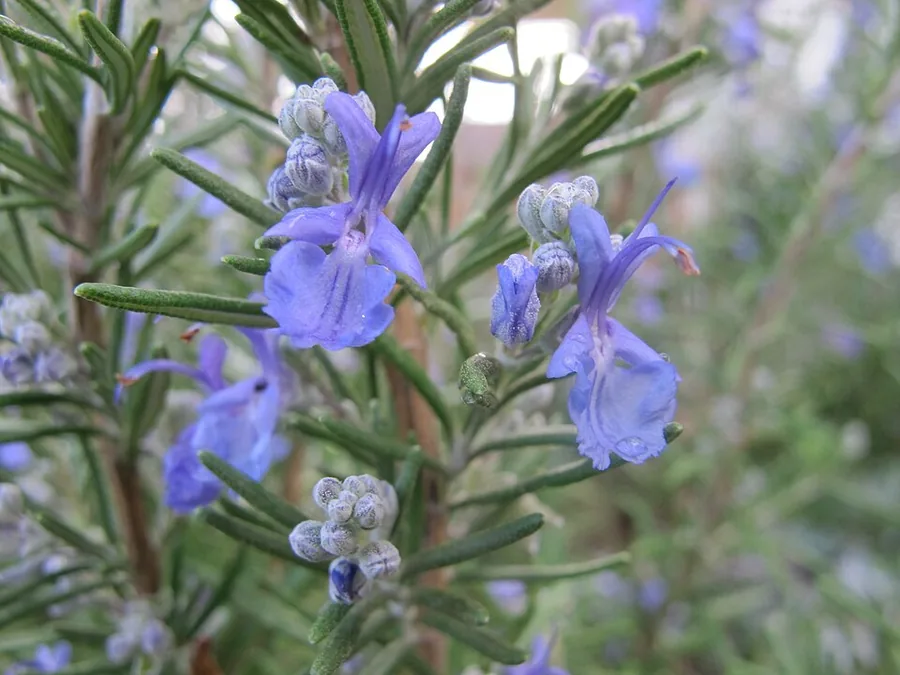
Narrow, needle-like leaves crowd its woody stems, and small blue flowers break out along them from late winter into spring.
Full sun
Every 7–14 days
USDA 7–11
2–6 ft · 0.6–1.8 m
Overview
Rosemary is a woody evergreen herb, and up close its character sits in the narrow, needle-like leaves that crowd its stems. The foliage stays green through the year and carries the pungent, aromatic scent that marks the plant out. It comes from the dry Mediterranean and belongs to the mint family, though its leaves are far finer and firmer than a mint's.
With age the plant builds gnarled, woody stems that stiffen into a low shrub. Small blue flowers, and sometimes pink or white ones, open in loose rows along the stems from late winter into spring. As a perennial, it holds this woody framework and its evergreen foliage year after year.
Run a hand along a stem and the leaves release their sharp, resinous scent, the same pungent, aromatic oil that flavors the kitchen. Each leaf is short, firm, and needle-thin, set densely enough to give the whole plant a bristled, fine-textured look. The wood beneath the green is what carries the plant from one year to the next.
Care
The short version: rosemary shows its Mediterranean character in narrow, needle-like leaves and woody stems, and it wants full sun and sharp-draining soil. Water it only after the soil has dried well down, feed it lightly, keep the air moving, and hold it on the dry side year-round.
Light
Rosemary wants full sun, 6 to 8 hours a day, and the light shows in the plant: dense, tight foliage and firm stems. In part shade the leaves thin out, the stems stretch pale and leggy, and the scent weakens. Indoors, the brightest window keeps the growth compact.
Water
Watering is where the plant most often fails. Let the top half of the soil dry out before watering again, roughly every 7 to 14 days, easing off further once it is established. Kept too wet, the needle-like leaves lose their firmness and the whole plant slumps.
Soil
Rosemary roots best in light, sandy, sharply drained soil that mirrors its rocky homeland. It tolerates poor, stony ground but rots in heavy clay, so grit or sand mixed in keeps the roots dry. A pH of 6.5 to 7.0, near neutral, suits it.
Temperature
Rosemary holds its evergreen leaves across a wide range, from about 10°F to 86°F (-12°C to 30°C), though cold hardiness varies by cultivar. A hard freeze can brown and kill the foliage of tender types, so cold zones call for a hardy selection or a pot moved indoors.
Humidity
Dry air suits it best, around 30% to 50% humidity, matching its dry-country origins. In damp, stagnant air a chalky powdery mildew can dull the leaf surfaces, so moving air keeps the foliage clean.
Feeding
Rosemary is a light feeder, and its flavor and scent are strongest when it is kept lean. One modest feeding of balanced fertilizer or compost in spring is enough. Too much pushes soft, sappy growth in place of firm, fragrant leaves.
Pruning
A light trim after flowering and regular cutting of sprigs keeps the plant dense and full-leaved. The one caution is to avoid cutting into old leafless wood, the bare brown stems near the base, which are slow to green up again.
Repotting
Repot a container plant every 1 to 2 years, or when roots circle the pot, water runs straight through, or new growth shortens. A gritty, fast-draining mix in a pot with drainage holes keeps the root run open.
Size & spacing
24–71 in (60–180 cm) tall
When to plant
Rosemary keeps a slow pace, and its bloom is the clearest marker of the season: small blue flowers, now and then pink or white, that open along the stems from late winter into spring. Seed started indoors in late winter is unreliable, so most plants are set out after spring frost. In mild climates the needle-like sprigs can be cut for the kitchen year-round.
Northern hemisphere
Southern hemisphere
Typical months for a temperate climate: start earlier in warm zones, later where spring frosts linger.
- Sow: 10-12 weeks before last spring frost (germination is slow and erratic)
- Plant: after danger of frost has passed in spring
- Harvest: Small blue (occasionally pink or white) flowers in late winter to spring; leafy sprigs can be harvested year-round in mild climates.
Hardiness
USDA hardiness zones: 7–11
Temperature: down to -18°C
Troubleshooting
Most of what goes wrong with rosemary shows first in the look of the plant itself, in the leaves and the woody stems. Too much water at the roots or too little air around the foliage lies behind nearly all of it. Match the physical signs below against your plant, then act while the damage is still limited.
Foliage wilting and yellowing above soil that stays wet
When the needle-like leaves yellow and droop while the soil stays wet, the cause is root rot rather than thirst. Below the surface the roots have turned soft and brown and smell sour. Stop watering, shift the plant into a gritty, fast-draining mix, and take a few firm cuttings as a backup if it keeps failing.
Fix:
- Stop watering and allow soil to dry
- Repot into fast-draining gritty mix and trim rotted roots
- Take healthy stem cuttings as a backup if the plant is failing
Fine webbing and a dull, speckled film over the leaves
Thin webbing strung between the leaves, with a pale, speckled dullness across their surface, points to spider mites. The tiny mites gather on the leaf undersides, worst on indoor and stressed plants in dry winter air. Rinse the foliage hard, coat it with insecticidal soap or horticultural oil, and open up the airflow.
Fix:
- Rinse foliage with a strong stream of water
- Apply insecticidal soap or horticultural oil
- Increase airflow and reduce plant stress
Bare brown stems, stripped of leaves, after a hard winter
Stems that snap dry and brown and drop their needle-like leaves after cold weather show winterkill, worst on tender cultivars in marginal zones. Scratch the bark to read the wood: green beneath means living, dry brown means dead. Cut the dead stems back to living tissue in spring, where fresh green growth pushes out.
Fix:
- Prune out dead wood back to living tissue in spring
- Allow plant to regrow from healthy stems
A chalky white bloom clouding the leaf surfaces
A dusty, chalk-white film over the leaves is powdery mildew, a fungus that spreads across the surfaces where the air sits still. It shows most on crowded indoor rosemary in stale winter air. Widen the spacing, drop the humidity, and strip off the most heavily coated leaves.
Fix:
- Improve air circulation and spacing
- Reduce humidity and avoid overhead watering
- Remove and discard affected foliage
Toxicity
Beyond its looks, rosemary is a plant you can grow safely around pets and children, since it is non-toxic in every case. The ASPCA lists it as safe for cats, dogs, and horses, and the same aromatic leaves you cook with are harmless on the plate. Only the concentrated essential oil, a separate product, should be kept from being eaten.
Safe for
People · Cats · Dogs · Horses · Rabbits · Livestock · Birds
Cats None
Rosemary is safe for cats and sits on the ASPCA's non-toxic list. A nibble at the needle-like leaves does no harm, though the strong scent keeps most cats from bothering.
Dogs None
Dogs can chew the leaves without harm, and rosemary even appears in some pet foods as a natural preservative. Only an unusually large mouthful might bring on a mild, passing stomach upset.
Horses Safe
Horses can graze rosemary safely. The pungent, aromatic foliage is no favorite, so they seldom take more than a taste.
Rabbits Safe
A little fresh rosemary suits rabbits within a varied diet. Hay and leafy greens should still form the bulk of what they eat.
Livestock Safe
Goats, sheep, and cattle can browse rosemary with no ill effect. The sharp-scented leaves keep most stock from eating much of it.
Birds Safe
Rosemary is harmless to backyard hens and pet birds. A sprig in the run is safe, and it usually goes untouched.
People Safe
Rosemary is safe for adults and children to cook with and eat, its aromatic leaves a kitchen staple. Only the concentrated essential oil, a separate product, is not for eating.
Highly concentrated rosemary essential oil is a separate product that can irritate skin or be harmful if ingested in quantity, but the culinary herb and growing plant are non-toxic.
Varieties
Rosemary takes on different physical forms, from low, trailing stems that hug the ground to tall, upright branches, and a handful of cultivars stand out by their shape, their flower color, or their tolerance of cold.
Arp
One of the most cold-hardy cultivars, its foliage riding out winters colder than most rosemary can bear.
Hill Hardy
An upright grower with a cold-tolerant, erect branching form that holds up in marginal northern zones.
Tuscan Blue
A vigorous, upright cultivar with deep blue flowers, its tall stems favored for cooking and for clipping into low hedges.
Prostratus
A low, trailing form whose stems spill flat over walls and pots, though its foliage takes cold less well than the upright types.
How to propagate
Stem cuttingsEasy
Spring to summer from softwood or semi-ripe growth · 4-8 weeks to root
Cuttings root readily and are the usual way to raise more rosemary. In spring or summer, take 8 to 15 cm lengths of soft or half-ripe stem, strip the lower needle-like leaves, and set them in a gritty, well-drained medium, where pale new roots form over 4 to 8 weeks.
SeedDemanding
Indoors 10-12 weeks before last frost · Several weeks to germinate, then a full season to establish
Seed is the slow, uncertain route. Sown indoors 10 to 12 weeks before the last frost, the tiny seeds germinate slowly and unevenly with a low strike rate, taking weeks to sprout and a full season before seedlings fill out. Most growers turn to cuttings instead.
Myths
Rosemary needs frequent watering to stay healthy.
Once its roots take hold, rosemary carries its firm, needle-like foliage through drought on very little water. Soggy soil, not a dry spell, is what softens and kills the plant. Its roots are built for dry, gritty ground.
The rosemary plant is toxic to pets because rosemary oil can be harmful.
The ASPCA lists the growing plant and its aromatic culinary leaves as non-toxic to cats, dogs, and horses. Only the concentrated essential oil, a separate and far stronger product, carries an irritation risk, and that is not the leafy plant an animal meets in the garden.