Houseplant · Asparagaceae
Lucky Bamboo
Dracaena sanderiana
Give it clean water and bright, indirect light, and this jointed green Dracaena holds its color for years.
Bright indirect
Every 7 days
64–75°F · 18–24°C
USDA 10–12
Overview
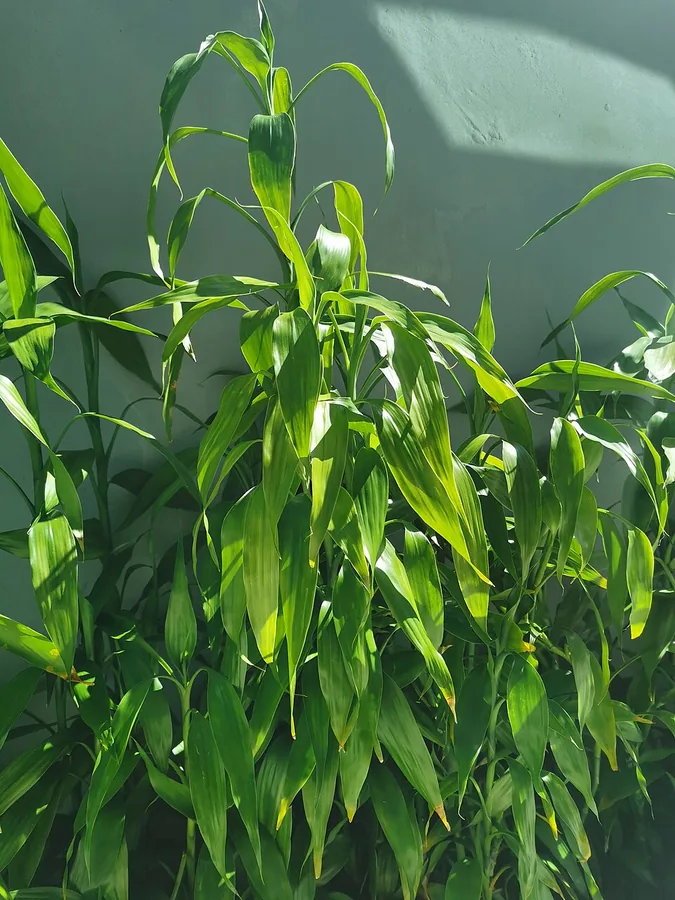
Lucky bamboo grows as upright green stalks ringed with raised nodes, and those joints are exactly what fool the eye into calling it bamboo. It is not. It is Dracaena sanderiana, a tropical relative of the corn plant, and from the top of each stalk springs a loose tuft of long, strappy leaves in a flat, glossy green. Growers coax the young stalks into curls, spirals, and braids, then stand them in a dish of water and pebbles.
Look at the base and you find the real oddity: the plant grows in plain water, its pale roots threading down through pebbles or marbles while the lower stem stays under the surface. The stalks stay smooth and firm, banded at each node, and the plant keeps producing fresh leaf tufts. It carries this on in low light better than most houseplants, holding its green where others thin and pale.
The green is easy to keep whole with one caution: the leaf blades brown and crisp at their tips when the plant meets the fluoride and chlorine in ordinary tap water. Give it clean water and bright indirect light, and the stalks stay solid and the leaves stay evenly green.
Care
The short version: bright indirect light, clean water free of fluoride and chlorine, and warm indoor temperatures keep the stalks green and firm. Stand it in pebbles and water or a well-drained mix, change the water weekly, and feed lightly through spring and summer.
Light
Lucky bamboo keeps its deepest green in bright, indirect light, the kind a step back from an east or north window. It stays green in low light and shade longer than most houseplants, but hot direct sun bleaches and scorches the leaf blades, so keep it off a baking sill.
Water
Stand the pale roots in chlorine-free water among pebbles or marbles, or in a steadily moist mix, with the roots and lower stem under the surface. The blades are sensitive to fluoride, chlorine, and salts, which crisp their tips, so use distilled, filtered, or rainwater, or let tap water stand uncovered for a day or two. Change the water weekly to keep it clear and free of mosquitoes.
Soil
In soil, use a well-drained, loam-based mix made for indoor or tropical plants. It takes a wide pH band from 6.0 to 8.0, and it grows just as well with the bare stalks standing in plain chlorine-free water and pebbles, no soil at all.
Temperature
Keep it in the warm, even range of a normal home, roughly 64°F to 75°F (18°C to 24°C). As a tropical plant, the green stalks have no tolerance for cold, so bring any outdoor display in well before the nights turn chilly.
Humidity
Average indoor humidity suits it, so there is no number to chase. Very dry air can brown the leaf tips a little, but water quality matters far more to the green blades than humidity ever will.
Feeding
Feed lightly through the growing season, spring into summer, with a weak liquid houseplant fertilizer. Stalks grown in water need less, only about every other month at roughly a quarter of the labeled rate.
Pruning
Trim off any yellowed or damaged stalks and the tired leaf tufts as they appear. To hold the height, cut a stem just above a node, the raised ring on the stalk, which pushes out new shoots, and the cut pieces root as fresh cuttings.
Repotting
Move it up a container every 1 to 2 years, or sooner once the pale roots crowd or circle the pot or fill the vase. Slowed growth and a knot of roots are the signs it wants more room, while water-grown stalks just need the water refreshed as they fill out.
Size & spacing
Indoors the stalks reach about 3 to 5 feet (91 to 152 cm) tall and roughly as wide across the leaf tufts, though trimming keeps most shorter. Growth is slow, so the green fills out over time rather than all at once.
Troubleshooting
Lucky bamboo writes its troubles on the plant itself, and the green shows every change first. The two you will see are dry brown tips on the leaf blades and a whole stalk fading yellow, and both come back to water more often than not. Match what the plant looks like below, then fix the cause behind the color.
A stalk or leaves turning yellow
When a firm green stalk fades to a sallow yellow, the trouble is overwatering or stale water, sometimes with too little light behind it. Sitting in old, standing water, the base of the stem loses its firmness, turns soft, and rots. Draw out the yellowing or rotting stalk, refresh the water each week with only the roots and the lower stem beneath the surface, and set it in bright indirect light with a weak feed so new stalks come in a clean, solid green.
Fix:
- Remove yellowing or rotting stalks
- Change the water weekly and keep only roots plus the lower stem submerged
- Provide bright indirect light and a weak fertilizer
Brown, crispy tips on the leaves
Those dry, papery brown points at the very ends of the leaves are tip burn from tap water. Lucky bamboo is a Dracaena, and Dracaenas take up the fluoride, chlorine, and salts in municipal water and drive them out to the leaf margins, where the green fades to a crisp, tan edge. Switch to distilled, filtered, or rainwater, or let tap water stand uncovered for a day or two, and keep the plant out of hot direct sun so the blades stay whole and green.
Fix:
- Switch to distilled, filtered, or rainwater, or let tap water stand uncovered 1-2 days before use
- Change water-grown plants' water weekly
- Move out of direct sun into bright indirect light
Toxicity
Keep this one away from pets. The green stalks and strappy leaves hold saponins, and the ASPCA lists lucky bamboo as toxic to cats and dogs, bringing on vomiting, drooling, and a flat, off-color mood if chewed. People are essentially safe, and no one eats it, though the clear sap from a cut stem can leave sensitive skin a little irritated, so wash your hands after pruning.
Toxic to
Cats · Dogs · Horses · Rabbits · Livestock · Birds
Safe for
People
Cats Moderate
When a cat bites through the crisp green stalk, the saponins bring on vomiting that can hold a thread of blood, along with heavy drooling and a dull, withdrawn look. Food gets refused, and after a bigger mouthful the pupils widen into dark, round circles.
Dogs Moderate
A dog that gnaws the strappy leaves or snaps a stalk drools in long strings and vomits, now and then streaked with a little blood. A flat appetite and a heavy, sluggish look tend to settle over it for a while.
Horses Caution
The saponins packed in those green stalks make them a poor nibble for a horse, so every piece belongs well out of reach. A mouthful would most likely leave the stomach churning.
Rabbits Caution
A rabbit should never crop the tender leaves or stems, since the saponins can turn a delicate gut sour. Any fallen leaf or trimmed stalk needs clearing before a rabbit finds it.
Livestock Caution
Grazing animals can take a digestive hit from the saponins in the stalks and leaves, though this indoor plant rarely lands within their reach. Trimmings stay well clear of anywhere stock might graze.
Birds Caution
A pet bird that pecks and splits a green stalk can end up with an upset stomach from the saponins inside. The plant sits where curious beaks cannot pick at the leaves.
People Safe
For people the plant is essentially safe, and no part of it is eaten. The clear sap from a cut stalk can leave some skin a little irritated, so a rinse of the hands follows pruning or repotting.
Sap may cause minor skin irritation in people; wash hands after handling.
Helpline numbers

United States
ASPCA Animal Poison Control: (888) 426-4435 (fee applies)

United Kingdom
Animal PoisonLine: 01202 509000 (fee applies)

Australia
Animal Poisons Helpline: 1300 869 738
Varieties
Lucky bamboo turns up less as a run of named cultivars than as one plant shaped and marked in different ways. These are the two forms you will actually see up close.
Braided / spiral lucky bamboo
These stalks twist into tight coils, loose spirals, and woven braids, shaped from young Dracaena sanderiana stems turned toward the light rather than grown as a separate cultivar.
Variegated lucky bamboo
This form streaks its long green leaves with lengthwise bands of cream or gold.
How to propagate
A whole new plant starts from a single green stalk. A cut length of stem and a glass of clean water are all it takes to grow fresh roots.
Stem cuttingsEasy
Spring through summer during active growth · Roots usually form in about 2-3 weeks
Fresh plants start from the green stalk itself. In spring or summer, while growth is active, cut a young shoot from the main stem just above one of its raised nodes, strip the lowest leaves from the base, and stand the bare end in chlorine-free water. Pale roots push out from the submerged node in about 2 to 3 weeks, after which the cutting can stay in water or settle into a pot.
Myths
Lucky bamboo is a kind of bamboo.
The jointed, node-ringed green stalks look every bit like bamboo canes, yet this is no true bamboo and stands apart from the grass family. It is Dracaena sanderiana, a Dracaena in the family Asparagaceae, much closer to a corn plant than to the woody bamboo it mimics.