Tree · Cupressaceae
Juniper
Juniperus chinensis
Aromatic scaled foliage and dusty-blue cones, on an evergreen that wants only full sun and sharp drainage.
Full sun
Every 7–14 days
USDA 3–9
1–59 ft · 0.3–18 m
Overview
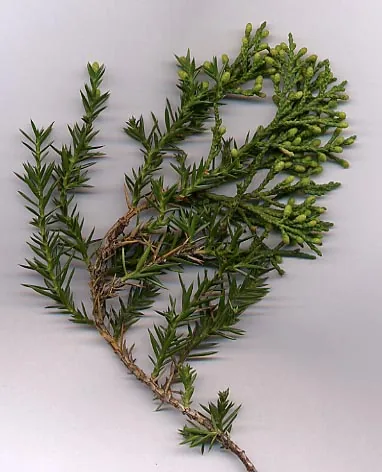
Juniper wears a distinctive foliage that shifts as the plant ages. Up close the growth is either fine, scale-like sprays pressed flat against the twigs or short, stiff, sharp-tipped needles that prickle at a touch, and both carry a strong resinous scent when crushed. Color runs from deep green through blue-green to a cool silvery blue-gray depending on the plant, and this cypress-family evergreen holds those tones through the whole year across the northern hemisphere.
The form itself is just as varied as the foliage. A juniper can be a flat, ground-hugging mat barely a foot high, spreading its branches out sideways over the soil, or an upright tree that reaches up to 59 feet (18 m) on a straight, fibrous, reddish-brown trunk. Whatever the shape, the surface reads as a dense, textured skin of tiny leaves rather than the broad blades of most shrubs.
On female plants the fruit is the detail that catches the eye. The berry-like blue cones are small, round, and dusted with a soft pale bloom over a deep blue skin, and they ripen slowly over about two years before birds strip them. The wood beneath grows slowly and will not resprout from bare old wood, so once a branch drops its green it stays a plain brown stick.
Care
The short version: full sun and fast-draining soil keep that dense, colored foliage at its best. Water through the first year to settle the roots, then largely leave it alone, feed it rarely, and prune only into the green growth.
Light
Juniper wants full sun, ideally 6 or more hours a day, and it will take a little partial sun. In real shade the foliage thins to gaps, the color washes out, and disease finds an opening.
Water
A new juniper needs regular water through its first year to settle the roots. After that it is very drought tolerant and needs help only in a long dry spell, since the one thing it will not stand is soggy soil around those fibrous roots.
Soil
Sharp drainage matters far more than rich ground here. The roots take to sandy, rocky, and even heavy clay soil as long as water moves through, and they stay content across a wide pH of 5.0 to 8.0.
Temperature
Few shrubs hold their foliage through such extremes. Juniper takes everything from about -29°F to 100°F (-34°C to 38°C), keeping its scaled, needled color through hard frost and shrugging off summer heat.
Humidity
Outdoor humidity is whatever the weather brings, and juniper does not mind it. Air movement counts for more than any humidity level, since still, damp air trapped in the dense foliage invites the tip blights.
Feeding
Juniper rarely needs feeding at all. If the foliage looks thin and pale, a single light application of balanced or slow-release fertilizer in spring is plenty, and overfeeding does more harm than good.
Pruning
Shape it lightly in late spring and cut only into the green growth, because the bare brown old wood will not push new needles and leaves a permanent gap. Pull off any dead, diseased, or blight-killed tips during dry weather.
Repotting
Container and bonsai junipers want fresh room every 2 to 3 years. Repot when roots circle the pot, water runs straight through, or the foliage slows and yellows.
Size & spacing
The forms range hugely, from a foot-high mat to an upright reaching 1 to 59 feet (0.3 to 18 m), with spreads of 2 to 20 feet (60 cm to 6 m). Match the cultivar to the space and leave each plant room for air to move through the dense canopy.
When to plant
Juniper is planted rather than sown, and spring and fall are the windows when the soil is workable and the weather is mild. Set plants out in either season so the roots settle before summer heat or winter cold, and water through that first year while the young foliage takes hold.
Northern hemisphere
Southern hemisphere
Typical months for a temperate climate: start earlier in warm zones, later where spring frosts linger.
- Plant: spring or fall
- Harvest: inconspicuous; blue berry-like female cones mature over about two years
Hardiness
USDA hardiness zones: 3–9
Temperature: down to -40°C
Troubleshooting
A juniper in the right spot keeps its dense, even foliage for years, so most trouble shows up first as a change in the needles or tips: a browning end, a yellow speckle, a bare patch. Look closely at the new tips, the inner foliage, and the branches, and match what you see against the entries below.
Whole plant thinning, dulling, and declining
The whole plant loses its density, the foliage grows sparse and dull, and the color drains from the top down when Phytophthora root rot takes a juniper standing in wet ground. Underground, the roots turn dark and rotted, and once that damage is done there is no easy cure. Open up the drainage, cut back the water, and lift out any plant too far gone to recover.
Fix:
- Improve drainage and stop overwatering
- Plant in raised beds and amend heavy clay with porous material such as ground pine bark
- Remove severely affected plants, as root rot is difficult to reverse
New tips paling to reddish-brown, then dying back
The color slides from green to pale, to reddish-brown, to dead brown at the branch ends because of two fungal tip blights. Phomopsis tip blight takes the soft, bright new growth in warm, wet weather, while Kabatina tip blight kills the year-old twigs in spring through small wounds. Cut well below the browned tissue on a dry day, wipe the blades clean between cuts, and thin the plant so the wet foliage dries faster.
Fix:
- Prune out and destroy blighted tips well below the dead tissue during dry weather, disinfecting tools between cuts
- Improve air circulation by spacing and selective thinning
- Avoid overhead watering and wetting foliage
- Apply a labeled fungicide (mancozeb, thiophanate-methyl, or copper) protectively on new growth where blight is recurring
Needles finely speckled yellow under a haze of webbing
A fine yellow speckling spreads across the needles, sometimes under a faint haze of webbing, from two tiny sap-feeders. Spruce spider mites puncture the needles in the cool of spring and fall and leave that thread-fine webbing, while juniper scale clings on as minute bumps and yellows the foliage from below. Tap a branch over white paper to see the specks crawl, wash them off with a hard jet of water or insecticidal soap, and coat the scale with a dormant oil spray in late winter.
Fix:
- Dislodge mites with a strong spray of water
- Apply insecticidal soap or a labeled miticide for heavy mite infestations and preserve natural predators
- Apply 2-3 percent horticultural oil as a dormant spray in late winter for scale, or treat crawlers with a labeled insecticide
Spindle-shaped bags dangling among the foliage
Small, spindle-shaped bags, each shaggy with bits of clipped foliage and shaped like a little carrot, hang from the twigs and mark bagworms. The caterpillars feed from inside those portable cases, and a heavy crop can leave branches bare or kill the whole plant. Pick the bags off through fall and winter to clear the overwintering eggs, then spray Bt in spring while the larvae are still small.
Fix:
- Handpick and destroy bags in fall and winter to remove overwintering eggs
- Apply Bacillus thuringiensis (Bt) in spring while larvae are young and small
- Use a labeled insecticide for heavy infestations of older larvae
Woody galls sprouting bright orange jelly horns
The round, brown, woody balls on the twigs are cedar-apple rust and its relatives, fungi that shuttle between junipers and apple-family plants like crabapple and hawthorn. In wet spring the galls swell and push out bright orange, gummy, tentacle-like horns, a startling sight that does the juniper itself little harm. Cut the woody galls off before the horns emerge, and set junipers well away from apples and crabapples.
Fix:
- Prune out and remove woody galls before they produce orange horns in spring
- Plant rust-resistant juniper cultivars
- Do not plant junipers within a few hundred yards of apples, crabapples, or hawthorns
- Apply a labeled fungicide (mancozeb or propiconazole) where control is needed, though galls do little harm to the juniper itself
Toxicity
Juniper is a low-worry plant around animals and people. It carries none of the toxins on the standard poison lists, and the sharp, resin-scented, prickly foliage usually keeps pets and livestock from eating much in the first place. The main points to know are that the berry-like cones can mildly upset a stomach in quantity, and that only a few species are the true culinary juniper used to flavor gin.
Safe for
People · Cats · Dogs · Horses · Rabbits · Livestock · Birds
Cats Caution
Juniper holds no poison for cats, and the sharp, resin-scented foliage usually turns them away before they bite. A cat that chews through a lot of the small blue berry-like cones may have a brief, mild stomach upset that clears on its own.
Dogs Caution
Dogs can nose the prickly, aromatic foliage without real danger, since juniper carries none of the listed toxins. A mouthful of the oily foliage or the blue cones usually brings nothing worse than some drooling or a loose stool for a day.
Horses Caution
The sharp terpene scent that rises off the needles makes juniper taste off, so horses tend to leave it. A horse that grazes a large amount of the berries may feel mild gut irritation, but the plant is not a poisoning risk.
Rabbits Caution
Rabbits rarely bite the stiff, resinous needles, and juniper holds no toxin that threatens them. The volatile oils packed in the foliage can loosen the gut in quantity, so any nibbling stays best kept small.
Livestock Safe
Cattle, goats, and sheep pass juniper by because of its bitter, aromatic foliage, and it is absent from the usual lists of plants that poison them.
Birds Safe
Birds eat the ripe, dusty-blue cones freely and carry the seed off, so the fruit poses no problem for them at all.
People Edible with care
The blue cones of a few species, mainly Juniperus communis, are the very spice that flavors gin, yet ornamental landscape junipers are not all edible and some cones can upset the stomach. Only known culinary species belong in the kitchen, and the prickly, oil-coated foliage is best handled with gloves.
The aromatic foliage and berry-like cones may cause mild, self-limiting stomach upset if eaten in quantity, and the prickly juvenile needles plus juniper oils can mildly irritate skin, so wear gloves when pruning. This is irritation, not poisoning.
Varieties
Junipers show more shapes and foliage colors than almost any other evergreen, from silvery blue cushions to deep green columns. The selections below are the ones you will meet most often at the nursery.
'Hetzii'
A vigorous, wide-spreading shrub whose blue-green foliage sprawls out to fill large foundation plantings and screens.
'Sea Green'
A compact shrub of arching, fountain-like branches clothed in rich mint-green foliage that reads as a soft low hedge.
'Spartan'
A slim, densely packed column of dark green that climbs to about 15 to 20 feet tall yet stays only around 5 feet wide.
'Hollywood' / 'Kaizuka'
An irregular, corkscrew-twisted upright dressed in deep, rich green foliage that looks like a living sculpture.
Juniperus scopulorum 'Skyrocket'
A pencil-thin column of cool blue-gray foliage so narrow it draws a vertical line against the sky.
Juniperus squamata 'Blue Star'
A dwarf, mounded cushion of 1 to 3 feet, dense with short silvery blue-gray needles.
How to propagate
How you multiply a juniper depends on the form you want to keep, since named cultivars will not come true from seed and have to be cloned another way.
Stem cuttingsModerate
Late fall through winter from semi-hardwood to hardwood growth · Several weeks to a few months to root
Most cultivars grow from cuttings so they hold the exact form and foliage color of the parent. Take firm semi-hardwood to hardwood pieces from late fall through winter, dip the cut ends in rooting hormone, and press them into well-drained media, where they root over several weeks to a few months.
GraftingDemanding
Winter under glass · Weeks to months
Grafting builds the tall, upright tree forms and choice cultivars that will not root from cuttings, joining scion to rootstock. Worked in winter under glass, the union takes weeks to months to knit, which keeps it in the hands of skilled growers.
LayeringEasy
Spring · Several months to a year
Layering is the simplest route for the low, spreading kinds with their long trailing branches. Pin one of those branches to the soil in spring and it roots in place over several months to a year, a natural fit for groundcover and shrub forms.
SeedDemanding
After cleaning and cold stratification · Slow and erratic, often more than a year to germinate
Seed raises the wild species rather than named cultivars, which do not come true from it. Clean the fleshy blue cones down to the seed, give it a cold stratification, then wait, since germination is slow and erratic and often takes more than a year.
Myths
The berries on any landscape juniper are safe to harvest and eat like the ones that flavor gin.
Only a few species, mainly Juniperus communis, are grown as a culinary spice. Many ornamental junipers carry berry-like blue cones that taste harsh and can bring on a mild stomach upset, so don't assume the berries on a landscape juniper are edible.
An overgrown juniper can be rejuvenated by cutting it hard into the old bare wood.
Junipers will not push fresh green shoots from old, leafless brown wood, so a hard cut into bare branches leaves a permanent bare hole. Always prune into green, foliage-bearing growth and reshape the plant a little at a time.