Tree · Cupressaceae
Dawn Redwood
Metasequoia glyptostroboides
A living fossil whose feathery needles flush russet-bronze each fall, on a trunk that rises fast.
Full sun
Every 3–10 days
USDA 4–8
70–100 ft · 21.3–30.5 m
Overview
Dawn redwood carries one of the great comeback stories among trees. For a long stretch it was known only from the fossil record, until living specimens were spotted in central China during the 1940s, and seed from them carried the species into gardens across the temperate world. It is that uncommon thing, a deciduous conifer, clothing itself in soft green needles through summer and casting them off every fall.
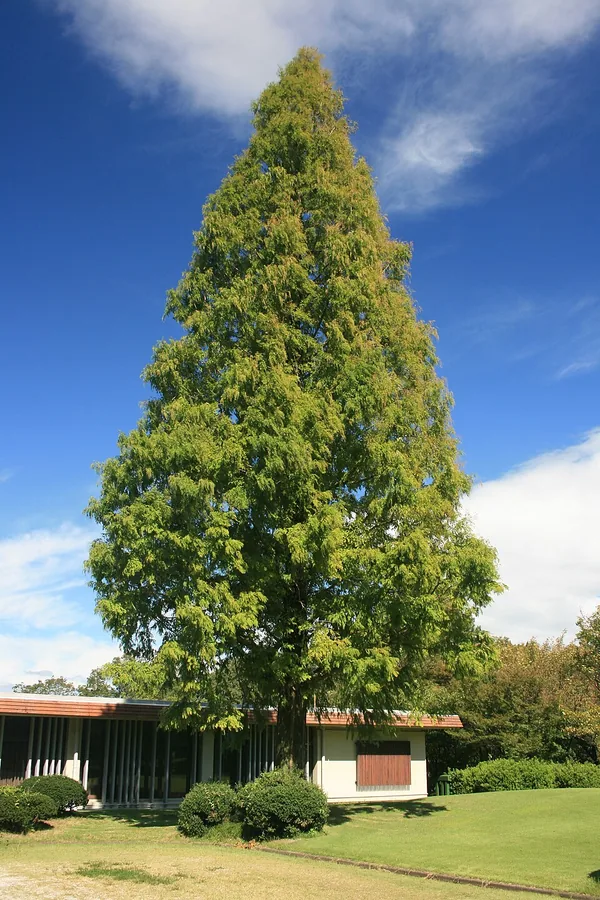
Give it space and it pays you back in a hurry. The trunk drives upward fast into a clean pyramidal shape topped by a single straight leader, and an aged tree can stand 70 to 100 feet over a wide, fluted, buttressed base. That pace and bulk rule it out of a small yard, yet make it a commanding pick for a park, the margin of a pond, or an open lawn.
Autumn is when it truly shows itself. Just before the needles let go, the entire crown burns to a warm russet-bronze to orange, a shade few conifers ever wear. Through the rest of the year it asks for little beyond soil that stays moist and leans acidic.
Care
The short version: full sun and deep, moist, slightly acidic soil, plenty of room for a large fast-growing tree, and steady water while it's young and during any drought.
Light
Set it in full sun to draw out the best shape and the richest color, though it will accept a touch of afternoon shade. Starve it of light and it grows thin and sluggish, never knitting together the tight pyramidal form it is prized for.
Water
This tree wants damp footing. Hold the soil consistently moist and deep, and it will even put up with boggy, waterlogged ground. Water it without fail while young and right through any drought, since a long dry stretch is more than it can bear.
Soil
Give it deep, moist, humusy, acidic soil that still lets water move through. Clay and wet ground suit it without protest, but it yellows into chlorosis on thin earth over rock or on high-pH alkaline ground. Steer the pH toward 5.0 to 6.5.
Temperature
It holds up across a broad span, hardy in zones 4 through 8 and brushing off cold as deep as roughly -29°F (-34°C) while taking summer heat to about 100°F (38°C). Its one soft spot is that early spring flush, where a late frost can pinch the tender new shoots.
Humidity
Open-air conditions suit it well, so there is no humidity figure to chase. What it truly craves is steady moisture down at the roots, not in the air around it.
Feeding
In passable soil it hardly asks to be fed. Where growth lags, work in a balanced slow-release tree fertilizer in early spring, and leave it off entirely on ground that is already rich.
Pruning
Pruning is mostly beside the point, since the tree raises its own sturdy pyramidal frame on a single central leader. In late winter while it sleeps, simply cut away any dead, damaged, or competing leaders to hold that clean line.
Repotting
Think of it as a landscape tree, not a lasting container subject. Nursery or bonsai specimens are repotted every 2 to 3 years in early spring, and the tells that it has waited too long are circling roots, roots poking from the drainage holes, and growth that has stalled and gone yellow.
Size & spacing
Plan around a colossus. A grown tree reaches 70 to 100 feet (21 to 30 m) tall and spreads 15 to 25 feet (4.5 to 7.5 m) across, so place it well away from buildings, foundations, and pavement and hand the roots open ground.
When to plant
You set dawn redwood out as a young tree rather than sowing it where it stands, and it does well across zones 4 through 8. Start stratified seed indoors in late winter, then move the young trees outside in spring once frost has cleared or in early fall. No bloom is on the way, only the russet-bronze foliage that brings each autumn to a close.
Northern hemisphere
Southern hemisphere
Typical months for a temperate climate: start earlier in warm zones, later where spring frosts linger.
- Sow: Late winter to early spring (stratified seed, 8-10 weeks before last frost)
- Plant: Spring after last frost, or early fall
- Harvest: Non-flowering; russet-bronze to orange fall foliage in autumn before needle drop
Hardiness
USDA hardiness zones: 4–8
Temperature: down to -34°C
Troubleshooting
A thriving dawn redwood gives almost no trouble, and most of what does crop up comes back to stress or a soil that does not suit it. Keep an eye on the needles and the new growth, since they signal the first trouble. Pair what you find below with what you see and act while there is still time to help.
Washed-out new growth with veins still running green
Where the freshest needles fade to a pale yellow-green but their veins keep a clear green line, you are looking at chlorosis, the tree's way of telling you iron has locked up in soil that runs too alkaline or sits too thin over rock. A quick pH test confirms it. Bring the soil down toward slightly acidic with elemental sulfur as the long game, paint on chelated iron to green the foliage up in the meantime, and spread mulch to cool and deepen the root zone.
Fix:
- Test and lower soil pH toward slightly acidic with elemental sulfur
- Apply chelated iron to green up foliage in the short term
- Mulch and improve soil depth and moisture over the root zone
Sunken patches on the bark with dead wood beyond
A stretch of bark that has gone sunken, cracked, and discolored, with the growth past it dead, marks a fungal canker, and it nearly always rides in behind some stress, whether drought, frost, or a fresh wound. Cut the affected wood out well below the lesion, wiping the blades with disinfectant between every cut. Your strongest guard is plain consistency though, steady moisture and a mulched root zone, because a tree kept comfortable rarely cankers at all.
Fix:
- Prune out cankered wood well below the lesion, disinfecting tools between cuts
- Improve growing conditions to reduce stress
- Keep the tree adequately watered and mulched
Bronzed, speckled needles laced with fine threads
When the soft needles take on a dull, stippled bronze cast and you spot thin silken threads strung between them, the culprit is spider mites, which thrive in hot, dry weather and pile on extra damage to a tree already running short on water. Hold a sheet of white paper under a branch, give it a sharp tap, and look for minute specks crawling across the page; the needle undersides will show webbing. Knock them off with a hard spray of water, then turn to insecticidal soap or horticultural oil if they persist, and keep the roots moist and mulched so the tree never gets stressed enough to invite them.
Fix:
- Spray foliage with a strong jet of water to dislodge mites
- Apply insecticidal soap or horticultural oil to affected foliage
- Keep the tree well watered and mulched to reduce drought stress
Foliage chewed to lace in early summer
Beetles shining with metallic green and copper, bunched on needles eaten down to a lacy skeleton, are Japanese beetles, a familiar summer visitor to this tree. Pluck them off into a tub of soapy water at first light, while the cool air keeps them slow and clumsy, and save an approved insecticide for the rare heavy swarm. The chewed foliage looks far worse than it is, and a settled, established tree shrugs off light feeding.
Fix:
- Hand-pick beetles into soapy water in the early morning
- Treat heavy infestations with an approved insecticide if warranted
- Tolerate light feeding, which rarely harms an established tree
Newest shoots blackened and limp after a spring cold snap
Dawn redwood breaks bud earlier than most, so a late-spring frost can sear the youngest shoots black while the older, hardened wood comes through fine. Snip away the dead tips once the tree starts moving again, and it will usually throw a second flush all on its own. Steer clear of low spots where night cold pools, or the same scorching comes back year after year.
Fix:
- Prune out dead frost-killed shoots once new growth resumes
- Allow the tree to push a second flush, which it usually does
- Avoid planting in frost pockets
Toxicity
Welcome news for any home with animals: dawn redwood is not toxic to pets, livestock, or people. It does not appear on the ASPCA's roster of harmful plants, and the worst an inquisitive nibble might bring is a brief stomach upset from overdoing any greenery. Plant it freely, without a second thought for whoever passes beneath it.
Safe for
People · Cats · Dogs · Horses · Rabbits · Livestock · Birds
Cats None
Nothing in the soft needles will harm a cat, so it sits safely in any space they roam. Should one gnaw a large amount of any leafy plant, expect at most a short, mild bout of stomach upset and nothing past that.
Dogs None
There are no toxins here that trouble dogs, so an inquisitive bite is nothing to worry over. A whole mouthful of foliage might loosen the stool a little, much as any plant would.
Horses None
Horses face no poison from this tree. Those soft, feathery needles carry nothing harmful, even if a grazing animal reaches up and browses a low branch.
Rabbits None
Rabbits come to no harm near it. Fallen needles or tender low shoots can be nibbled freely with no toxic risk at all.
Livestock None
Cattle, goats, and sheep can all browse the foliage safely, with no chance of poisoning from any part of the tree.
Birds None
Birds are perfectly safe around it, free to perch in its branches, build a nest, or pick at the seed cones.
People None
People are in no danger from it, and no part of the tree calls for cautious handling. It is simply not grown for eating, so there is nothing on it worth a taste.
No special handling precautions are required; this is an outdoor landscape tree.
Varieties
Nearly every dawn redwood on offer is the plain species, but a handful of selections earn attention for their color or their outline. These are the few worth knowing by name.
'Gold Rush' ('Ogon')
Its soft, feathery needles glow a golden-yellow right through the warm months, shift to orange-brown by fall, and the tree itself climbs more slowly than the ordinary species.
'National'
Chosen in 1958 at the U.S. National Arboretum, this is a strikingly slim, columnar tree prized for its tight, upright pyramidal outline.
'Miss Grace'
An uncommon weeping dwarf whose branches spill downward and stay low in a soft mound, unless you stake the leader to draw it upright.
How to propagate
Dawn redwood comes along easily, whether you begin with cold-treated seed or root a cutting taken from a tree already in the ground.
SeedModerate
Late winter to spring after cold stratification · 1-2 years to a sturdy seedling
Held for ages as nothing but a fossil until living trees surfaced in China in the 1940s, dawn redwood sprouts willingly from seed once that seed has spent a spell in the cold. Sow from late winter into spring and allow 1 to 2 years for it to firm up into a sturdy seedling.
Stem cuttingsEasy
Softwood cuttings in early summer or hardwood cuttings in late fall to winter · 2-4 months to root, then a season to establish
For dependable results, take cuttings. Pull softwood pieces in early summer or hardwood lengths anywhere from late fall into winter; they strike roots over roughly 2 to 4 months, then call for a full season to truly settle in.
Myths
Dawn redwood is just another name for bald cypress or the evergreen coast redwood.
It stands as its own species, Metasequoia glyptostroboides, with a handful of plain features that mark it out. The needles ride in matched opposite pairs, whereas the similar bald cypress sets its needles alternately and pushes up woody knees wherever it grows in standing water. Unlike the evergreen coast redwood, dawn redwood is deciduous and lets its needles go each fall once they have flushed a warm russet-bronze.