Tree · Cupressaceae
Eastern Red Cedar
Juniperus virginiana
A native conifer of dense dark foliage and frosty blue cones over reddish, sweet-smelling wood.
Full sun
Every 10–21 days
USDA 2–9
30–39 ft · 9–12 m
Overview
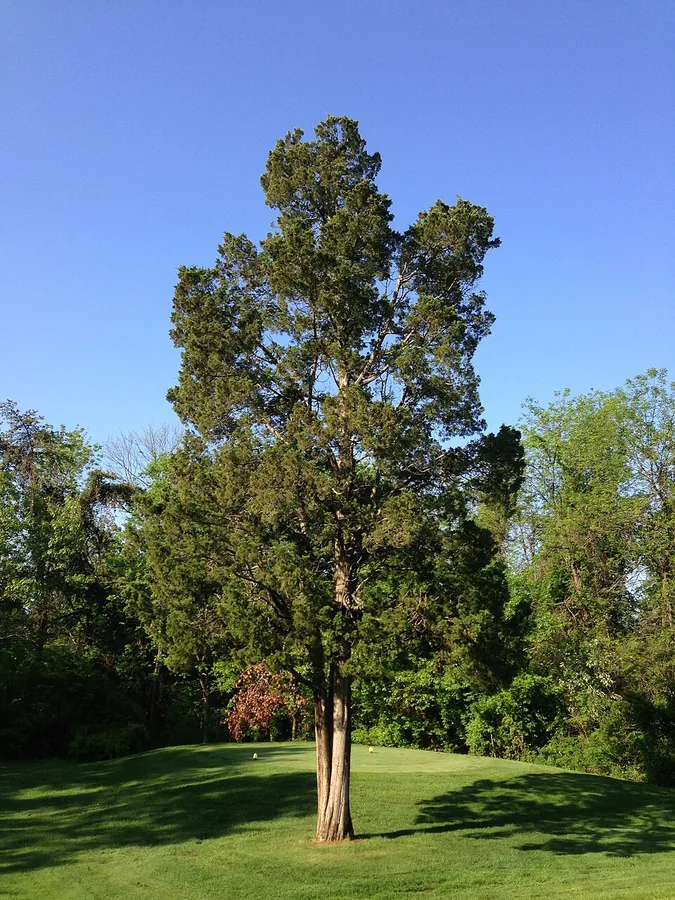
Eastern red cedar stands as one of the toughest evergreens around, clothed top to bottom in dense, fine, scale-like foliage. It is a juniper, not a true cedar, and it grows wild across much of the eastern United States on ground other trees avoid. In sun, it settles into clay, sand, rock, or dry alkaline soil and fills out into a solid green column.
Its working forms are the screen, windbreak, or wildlife tree, all built on that thick foliage. On female plants the branches carry frosty blue berry-like cones, small and dusted with a pale bloom, that feed waxwings, robins, and other birds through winter, while the dense growth gives shelter and nesting cover. Cut into the trunk and you reach the reddish, aromatic wood, the same fragrant cedar of lined closets and weathered fence posts.
This is a slow, long-lived tree that can stand for centuries, hardening into a dense evergreen mass over time, but two habits stand out. It crowds into open grassland once fire no longer holds it back, and it is the alternate host for cedar-apple rust, so it belongs nowhere near apples or hawthorns.
Care
The short version: this dense, deep green conifer takes full sun and almost any well-drained soil, and it needs very little water once its roots hold. It asks for no feeding on most sites and little pruning, and it grows best kept clear of apple and hawthorn trees.
Light
In full sun the foliage grows thickest and holds its deepest, healthiest green. The tree takes light shade, but in shade the growth turns thin and open, the dense column breaking up and losing the tight green form that makes it a useful screen.
Water
Once the roots take hold, this is one of the most drought-tolerant conifers of the eastern U.S. and rarely needs water. Keep new plantings watered through their first season, then let the soil dry between waterings while the established tree holds its green on its own.
Soil
The tree puts up with almost any ground, settling into average, dry to medium, well-drained soil and adapting to clay, sand, shallow rock, and poor or dry alkaline sites across a pH from 4.7 to 8.0. The one ground it refuses is soil that stays wet around the roots.
Temperature
The tree is hardy across a wide span, from -40°F to 104°F (-40°C to 40°C). Hard frost does not mark the foliage, and it holds up through heat and exposed, windy sites just as well.
Humidity
Outdoor humidity leaves an established tree untouched. Good airflow matters more than moisture in the air, since foliage that sits crowded and damp is what the tip blights brown and kill.
Feeding
On most sites the tree feeds itself and needs nothing extra. Where the green looks pale and growth genuinely lags, a balanced slow-release fertilizer in spring restores it, but a settled tree on ordinary ground keeps its color unaided.
Pruning
Pruning stays light, though the dense foliage takes shearing well into a screen or hedge. Work in late winter to early spring, cutting out any swollen brown galls and dying twig tips at the same time to hold back cedar-apple rust.
Repotting
Not applicable; grown as a landscape tree, not a houseplant
Size & spacing
A mature tree rises to about 30 to 40 feet (9 to 12 m) in height and broadens to a spread of 10 to 20 feet (3 to 6 m) of dense foliage. Give it room to fill that frame, and expect it to reach there at a steady, moderate pace.
When to plant
A tree this hardy keeps no sowing season. Set new plants out in spring or fall so the roots take hold before summer heat or winter cold, and watch the frosty blue cones swell on female trees and ripen from fall into winter.
Northern hemisphere
Southern hemisphere
Typical months for a temperate climate: start earlier in warm zones, later where spring frosts linger.
- Plant: Spring or fall
- Harvest: Non-flowering; female trees bear frosty blue-green berry-like cones that ripen fall to winter (Sep-Feb)
Hardiness
USDA hardiness zones: 2–9
Temperature: down to -46°C
Troubleshooting
A healthy eastern red cedar wears its dense green foliage with little bother, but a few pests and fungi leave visible marks on the needles and twigs. Most of what shows up looks worse on the surface than it runs underneath. Match the look below and act before it spreads.
Rubbery orange horns curling out of brown woody galls after rain
Those swollen brown woody galls, sprouting bright orange gelatinous horns after spring rain, are cedar-apple rust and its relatives, fungi shared between the cedar and nearby apples, crabapples, or hawthorns. On the cedar the mark is light, just the galls and a little twig dieback. Cut out the brown galls in late winter before the orange horns form, and keep the tree well away from any rose-family plants nearby.
Fix:
- Prune out and destroy galls and infected branch tips in late winter to early spring before horns form
- Do not plant near apples, crabapples, hawthorns, quince, or serviceberry
- Apply a myclobutanil fungicide in early spring on high-value plants before infection (copper and sulfur are less effective)
Needle-flecked silk pods swinging at the branch tips
Those spindle-shaped silken bags, shaggy with stuck-on bits of foliage and hanging from the twigs, are the work of bagworm caterpillars that strip the needles and thin the crown. Each bag is sheathed in the tree's own foliage, so it hides against the green. Pick the bags off by hand from fall through early spring to clear the overwintering eggs, then spray Bt while the larvae are still small in late spring.
Fix:
- Handpick and destroy bags in fall through early spring to remove overwintering eggs
- Apply Bacillus thuringiensis or an approved insecticide while larvae are small in late spring to early summer
Yellow-stippled needles studded with crusty flecks on the twigs
The small crusty, encrusted specks fixed to the stems and needles are juniper scale, while the fine stippling can also mark spider mites. Both drain the foliage to a dull, yellowing, discolored cast, sometimes glazed with sticky honeydew or blackish sooty mold. Smother the overwintering scale with horticultural oil, treat the crawlers as they emerge in late spring, and cut out any branch crusted over with them.
Fix:
- Apply horticultural oil to smother overwintering scale
- Treat crawlers with horticultural oil or an approved insecticide at the crawler stage
- Prune out and destroy heavily infested branches
Rust-brown dying tips flecked with black pinpoint bodies on the twigs
Branch tips that brown and die back, their dead twigs flecked with tiny black pinpoint fruiting bodies, point to Phomopsis or Kabatina tip blight, fungi that take hold after wet weather. On a healthy tree the browning is mostly cosmetic, scattered across the tips. Prune the dead twigs out during a dry spell, skip overhead watering, and open the branches so air dries the foliage.
Fix:
- Prune out dead and dying twigs during dry weather
- Avoid overhead watering and improve air circulation
- Apply an approved fungicide to new growth on high-value plants if needed
Toxicity
Eastern red cedar is not a poisoning hazard. It is absent from the ASPCA toxic lists, and people, pets, and livestock all tolerate it. The cautions that remain are mild: a stomach upset if an animal eats a lot of the oily foliage or the blue berry-like cones, and skin that the prickly, needle-fine young growth and the aromatic sap can leave red and irritated.
Safe for
People · Cats · Dogs · Horses · Rabbits · Livestock · Birds
Cats Mild
Cats are not on the ASPCA poison lists, so a nibble is no real danger. A cat that chews a lot of the foliage or the blue cones might run a loose stomach for a day, and the aromatic oils tend to put many cats off it anyway.
Dogs Mild
Dogs are safe around it in passing, though one that eats a pile of the blue berry-like cones or foliage may end up with mild diarrhea. Nothing alarming, but keep an eye out if a large amount goes down.
Horses Mild
Horses graze around it without trouble. Eating a real quantity of the oily green foliage or cones can stir up a passing stomach upset, so it is not a feed to lean on, though it poses no poisoning risk.
Rabbits Safe
Rabbits browse the juniper foliage in the wild and handle it fine. There is no toxin here to worry about.
Livestock Safe
Sheep, cattle, and goats crop the scaly green foliage with no danger of poisoning. Take in enough of the resinous, oil-rich needles and the rumen may churn, though the animal itself comes to no real harm.
Birds Safe
The frosty blue berry-like cones are a winter staple for cedar waxwings, robins, and many other birds, which spread the seed as they feed.
People Safe
There is no poisoning hazard for people. The prickly young foliage and aromatic sap can irritate skin, so wear gloves when you prune, and do not treat the blue cones as food.
Not a poisoning hazard, but foliage and the blue berry-like cones can cause mild gastrointestinal upset (such as diarrhea) if eaten in quantity, and the aromatic volatile oils are mildly irritating. Sap and prickly young foliage may irritate skin; wear gloves when pruning.
Varieties
The species shifts its silhouette and the very color of its foliage from one selection to the next, from deep green to blue-green to silvery gray. A few of these forms turn up again and again in gardens.
'Canaertii'
A favorite ornamental selection holding a dense, narrow pyramid of rich dark green foliage studded with frosty blue cones.
'Brodie'
An upright columnar tree sheathed in soft blue-green foliage that forms a clean, narrow screen or accent.
'Taylor'
A tightly fastigiate column climbing to about 20 to 25 feet tall yet only 3 to 4 feet wide, a slim spire of an upright accent.
'Grey Owl'
A low, spreading shrub draped in silvery gray foliage rather than the deep green of the usual upright tree.
How to propagate
Eastern red cedar grows from seed, cuttings, or grafts, and each tests your patience. Seed is slow and stubborn, while cuttings and grafting carry a cultivar's exact foliage color and form straight into the next plant.
SeedDemanding
Sow stratified seed in fall or spring · Months to over a year; seed has dormancy requiring cold stratification and can be slow and erratic to germinate
The tree self-seeds freely in the wild, yet starting it on purpose tests your patience. Collect the small blue cones from a female tree in fall or winter, rub off the fleshy coat, and give the seed a long cold stratification to break its dormancy. Even then germination comes slow and uneven, often anywhere from a few months to more than a year.
Stem cuttingsModerate
Take semi-hardwood cuttings in late summer to fall · Several months to root
Cuttings are the usual way to copy a named cultivar and hold its exact form and foliage color. Take semi-hardwood cuttings in late summer to fall and expect several months for roots to form. It runs slower than rooting a houseplant, but far more reliable than seed for the plant you want.
GraftingDemanding
Dormant season · One season
Grafting is mainly a nursery method, joining a selected cultivar onto seedling rootstock. The work is done in the dormant season, and a successful union knits together over a single growing season. It takes skill, so most gardeners leave this one to the growers.
Myths
Eastern red cedar is a true cedar.
The name misleads. This tree is really a juniper that sits within the cypress family, and it is no true cedar. The genuine cedars are the genus Cedrus, which belongs to the pine family. Its everyday name has simply clung on as an old misnomer.
Cedar-apple rust destroys the cedar that hosts it.
On the cedar the rust does little beyond raising a few swollen galls and killing back the odd twig. The serious harm lands on nearby apples, crabapples, and hawthorns, with the cedar serving only as the alternate host that completes the fungus's life cycle.