Tree · Cupressaceae
Italian Cypress
Cupressus sempervirens
Set once in full sun and dry, well-drained soil, this slim green column of scaly sprays holds its shape for decades.
Full sun
Every 7–14 days
USDA 7–10
39–69 ft · 12–21 m
Overview
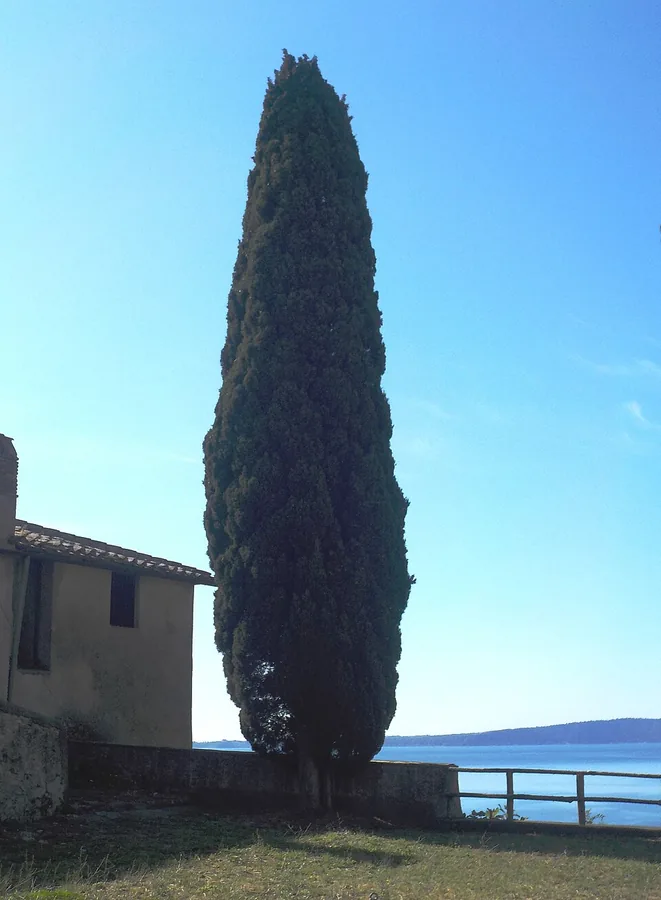
Italian cypress is a tall, tapered spire of deep green, its foliage made not of needles but of tiny scale-like leaves pressed flat against the twigs so the whole surface reads as smooth, dense sprays. Countless upright branches pack together into one narrow column that runs nearly the same slim width from base to tip. A mature tree draws that dark green line up to 40 feet and beyond while staying only a few feet wide.
Up close the tree is dry and resinous rather than soft. Crush a spray of the scaly foliage and it gives off a sharp, clean scent from the oils packed inside, and the small round woody cones sit tucked among the branches, hard and knobbed. That same tough, low-moisture makeup lets it shrug off drought, poor rocky ground, and alkaline soil, and hold firm down to 0°F (-18°C), though it turns sallow and thin where the roots sit wet.
The tree grows slowly and lives long, thickening its green column year by year. Give it sun, sharp drainage, and vertical room, and it keeps that clean, sword-like outline for generations with no shearing at all.
Care
The short version: full sun, lean and sharply drained soil, and a deep drink while young keep the scaly green column dense and firm, after which the tree needs almost nothing. Skip the pruning, and keep its roots clear of standing water.
Light
Give Italian cypress full sun for as much of the day as you can. It carries no real shade tolerance, and a tree short on light grows thin and open, its sprays loosening and leaning until the tight green column falls apart.
Water
Water young trees regularly to root them, letting the top half of the soil dry between drinks so the scaly foliage stays firm. Once established, the tree is very drought tolerant and asks little. What it cannot take is wet, poorly drained soil, which rots the roots.
Soil
It grows best in well-drained sandy loam but takes poor, rocky, sandy, and alkaline ground in stride. A pH anywhere from 6.0 to 7.8 suits it. The dry, gritty footing matters far more to it than any richness in the soil.
Temperature
This is a tough tree across a wide range, holding its green from about 0°F to 104°F (-18°C to 40°C). It carries Mediterranean heat and real winter cold alike, which is why it grows well through hardiness zones 7 to 10.
Humidity
Italian cypress prefers low humidity and the dry air of its native Mediterranean, which keeps the scaly foliage clean and crisp. Damp, muggy climates work against it, since moisture clinging to the sprays raises the odds of disease.
Feeding
Feeding is rarely needed. Only where the green looks pale and growth is poor should a balanced slow-release fertilizer go on in spring, and even then a light hand is plenty. A well-sited tree draws what it needs from lean soil.
Pruning
The tree is best left untouched. Its packed upright sprays hold the natural columnar habit on their own, so don't shear it for shape. Remove only dead or diseased branches, cutting well below any canker with disinfected tools.
Repotting
Italian cypress is a landscape tree that's rarely repotted. Set it in its permanent spot and leave it, since this slow grower resents having its roots disturbed once they take hold.
Size & spacing
A mature tree draws its green column to roughly 40 to 70 feet (12 to 21 m) tall while staying narrow, spreading only 3 to 20 feet (91 cm to 6 m) across depending on the form. Plan for that height and give the crown room and air.
When to plant
Italian cypress roots in best while those roots are actively growing, so plant in spring or fall, with April and September the easiest windows to transplant. Water it deeply through that first stretch so the young sprays stay full and green while the tree anchors before the dry season or the cold.
Northern hemisphere
Southern hemisphere
Typical months for a temperate climate: start earlier in warm zones, later where spring frosts linger.
- Plant: Spring or fall (April and September are best for transplanting when roots are actively growing)
- Harvest: Non-flowering; produces round woody cones to 1.5 in across
Hardiness
USDA hardiness zones: 7–10
Temperature: down to -18°C
Troubleshooting
A healthy Italian cypress keeps a solid, even green surface, and most trouble first shows as a change in that surface. Watch for branches fading to brown, the sprays thinning or dulling, or ragged bags hanging in the foliage, and act early. Nearly all of it traces back to too much water at the roots or too little reaching the crown.
Brown flagging branches with oozing cankers on the stems
When branches die back into rust and brown streaks that break the even green surface, the cause is usually cypress canker, most often Seiridium, worst on trees weakened by drought. Where a dead branch joins the stem, the bark cracks into a dark, sunken canker beaded with sticky resin. No fungicide clears it, so prune well below each canker into pale, clean wood, disinfect the blade between cuts, and keep the tree watered so it can wall off the damage.
Fix:
- Prune out diseased branches 3-4 in below the canker into healthy wood
- Disinfect pruning tools between cuts with a 10 percent bleach solution
- Destroy or discard all pruned material
- Reduce drought stress with regular deep irrigation to help trees recover
A tree that stalls and yellows in soggy ground
A tree stuck in wet ground thins out, its dense green sprays turning sparse and washing to sallow yellow or a bruised purple, the mark of Phytophthora root rot at work below. Scrape the soil back and the roots show dark and soft, the base cankered at the line where wood meets earth. Sharpen the drainage and stop the overwatering at once, lift any tree past saving, and keep new cypress out of that spoiled soil.
Fix:
- Improve drainage and stop overwatering
- Remove and destroy severely affected plants
- Do not replant cypress in contaminated soil
Foliage turning dull, speckled, and bronze
The deep green loses its luster and takes on a fine sandy speckle that deepens to a dull bronze cast, the signature of spider mites that swarm in cool, dusty, drought-stressed spells. Tap a branch over a white sheet and the specks that scatter and crawl are the mites themselves, strung about with fine silk webbing. A hard jet of water strips them from the scaly sprays, and going light on broad insecticides leaves the lady beetles and predatory mites to hunt the rest.
Fix:
- Spray foliage with a strong jet of water to dislodge mites
- Preserve natural predators such as lady beetles and predatory mites by minimizing insecticide use
Small spindle-shaped bags dangling from chewed branches
Hanging from the twigs are 1 to 2 inch spindle-shaped bags, each stitched over with clipped bits of the tree's own scaly foliage until it looks like a small ragged cone, the work of bagworms. The caterpillar sealed inside eats the sprays down to thin, bare twigs. Pick the bags off and destroy them across winter and early spring before the eggs hatch, and treat any survivors with Bt in May while the larvae are still small.
Fix:
- Handpick and destroy bags in winter and early spring
- Apply Bacillus thuringiensis (Bt) in May when larvae are small
Toxicity
For anyone with animals, the answer is reassuring: Italian cypress is not toxic. ASPCA does not list it among the plants that poison cats or dogs, and it is safe around horses, livestock, and people. The resinous, scale-like foliage may cause a brief, mild stomach upset if a pet swallows a mouthful, but nothing in the tree is dangerous.
Safe for
People · Cats · Dogs · Horses · Rabbits · Livestock · Birds
Cats None
Italian cypress is safe for cats, and ASPCA leaves it off its toxic list. A cat that mouths the resinous, scale-like foliage might drool or feel briefly queasy from the sheer bulk of green it swallowed, and nothing worse.
Dogs None
Dogs can share the ground beneath it without worry. A determined chewer working at the aromatic sprays risks only a short bout of mild stomach upset, no real cause for concern.
Horses Safe
The tree is not toxic to horses. The strong scent released from the crushed, resin-rich foliage keeps most from grazing it, and a passing taste does no harm.
Rabbits Safe
Rabbits are in no danger from Italian cypress. The pungent oils in the scaly foliage turn them away long before they eat enough to matter.
Livestock Safe
Cattle, goats, and sheep can graze beside it safely. The sharp, resinous smell of the foliage makes it unappealing, and it carries no compound known to poison farm animals.
Birds Safe
Birds tuck into the tight columns of scaly foliage to nest and perch with no risk. The small round woody cones and the scale-like leaves hold no toxic threat.
People Safe
Italian cypress is not poisonous to people. It grows no edible part, so nothing on it is meant for eating, but running a hand over the soft-looking scaly sprays or brushing past them is perfectly safe.
Foliage is aromatic when crushed; minor gastrointestinal upset is possible if large amounts are chewed.
Varieties
The named forms of Italian cypress differ most in the color and shade of their scaly foliage and in how tightly they hold the column. These are the ones worth knowing.
Glauca (Blue Italian)
A slim column clothed in cool blue-green, scale-like foliage that rises 40 to 60 feet tall while holding to a slender 5 to 10 feet across.
Stricta
The pencil-thin Italian cypress in its purest form, its very narrow, tightly upright sprays packed into a straight vertical line that needs no help.
Swane's Golden
A slender column whose scale-like foliage glows a warm golden-yellow rather than the deep green of the ordinary tree.
Tiny Tower (Monshel)
A compact, slow-growing dwarf that gathers the same narrow columnar shape into a small, tidy frame for tight spaces.
How to propagate
Italian cypress can be raised from seed or from cuttings, and the two part ways in the shape they give. Seed scatters the outline, while cuttings copy the parent's exact scaly column.
SeedModerate
Sow in spring; seed of columnar forms may not come true to shape · 1-2 years
Seed sown in spring hatches into seedlings that take a year or two to establish, their young sprays soft and open at first. The catch is that these seedlings vary in outline, so a packet rarely repeats the tight pencil form. That is why the named cultivars, prized for their exact shape, are struck from cuttings instead.
Stem cuttingsModerate
Take semi-hardwood cuttings in summer to early fall · 1-2 years
Cuttings copy a named cultivar exactly, right down to the packed, upright sprays that make its narrow column. Take semi-hardwood cuttings from summer into early fall, then wait a year or two while the young plant roots in and begins to build its vertical line.
Myths
Italian cypress is poisonous to cats and dogs.
ASPCA does not list the tree as toxic, and it is treated as safe around pets. A dog or cat that chews down a mouthful of the resinous, scaly foliage might get a mild stomach upset, but the tree itself is not poisonous.
Italian cypress needs regular shearing to keep its shape.
The tree draws its own tight, narrow column from packed upright sprays, so there is nothing to shear. Cut only dead or diseased wood, because each fresh wound in the bark is an open door for canker.