Ornamental · Asteraceae
Joe Pye Weed
Eutrochium purpureum
Under strong sun and moist soil, Joe Pye weed hoists dusky mauve-pink flower domes above the late-summer border, crowded with pollinators.
Full sun
USDA 4–9
5–7 ft · 1.5–2.2 m
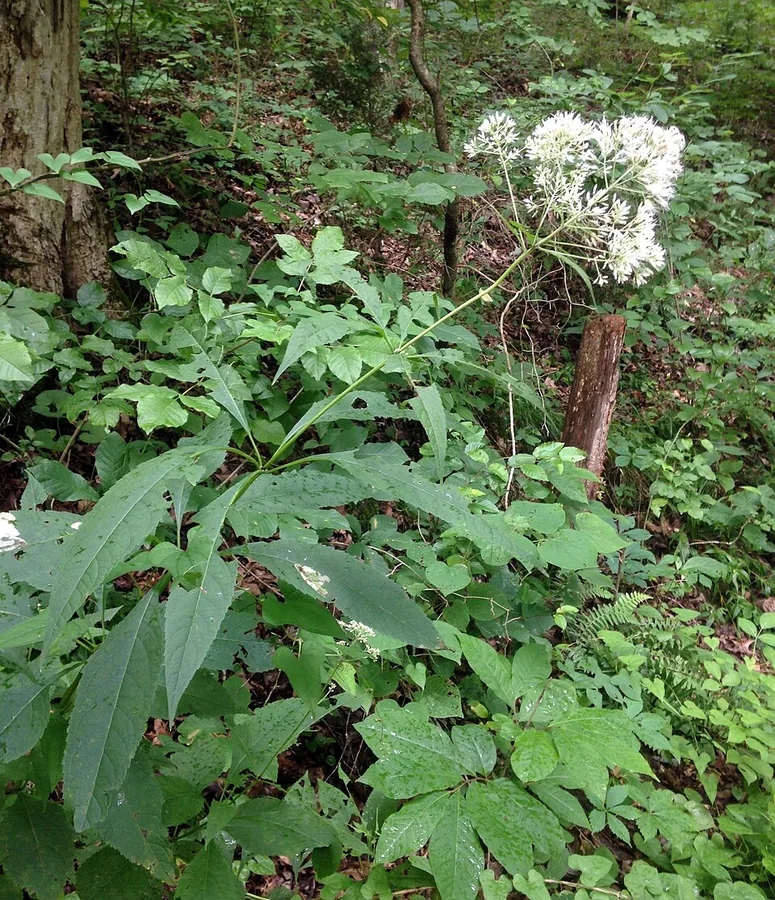
Overview
Joe Pye weed is a tall native perennial of eastern North America, and up close it is all height and heft. From midsummer into early fall each stem lifts a broad, domed cluster of tiny dusky mauve-pink flowers high overhead, the whole head crowded with bloom on stalks that reach 5 to 7 feet (150 to 215 cm). Butterflies and bees crawl across those flat, wide flower crowns for weeks.
The name suggests something coarse, but the plant reads differently than it sounds. It grows as a slow-spreading clump of tall, upright stems, holding its shape, needing little, and returning taller each year. Its one firm demand is moisture, which fits it to a rain garden, a pond edge, or any low, damp ground.
It sits in the aster family, and its dense, nectar-rich flower heads feed late-season pollinators just as other blooms fade. Give it room and steady moisture, and those tall stems and pink clusters carry the show on their own.
Care
The short version: full sun and steadily moist, fertile soil. Water it through any dry spell, since drought is the one thing it will not tolerate, and cut the old stems to the ground in late winter.
Light
Joe Pye weed opens its fullest, most crowded flower heads in full sun, and it will take partial shade, though the plant shows the cost quickly. In low light the tall stems stretch thin, lean, and flop rather than standing upright under the weight of their clusters.
Water
This is a moisture lover that wants consistently damp to occasionally wet soil and has no tolerance for drought. Let the ground dry and the thin outer edges of the leaves scorch brown, so water deeply through any dry spell to keep the broad foliage full and green.
Soil
It roots into moist, fertile, humus-rich ground, whether clay, loam, or sand, and it even takes wet sites that leave other perennials waterlogged. It is easy on pH, at home anywhere from 5.5 to 8.0.
Humidity
Outdoor humidity is never the issue with this plant. What counts is airflow moving between the leaves and stems, since crowded, still air is what lets powdery mildew and rust settle onto the foliage.
Feeding
Rich, moist soil feeds this plant on its own, so it needs little to no feeding. A thin scattering of compost during the growing season is enough where the ground runs lean.
Pruning
Cut the tall old stems to the ground in late winter or early spring to clear the crown for the new shoots. For a shorter, thicker-stemmed plant that flops less, cut it back by about half in early summer.
Size & spacing
This is a big, upright plant, 5 to 7 feet (150 to 215 cm) tall and 2 to 4 feet (60 to 120 cm) across at maturity. Give it room at the back of a border so air moves through the tall stems and the leaves stay clean.
When to plant
Joe Pye weed keeps the seasonal rhythm of a hardy perennial. Set plants out after the last spring frost, watch the tall stems build through the season, and the mauve-pink clusters open from July into September before the plant dies back for winter.
Northern hemisphere
Southern hemisphere
Typical months for a temperate climate: start earlier in warm zones, later where spring frosts linger.
- Sow: Sow seed after about 3 months cold-moist stratification; germination is slow and rates are low
- Plant: After last frost in spring
- Harvest: Blooms July to September (summer to early fall)
Hardiness
USDA hardiness zones: 4–9
Temperature: down to -34°C
Troubleshooting
Most trouble with Joe Pye weed shows on the plant itself, and it comes from one of two things: soil that dried out, or still air packed in around crowded leaves. The foliage tells the story first. Match what you see below and correct the underlying condition rather than the symptom.
Brown, crisp edges along the leaves
When the leaf margins turn brown and go brittle to the touch, that is leaf scorch, and dried-out soil is behind it. Joe Pye weed holds no reserve against drought, so the thin outer rim of each leaf dries and browns first in fast-draining or sun-baked ground. Deep watering through dry spells and a blanket of mulch keep the foliage green, and a spot that stays parched is better swapped for damp ground such as a rain garden or a pond edge.
Fix:
- Water deeply during dry periods
- Mulch to retain soil moisture
- Relocate to a moister site such as a rain garden or pond margin
A floury white coating dusting the green leaves
A pale, flour-like dusting over the green leaf surface is powdery mildew, a fungus that grips where plants press together and the air goes still. Set the plants apart so a breeze moves between the leaves, water low at the base so the surfaces stay dry, and pull off the leaves worst caked in white. The film looks harsh against the foliage, yet it seldom does the plant any lasting damage.
Fix:
- Improve air circulation by spacing plants
- Avoid overhead watering
- Remove affected foliage
Tall stems that stretch, lean, and flop
Stems that grow thin, drawn out, and floppy are reaching for light they cannot find, climbing until they can no longer bear their own height and tipping to one side. Full sun brings on the thicker, stouter stems that stand on their own. A cutback of about half in early summer forces shorter, firmer growth, and a stake props up any tall stem that still leans.
Fix:
- Site in full sun
- Cut plants back by about half in early summer to encourage sturdier, shorter growth
- Stake tall stems if needed
Raised rust-orange blisters speckling the leaf undersides
Small raised bumps in orange to brown, scattered across the underside of a leaf, are the mark of rust, a fungus that takes hold in damp, unmoving air just as mildew does. Strip off the flecked leaves and bin them the moment they show, open the planting up so air passes between the stems, and keep water off the foliage so the spores find no wet surface to grip.
Fix:
- Remove and dispose of affected leaves
- Improve air circulation
- Avoid overhead watering
Toxicity
For homes with animals, the record is reassuring: Joe Pye weed is not listed as toxic to pets, livestock, or people by horticultural sources. Its nectar-rich flower heads make it a prized pollinator plant, safe to grow where cats, dogs, horses, and grazing animals roam.
Safe for
People · Cats · Dogs · Horses · Rabbits · Livestock · Birds
Cats None
No toxicity to cats sits on record. A single curious nibble of a leaf brings no trouble. A large mouthful of any plant can still leave a cat with a mild, passing stomach upset.
Dogs None
No toxic effect in dogs is documented. A dog that chews through a stem or a leaf faces no real hazard.
Horses Safe
It is safe for horses, carrying no compounds known to harm them where the tall stems rise in a pasture or a border.
Rabbits Safe
Rabbits can browse the leaves without harm, since no toxins are recorded for the plant.
Livestock Safe
Cattle, goats, and sheep can graze near it in safety, with no reports of poisoning in livestock on record.
Birds Safe
Birds are safe near it. The mauve-pink flower clusters draw butterflies and bees, and the plant poses no threat to backyard or wild birds.
People Safe
No toxicity to people is documented, and it stands as a safe garden ornamental. It is not grown as food, though, so there is no reason to eat it.
Varieties
Several species and selections carry the name Joe Pye weed, and they part ways mostly on height and on what the stems look like. These are the ones worth knowing.
Eutrochium maculatum (Spotted Joe-Pye weed)
Its stems are marked with purple spots and filled with solid pith, its flower clusters spread flat across the top, and it endures wet ground and cold down to zone 3.
'Gateway'
A more compact spotted selection whose large clusters glow a dusky pink and draw pollinators by the dozen.
'Little Red'
A shorter form of E. purpureum that reaches only about 3 to 4 feet, which fits it to a smaller garden.
Eutrochium fistulosum (Hollow Joe-Pye weed)
The tallest of the group, with lower stems that are hollow inside and a heavy load of nectar on plants that can climb to 10 feet.
How to propagate
You can raise more Joe Pye weed the slow way from seed or the easy way by splitting a clump, and most gardeners reach for the second.
DivisionEasy
Fall as the plant goes dormant, or early spring · One growing season
Division is the most reliable way to make more Joe Pye weed. Lift a clump in fall as the stems die back into dormancy, or in early spring, pull it apart into rooted pieces, and each section takes hold and fills out over a single growing season.
SeedModerate
After about 3 months cold-moist stratification · Slow; germination rates are low
Seed is the slower road. The seed needs about 3 months of cold, moist stratification before it breaks dormancy, and even then it sprouts unevenly and slowly. Stem cuttings taken in late spring root readily and give the same plant without the wait.
Myths
Joe Pye weed is a coarse weed that sprawls across a garden.
The name paints a wilder plant than the one you get. It grows as a clump-forming native perennial that widens slowly and keeps to its footprint, which is why gardeners plant it as a well-behaved ornamental and pollinator magnet rather than fight it as a weed.
It clings to life only in ceaselessly waterlogged, boggy soil.
It leans toward moisture, but it asks for no swamp. It grows well in an ordinary bed as long as the soil stays evenly moist and well drained, and it shrugs off the occasional wet spell. Drought is the one thing it will not forgive.