Ornamental · Asteraceae
Goldenrod
Solidago canadensis
Given full sun and lean soil, goldenrod raises its golden plumes above leafy stems as the late summer turns.
Full sun
Every 7–14 days
USDA 4–9
2–6 ft · 0.6–1.8 m
Overview
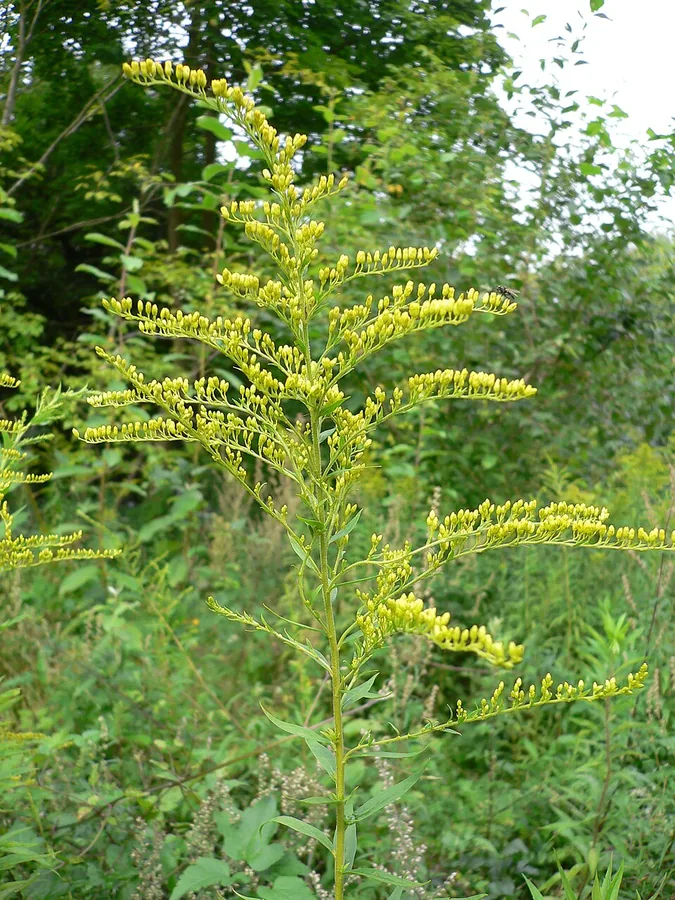
Goldenrod carries its flowers in dense plumes of tiny gold florets, each spray branching into hundreds of small blooms that mass into a single bright feather at the top of the stem. The stems stand tall and leafy, clothed to the tip in narrow, pointed leaves, and they rise straight up as a tough, long-lived perennial of the aster family. It grows wild across most of North America, and it opens its color in late summer when much else has gone over.
Those crowded flower heads are what make goldenrod such a magnet for pollinators. The shallow florets sit open to bees, butterflies, and beneficial insects just as other blooms run out, and once the gold fades the heads dry to tufted seed that feeds birds through winter. The whole plumed head earns its keep long past its bright weeks.
The plant's vigor shows below ground as much as above. Tall goldenrod pushes creeping rhizomes out through a bed and drops self-sown seed with abandon, so its leafy stems can thicken into a stand that shoulders gentler plants aside. A clump-forming species keeps a neater, tighter shape, while the tall types need dividing every few years to hold their spread.
Care
The short version: full sun and ordinary to poor, well-drained soil keep those leafy stems upright and the plumes bright. Water through long dry spells but otherwise let the rain do the work, skip the fertilizer, and divide vigorous clumps every few years to hold them in bounds.
Light
Goldenrod holds its leafy stems straight and packs its plumes fullest in full sun. It will take some partial shade, but then the stems stretch thin and flop and the flower heads thin out the less light they get.
Water
The roots of goldenrod settle happily into ground that holds steady moisture without ever turning to sodden mud, and once a clump has anchored in it barely flinches at a brief dry stretch. Across most temperate gardens the rain alone keeps it satisfied, so the hose comes out only when a long drought grips the soil.
Soil
It roots into clay or loam wherever the drainage holds, and it takes the poor, thin ground that stops fussier plants. A pH from 5.5 to 7.5 suits it, and lean soil keeps the stems stiff and self-supporting.
Temperature
Goldenrod is remarkably hardy, its stems and roots taking cold down to -29°F (-34°C) and heat past 95°F (35°C). That wide range is why it stands untended across so much of the continent.
Humidity
Average outdoor humidity is all it needs, so there is no figure to fuss over. Air movement counts for more, since still, muggy air is what lets rust and powdery mildew dull the leaves.
Feeding
Skip the fertilizer in all but the poorest ground. Goldenrod thrives on lean soil, and too much nitrogen swells the growth into floppy, weak stems, so give at most a light spring topdressing of compost.
Pruning
Cut the spent flower stems after bloom, or leave the tufted seedheads standing to feed birds through winter. Take all the stems to the ground in late winter before new growth breaks, and a pinch in early summer keeps the tall, leafy types from flopping.
Size & spacing
The leafy stems stand 2 to 6 feet (61 to 183 cm) tall and the clump spreads 4 to 6 feet (122 to 183 cm) wide, so give it real room. That broad spread is also why the vigorous species need dividing to stay in their lane.
When to plant
Goldenrod moves through the year in clear stages. Start seed in late winter or sow it outdoors in fall, set young plants out in spring once frost has passed, and watch the leafy stems build until they raise their gold plumes from late summer into fall.
Northern hemisphere
Southern hemisphere
Typical months for a temperate climate: start earlier in warm zones, later where spring frosts linger.
- Sow: Late winter, 8 to 10 weeks before last frost; seeds benefit from cold-moist stratification and need light to germinate
- Plant: Spring after the last frost, or in early fall
- Harvest: Late summer through fall (August to October)
Hardiness
USDA hardiness zones: 4–9
Temperature: down to -34°C
Troubleshooting
Goldenrod is rarely troubled by anything serious, and most of what marks the leaves and stems is only cosmetic. Crowding and damp foliage bring on the worst of it, so airflow clears more than any spray. Match what you see below and step in only when it bothers you.
Powdery rust-orange spots crusting the leaf undersides
Turn a leaf over and you may find raised blisters in orange or brown that crumble into a fine colored powder against your skin. This is rust, a fungus, and while it stains the foliage it rarely does lasting harm. It thickens fastest in packed, damp clumps, so strip the worst-marked leaves, thin or divide for airflow, and keep water off the foliage by aiming at the base.
Fix:
- Remove and destroy heavily infected leaves
- Improve air circulation by thinning or dividing crowded clumps
- Avoid overhead watering and water at the base
A white powdery crust filming the leaves and stems
A powdery gray-white film settles over the leaf surfaces like a dusting of flour, the mark of powdery mildew. It creeps in late in the season when nights turn humid or the plant sits in shade, and it looks far worse than it acts on a settled clump. Cut back the coated foliage, open the plant to more sun and moving air, and clear the fallen debris before winter.
Fix:
- Cut back affected foliage
- Increase spacing and sun exposure to improve air movement
- Remove infected debris at season end
Clusters of minuscule insects along the stem tips, glistening and sticky
Small, soft-bodied aphids crowd the tender stem tips and flower buds in dense little knots, and the sticky honeydew they leave glistens along the stems and pulls in ants. Goldenrod feeds so many beneficial insects that a light gathering is worth leaving alone. Wash the heavier clusters off with a strong jet of water, and reach for insecticidal soap only when they cling on.
Fix:
- Spray off with a strong jet of water
- Tolerate where possible since goldenrod supports many beneficial insects
- Use insecticidal soap only if infestation is heavy
Bulbous rounded knots swelling the stems
A smooth, rounded ball or a longer spindle-shaped bulge along the stem is a gall, formed where the goldenrod gall fly laid an egg and a larva grew inside the tissue. These swellings do the plant little harm and hold a meal for birds and wildlife through winter. Prune the marked stems out if the shape bothers you, but leaving them in place costs the plant nothing.
Fix:
- Prune out and discard galled stems if appearance is a concern
- Otherwise leave in place as galls rarely harm the plant and feed wildlife
Toxicity
Goldenrod is safe all around, with nothing toxic in its stems, leaves, or golden flowers for people, pets, or livestock. It carries the old blame for hay fever, but that belongs to ragweed instead. You can plant it freely where children and animals roam, and even steep the leaves into a herbal tea.
Safe for
People · Cats · Dogs · Horses · Rabbits · Livestock · Birds
Cats None
Goldenrod is safe around cats, with nothing in the slender leaves or golden flowers that harms them. A curious mouthful might bring a brief, mild stomach upset, no different from any plant a cat is not built to eat.
Dogs None
Dogs are safe near goldenrod, since it holds no toxic compounds in stem, leaf, or bloom. A dog that chews through a big mouthful of the foliage may drool or pass it loosely, and that eases on its own.
Horses Safe
True goldenrod is safe for horses and stands in many pastures without trouble. It is not the toxic lookalike sometimes confused with it, so grazing alongside its leafy stems poses no danger.
Rabbits Safe
Rabbits can browse goldenrod safely, nibbling the soft leaves and flower sprays as wild ones do. The plant holds no toxins, though any new green is best introduced in small amounts.
Livestock Safe
Cattle, goats, and sheep can graze around goldenrod without harm, as it carries no toxicity. They tend to pass its coarse stems by in favor of more tender forage.
Birds Safe
Birds are safe around goldenrod and gain from it, picking the ripened seeds from the spent heads and the insects its flowers draw. Nothing about the plant is harmful to them.
People Safe
People have nothing to fear from goldenrod, and its slender leaves and golden flower plumes carry a long tradition of being steeped into herbal tea. The hay fever blamed on it belongs elsewhere: its pollen grains are too heavy and sticky to lift off on a breeze.
Varieties
Goldenrod is not one plant but a whole genus, and the species differ in the height of their stems and the shape of their flower heads. These are the ones most worth knowing before you plant.
Solidago rugosa 'Fireworks'
A compact 3 to 3.5 foot selection whose arching sprays of tiny flowers spray outward like a burst of fireworks, and it creeps by rhizomes without turning invasive.
Solidago canadensis
The vigorous tall species, climbing 2 to 6 feet and topped with broad pyramidal heads of flowers, spreading fast by both seed and rhizome.
Solidago speciosa (Showy goldenrod)
An upright clump-former at home in poor, dry ground that keeps a tighter, more contained shape than the tall goldenrod.
Solidago caesia (Bluestem/wreath goldenrod)
A woodland goldenrod whose bluish arching stems carry their flowers tucked into the leaf axils, and it takes shade in stride.
How to propagate
Goldenrod multiplies with little effort, whether you split an established clump or start fresh from its small seed.
DivisionEasy
Spring or early fall; divide established clumps every 2 to 3 years to control spread and maintain vigor · One growing season
Division is the simplest way to make more goldenrod and to hold a spreading clump in check. In spring or early fall, lift the plant and pull apart the mat of pale roots into sections that each carry roots and shoots, then replant them at once. Done every 2 to 3 years, it keeps the clump vigorous, and each piece settles back in within a single growing season.
SeedEasy
Sow in fall outdoors or stratify and start indoors in late winter · Blooms typically in the second year from seed
Goldenrod grows easily from its small, tufted seed, though it asks for patience and light. Scatter the seed on the soil surface outdoors in fall, or stratify it and start it indoors in late winter, but never bury it, since it needs light to sprout. Plants usually flower in the second year, and they self-seed freely once established.
Myths
Goldenrod fills the late-summer air with allergy-causing pollen.
Goldenrod pollen is large, sticky, and heavy, so it clings to insects that carry it flower to flower and almost never lifts onto the wind. The real cause of late-summer sniffles is ragweed, a plain, green-flowered plant that blooms at the same time and casts off clouds of fine, wind-borne pollen. Goldenrod simply stands nearby in bright bloom, the obvious plant to blame when the sneezing starts.