Ornamental · Onagraceae
Gaura
Gaura lindheimeri
Give it full sun and lean, well-drained soil, and gaura lifts clouds of butterfly-like blooms on slender wands from spring to frost.
Full sun
Every 7–14 days
USDA 5–9
3–5 ft · 0.9–1.5 m
Overview
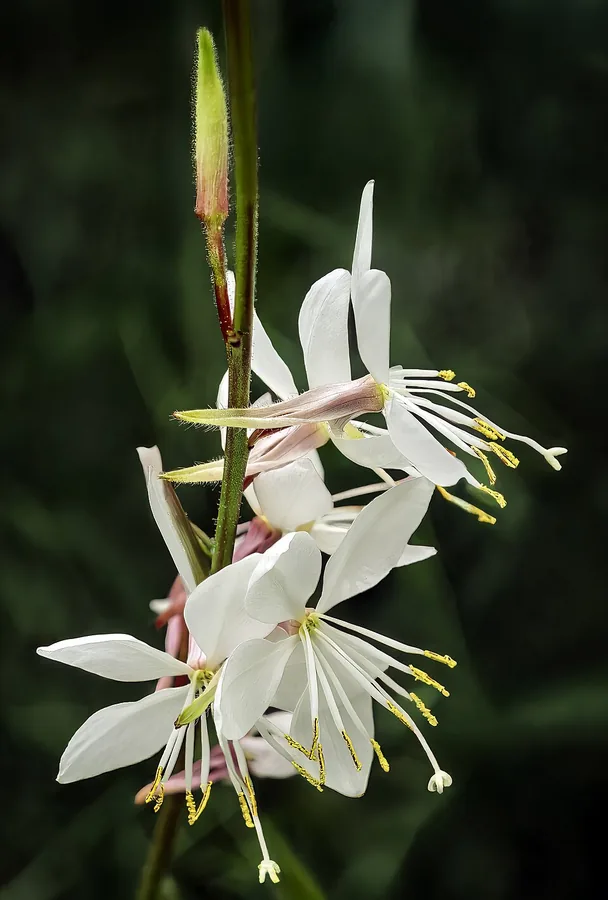
Look closely at gaura and the name whirling butterflies makes instant sense. Small white or pink flowers ride the tips of slender, wand-like stems, and each bloom sits so lightly that it seems to hover and flutter above the leaves at the slightest stir of air. It is a taprooted perennial in the Onagraceae family, built to hold its ground in tight, lean soil.
The whole plant reads as fine and airy. A deep taproot anchors it below while the thin, wiry stems rise up top, and it flowers more freely in poor ground than in pampered beds. Those same slim stems are the catch, since they bow and flop, so full sun, open spacing, and a sturdy neighbor or two keep them standing.
Hardy through zones 5 to 9, gaura carries its small flowers from late spring or summer to the first fall frost. Pollinators work the blooms, and the long, open flowering keeps the plant in motion at the front or middle of a sunny border.
Care
The short version: full sun, lean and sharply drained soil, and a deep but infrequent drink. Skip the rich feeding, deadhead to keep the wands flowering, and cut floppy stems back for a fresh flush.
Light
Gaura wants full sun to bloom fully and hold its wands upright. It takes a little partial shade, but in deeper shade the thin stems stretch, bow over, and carry far fewer flowers.
Water
Once established, the deep taproot carries gaura through drought and heat with ease. Water moderately, letting the top half of the soil dry between drinks, and avoid soggy ground, which brings on root rot. A deep soak every 7 to 14 days suits it far better than frequent sips.
Soil
Plant in sandy or loamy, sharply drained soil, since good drainage is the one thing gaura cannot do without. A slightly acidic pH of 5.5 to 6.5 suits it well. Skip rich, heavily amended beds, which push leafy growth at the expense of the flowers.
Humidity
Ordinary outdoor humidity is fine, so there is no number to chase. Airflow matters far more here, because crowded, still foliage is what lets powdery mildew dust the leaves and rust speckle their undersides.
Feeding
Gaura flowers best on a lean diet, so feed only lightly during the growing season, if at all. Rich or heavily fertilized soil reduces flowering and drives soft, floppy stems instead.
Pruning
Deadhead spent blooms to keep the flowers opening, and cut back floppy or leggy stems to draw a bushier rebloom. Shear the flower spikes in fall, then clear the dead foliage away in spring.
Size & spacing
Gaura climbs 3 to 5 feet (91 to 152 cm) tall on its slim wands and spreads 1 to 3 feet (30 to 91 cm) across. Give each plant that full spread so air moves through and the stems have room to stand.
When to plant
Gaura runs on the warm season and will not push out ahead of frost. Start seed indoors 6 to 8 weeks before your last spring frost, set plants out once the soil has warmed, and watch the wands open from late spring or summer through the first fall frosts.
Northern hemisphere
Southern hemisphere
Typical months for a temperate climate: start earlier in warm zones, later where spring frosts linger.
- Sow: Start seed indoors 6 to 8 weeks before the last spring frost.
- Plant: Transplant after the last spring frost once soil has warmed.
- Harvest: Blooms from late spring or summer through the first fall frosts.
Hardiness
USDA hardiness zones: 5–9
Temperature: down to -29°C
Troubleshooting
Most gaura trouble shows up in two places: down in the roots when the soil stays wet, or across the fine foliage when the air will not move. Read the early marks on leaves and stems and you can catch the cause before the plant suffers. Match what you see below, then act while it still helps.
Wilted growth, a blackened base, and a slumping plant
When the leaves go limp, the base turns black, and the whole plant sinks down, root rot is at work below the soil. Lift the crown and the roots show up dark, soft, and mushy in ground that stays wet long after watering. Move the plant to a raised or sandier spot, cut back the water, and pull any roots that have gone to mush.
Fix:
- Improve drainage or move the plant to a raised or sandier site
- Reduce watering and allow soil to dry between waterings
- Remove and discard severely rotted plants
A chalky white bloom across leaves and stems
A powdery white crust dusting the green surfaces is powdery mildew, and it settles in where the foliage stands crowded and the air hangs still. Drag a finger across a patch and the white lifts clean off the leaf. Thin and space the plants to let air slip through, strip away the worst-coated leaves, and keep water off the foliage.
Fix:
- Improve air circulation by spacing and thinning plants
- Remove affected foliage
- Avoid overhead watering
Raised rusty pustules speckling the leaf undersides
Small raised pustules in shades of orange to brown, studding the undersides of the leaves, are the mark of rust, a fungus that travels on damp, motionless foliage. Strip off the spotted leaves and destroy them before the specks spread across the plant. Open the growth for moving air, and aim water at the soil so the leaf surfaces stay dry.
Fix:
- Remove and destroy infected leaves
- Improve air circulation
- Avoid wetting foliage when watering
Thin stems stretching long and folding over
The slim, wiry stems draw out long and then bow toward the ground when nothing holds them, and rich soil or too much shade pushes them further into the sprawl. The bend shows most after rain weighs the stems or in a low-light corner. Cut the stretched stems back for a denser, bushier rebloom, set the plant in full sun and leaner soil, and let sturdy neighbors take the lean.
Fix:
- Cut back leggy stems to encourage bushier rebloom
- Plant near sturdy companions that provide support
- Grow in full sun and leaner soil
Toxicity
For a home with animals, gaura is easy on the mind: it is non-toxic across the board. It does not appear on the ASPCA list of plants toxic to dogs or cats, and no part of it poses a poisoning risk to pets, livestock, or people. Plant it freely wherever curious noses wander.
Safe for
People · Cats · Dogs · Horses · Rabbits · Livestock · Birds
Cats None
Gaura is safe around cats. A curious nibble at a leaf or bloom will not poison them, so there is nothing here to worry about.
Dogs None
Dogs share the garden with gaura at no risk. The plant is absent from the ASPCA toxic list, and a mouthful of its slender foliage does no harm.
Horses Safe
Horses graze near gaura in safety, since the plant carries no known toxin that would trouble them.
Rabbits Safe
Rabbits browse the thin leaves with no ill effect, though any fresh green is best brought in slowly.
Livestock Safe
Cattle, goats, and sheep graze around gaura without poisoning, as it poses no toxic threat in the pasture.
Birds Safe
Birds are fine around gaura. The airy flowers draw in pollinators, and nothing about the plant is toxic to them.
People Safe
Gaura is harmless to people. It is grown purely as an ornamental, so its wands and blooms can be handled and planted freely.
Varieties
A handful of named selections narrow gaura to a certain size and flower color. These are the ones worth knowing by name.
Whirling Butterflies
A compact 2 to 3 foot selection whose white flowers open from pink buds and seem to flutter on thin wiry stems, and it stays sterile so it will not self-seed.
Siskiyou Pink
A pink-flowered cultivar set off by dark stems and reddish new growth.
Belleza
A dwarf, compact series with a low, tight habit and dense bloom.
Summer Breeze
A taller form at roughly 3 to 4 feet tall and 2 to 3 feet wide, thick with pink-tinged white flowers.
How to propagate
You can raise more gaura from seed or by dividing an established clump, though the deep taproot calls for a gentle hand either way.
SeedModerate
Sow in spring; the species self-seeds readily while many named cultivars are sterile. · Blooms the first or second season from seed.
Sown in spring, the species scatters its own seed freely, and the first flowers open in the first or second season. Many named cultivars are sterile, though, so those get multiplied by division or cuttings rather than seed.
DivisionModerate
Divide in spring, taking care with the deep taproot. · Reestablishes over one growing season.
Divide in spring for more plants, but work gently around the deep taproot, which resents being disturbed. A clump knits back together over a single growing season, and where the taproot makes division risky, basal cuttings are the safer route.
Myths
Gaura needs frequent watering and rich, fertile soil to thrive.
The deep taproot lets it ride out drought and heat once it is settled in. Lean, well-drained soil is exactly what it wants, and rich ground with heavy watering thins the bloom and rots the roots.
Gaura is poisonous to dogs and cats.
It does not appear on the ASPCA list of plants toxic to dogs or cats. Gaura is regarded as non-toxic, a safe choice for a garden shared with pets.