Ornamental · Onagraceae
Fuchsia
Fuchsia × hybrida
Give it cool shade and steady moisture, and the fuchsia keeps hanging out its two-tone, eardrop-shaped flowers all season.
Partial shade
Every 2–4 days
59–70°F · 15–21°C
USDA 10–11
Overview
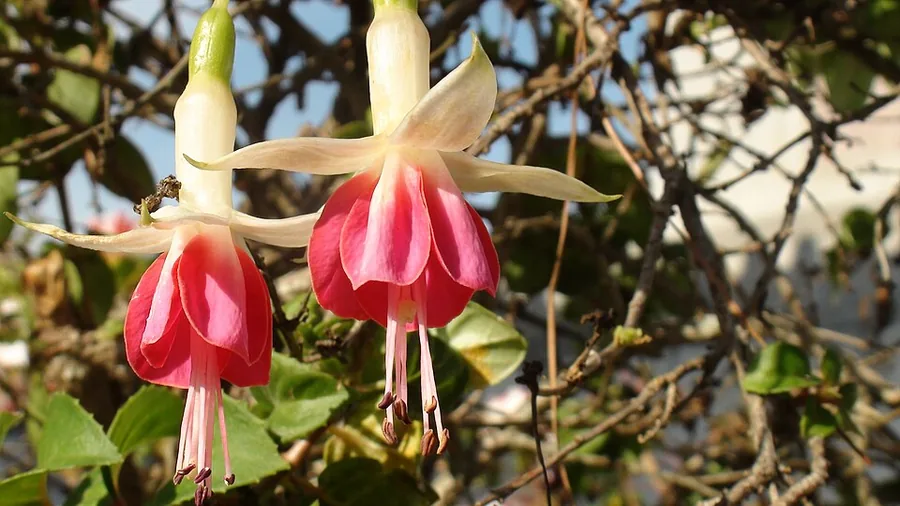
Little else in the garden matches a fuchsia at its peak. The flowers hang straight down off the stems on slender stalks, each one often painted in two contrasting colors, so a plant in bloom looks strung with tiny pendant eardrops, the very look that earned it the old name lady's eardrops. Most garden fuchsias are hybrids grown for exactly this display, whether trained up into an upright bush or let spill loose from a hanging basket.
At its core this is a shade lover. Fuchsias hit their stride in cool, part-shaded corners and languish in heat, so they pay back a gardener who tucks them into a sheltered spot away from the harsh afternoon sun. Look after them and they keep pushing out flowers from spring straight through fall.
Most gardeners raise fuchsia as an annual or move it under cover for the cold months, though the hardy types can stay planted in the ground where winters run mild. Either way it drinks deep and feeds hard, and it answers the effort with months of dangling bloom.
Care
The short version: cool part to full shade, soil kept evenly moist and never bone dry, a balanced feed every two weeks through the growing season, and shelter from hot afternoon sun and wind.
Light
Set a fuchsia in part to full shade, and the cooler the corner the better. It handles bright indirect light too, but hot afternoon sun burns the soft leaves and shuts the flowers off, so aim for a sheltered, shaded place.
Water
Hold the soil consistently moist and never let it dry out, since a thirsty fuchsia wilts in a hurry. Plants in pots and hanging baskets lose water fast and want frequent watering along with cover from drying wind. Cut back on the water in fall to nudge the plant toward dormancy.
Soil
Grow it in rich, moisture-retentive loam with a generous amount of organic matter dug in. A slightly acidic pH of 5.5 to 6.5 suits fuchsias, and a soil that stays damp without going waterlogged keeps the roots content.
Temperature
Fuchsias want cool conditions, ideally 59°F to 70°F (15°C to 21°C). When the average daily temperature climbs past 76°F (24°C) the flowers close down, so summer heat is the chief thing standing in your way.
Humidity
The plant prefers moist air, somewhere around 50% to 70% humidity. Dry air stresses the leaves and draws in spider mites, so a sheltered, faintly humid nook beats a wide-open, sun-baked one.
Feeding
Fuchsias are heavy feeders. Feed them a soluble, balanced complete fertilizer every two weeks all the way through the growing season to keep the flowers coming without a break.
Pruning
Pinch the new shoots once they have made two full sets of leaves to make the plant branch and fill out, then leave off pinching about a month before the first frost. For hardy types, cut them back in mid-March after the risk of a freeze has gone.
Repotting
Shift potted fuchsias into fresh mix every spring. Roots winding around the inside of the pot, soil that goes dry almost the moment you water, and growth that stalls all signal the plant has outgrown its container.
Size & spacing
Most plants stand 1.5 to 3 feet (46 to 91 cm) tall and spread 12 to 24 inches (30 to 61 cm) across. Leave each one room enough for air to slip freely around the leaves, which holds rust and mildew off.
When to plant
Fuchsias take their cue from cool air rather than the calendar's notion of summer. Root cuttings indoors in early spring, move plants outside after the last frost once nights hold above freezing, and expect flowers from spring through fall, with a quiet stretch when midsummer heat settles in.
Northern hemisphere
Southern hemisphere
Typical months for a temperate climate: start earlier in warm zones, later where spring frosts linger.
- Sow: Cuttings rooted indoors in early spring; seed germinates in 21-28 days at 70-75°F
- Plant: After the last spring frost when nights stay above freezing
- Harvest: Spring through fall, slowing in summer heat
Hardiness
USDA hardiness zones: 10–11
Temperature: down to -1°C
Troubleshooting
Most fuchsia problems trace to heat, or to a short list of pests and one or two fungi. Keep an eye on the flowers and turn the leaves over to check their undersides, since that is where the first signs appear. Match what you find below and step in before it takes hold.
Shoot tips swell into lumpy galls and the leaves flush red
The culprit is the fuchsia gall mite, so small the eye cannot catch it, and it warps the tender growing tips and flower buds into thick, blistered galls while the young leaves redden. Snip away and destroy every twisted, swollen part, then dab on horticultural oil or insecticidal soap every 2 to 3 weeks. Set the plant apart and wash your tools, hands, and clothes, since the mite rides from plant to plant with ease.
Fix:
- Remove and destroy all infested plant parts
- Apply horticultural oil or insecticidal soap at 2-3 week intervals
- Isolate infested plants and clean tools, hands, and clothing
The dangling flowers quit and the buds drop when heat arrives
Fuchsias set their pendant blooms in cool air, and the flowering stops once the average daily temperature climbs past 76°F (24°C). The plant has not given up, it is simply idling through the heat while the leaves may droop. Shift containers into deeper, cooler shade, hold the soil evenly moist, and the little eardrop flowers return as fall cools the air.
Fix:
- Move containers to a cooler, shadier location
- Keep soil evenly moist
- Provide protection from hot afternoon sun and wind
Powdery orange spots dusting the backs of the leaves
Those rusty pustules on the lower leaf surface are fuchsia rust, a fungus that colonizes the underside while the top of the same leaf may go blotchy yellow. Pluck off and destroy each spotted leaf, thin the stems so air can pass through the plant, and aim your watering at the roots rather than the foliage.
Fix:
- Remove and destroy affected leaves
- Improve air circulation
- Avoid wetting foliage when watering
Tacky leaves, black sooty film, and a puff of white specks
The likeliest offenders are whiteflies, which lift off in a snowy cloud when you brush the foliage and coat the leaves in sticky honeydew that darkens into black sooty mold. Aphids and spider mites cause the same mess, the first crumpling the leaves and the second freckling them with fine dots and threads of webbing. Hose the plant down, treat it with insecticidal soap or horticultural oil, and repeat to break the breeding cycle.
Fix:
- Rinse foliage with water
- Apply insecticidal soap or horticultural oil
- Repeat applications to break the life cycle
Toxicity
This one is easy to plant with confidence: fuchsia is safe across the board. The ASPCA rates it non-toxic to cats, dogs, and horses, no part of the plant holds a poison, and the small dark berries are even edible for people. It can go anywhere without a second thought for pets, livestock, or curious children.
Safe for
People · Cats · Dogs · Horses · Rabbits · Livestock · Birds
Cats None
The ASPCA files fuchsia among its non-toxic plants, so a cat that bats down a dangling flower and chews it takes no harm. A very large helping of any greenery can churn a stomach for a bit, but nothing in the plant is poisonous.
Dogs None
Cleared by the ASPCA for dogs. The leaves, the blooms, and the dark little berries all pass through without trouble, though a dog that wolfs down a mouthful of foliage might have soft stools for a day.
Horses None
Nothing to worry about with horses. The plant holds no compound that affects them, so a stray nibble at a trailing stem hanging within reach does no damage.
Rabbits None
A rabbit can graze on fuchsia freely. The soft leaves and pendant flowers are harmless, and the small dark berries are edible on top of that.
Livestock None
Goats, sheep, and cattle are safe browsing near fuchsia. Not one part of the plant, from stem to berry, holds a toxin that would bother them.
Birds None
Birds go straight for the ripe dark berries and come to no harm, often stripping the fruit off the stems before anyone else reaches it.
People None
The whole plant is safe for people, and the dark little berries are truly edible, carrying a soft sweetness that sometimes turns faintly peppery. Wait until they are fully ripe to pick them for the best taste.
Varieties
Garden fuchsias run to hundreds of named hybrids, but they fall into a handful of groups worth knowing before you buy.
Gartenmeister
A triphylla hybrid whose long, tubular flowers glow coral-red above dark bronze-green foliage, and it shrugs off summer heat better than most fuchsias.
Hardy fuchsia (Fuchsia magellanica types)
Sturdier, more shrub-like plants with woodier stems that can stay rooted in the ground and ride out milder winters outdoors.
Trailing or basket types
Weeping forms whose limber stems cascade over the edge of a hanging basket, in contrast to the upright, self-standing shrubs that hold at 1 to 2 feet (30 to 60 cm) tall.
How to propagate
Fuchsias are easy to multiply, and taking a cutting is the only dependable way to hold onto a hybrid exactly as it grew.
Stem cuttingsEasy
Spring or late summer using softwood cuttings about 6 inches long · Roots typically form in 2-4 weeks
Snip softwood cuttings about 6 inches (15 cm) long in spring or late summer and they strike roots in 2 to 4 weeks. Cuttings are the route to take with fuchsias, because the hybrid cultivars don't come true from seed and only a slip off the parent carries its exact flower shape and color forward.
Myths
Fuchsia berries are poisonous to people and pets.
Just the reverse holds. The ASPCA marks fuchsia as non-toxic to cats, dogs, and horses, and those dark little berries are safe and edible for people, tasting mildly sweet with a peppery edge once fully ripe.
Fuchsias grow best in full sun.
Fuchsias belong in the shade, not out baking in the sun. Their pendant flowers open best in part to full shade with cool temperatures, and a hot afternoon exposure fights against them, since heat above 76°F (24°C) closes the blooms down completely.