Houseplant · Euphorbiaceae
Crown of Thorns
Euphorbia milii
Sun on its bracts, dry roots, and gloved hands, and crown of thorns keeps blooming nearly all year.
Full sun
Every 7–14 days
50–86°F · 10–30°C
USDA 9–11
Overview
Crown of thorns lives up to its name on two counts: woody stems studded with sharp spines and a scatter of small blooms riding just above them almost without pause. The plant sits in the spurge family and behaves as a succulent, packing water into those swollen stems so it can ride out dry stretches that would wither a tenderer plant. Most growers keep it indoors on a sunny sill, where it flowers in fits and starts across the seasons.
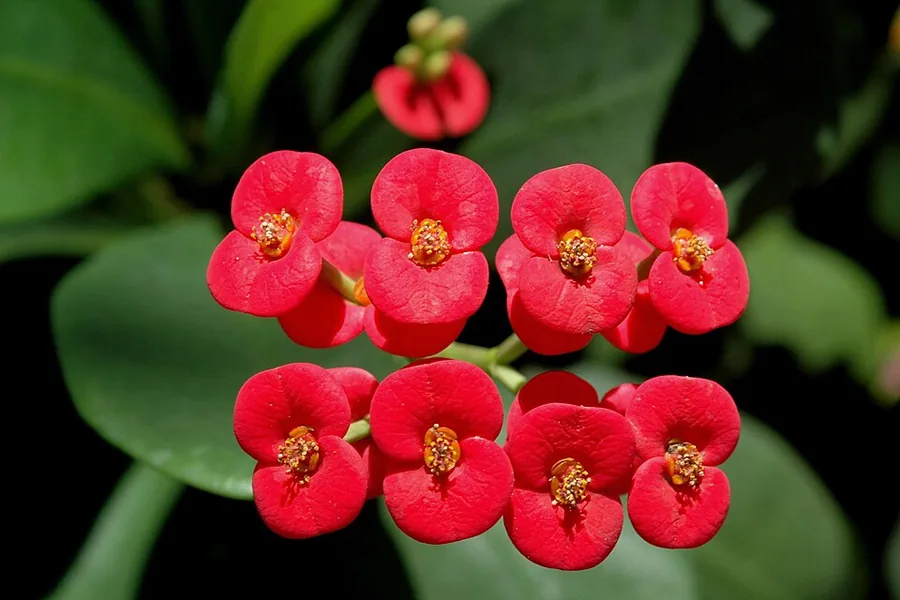
The part that reads as a flower is actually a pair of colored bracts, modified leaves in red, pink, or yellow that cup the minute true blooms tucked at their middle. Kept inside it holds to a tidy size and asks for almost nothing: hard light, a quick-draining pot, and a long thirsty gap between waterings. Its slow, measured growth means it seldom strains the space it sits in.
The trait that demands respect is the milky latex running through every stem. It scalds skin and eyes and inflames the mouth and gut if anything chews it, and the spines stack a second hazard on top. Work on it in gloves, set it beyond the reach of pets and children, and you have a tough, long-lived plant that gives far more than it takes.
Care
The short version: the hardest light you can manage, direct sun for choice, a gritty mix that sheds water almost at once, and a drink only after the soil has gone fully dry. Feed it sparingly through the warm season and always handle it with gloves.
Light
Hand it the strongest position you have, ideally several hours of direct sun against a south-facing pane. It will scrape by in bright indirect light, but the flowering tails off quickly as light wanes, and a shaded plant stretches thin and goes bare.
Water
Wait until the mix has gone fully dry before you water, then drench it and let it drain right through. In practice that lands around every 7 to 14 days, and a good deal less in winter. Wet, heavy soil is what kills it quickest, so always pour off the saucer.
Soil
Set it in a gritty, fast-draining mix built for cacti and succulents, the sort that water pours straight through. It sits comfortably across a pH of 6.0 to 7.5, so the drainage counts for far more than hitting any precise figure.
Temperature
Everyday room warmth suits it, anything from 50°F to 86°F (10°C to 30°C). Hold it above 50°F and clear of cold drafts, because cold paired with wet soil is exactly what sets off rot.
Humidity
This is a low-humidity plant that wants no part of misting or a soggy corner. Plain dry indoor air is precisely its preference, and steady airflow helps fend off rot.
Feeding
Feed once a month across spring and summer while it is actively growing, with a balanced or low-nitrogen liquid feed at half strength. Drop it altogether in winter, and keep a light hand year round, since heavy nitrogen drives leaves rather than blooms.
Pruning
Prune in spring to shape it and rein in its size, and treat this as the chore that calls for the most caution. Wear gloves and eye protection, since cut stems weep caustic latex and bristle with sharp spines. Cut cleanly, keep the sap off your skin, and wash tools and hands when you are done.
Repotting
Step it up a pot size every 2 to 3 years, or sooner if roots wind around the base and water shoots straight through. Repot in spring into fresh gritty mix with gloves on, and resist jumping it into a pot far bigger than it needs.
Size & spacing
Inside it climbs to roughly 2 to 6 feet (60 to 180 cm) over many years, fanning out 1 to 2 feet (30 to 60 cm) across. Its slow pace keeps it neat, so a lone plant rests easily on a sill without crowding its neighbors.
Troubleshooting
Nearly every crown of thorns complaint comes down to water or light. A soft, yielding stem signals a surplus of one; a stubborn refusal to flower signals a shortage of the other. Find the match below and act before a minor slip turns into rot.
Leaves going yellow above stems that have turned soft and pulpy
When the base of a stem turns dark and squishy under a thumb, you are looking at stem and root rot, and the culprit is nearly always water sitting in a mix that won't drain. Put the watering can away, let everything dry hard, and carve out the dead tissue with a sterile blade. Where rot has crept up the plant, move it into fresh gritty mix and hold off until the soil feels bone dry.
Fix:
- Stop watering and let the soil dry out completely
- Remove rotted tissue with sterilized tools
- Repot into fresh gritty, fast-draining mix if rot is advanced
Stems and leaves look fine, yet hardly a bloom appears
This plant flowers in proportion to the light it gets, so one parked a few feet back from a bright window will stay green and bare. Pile on the nitrogen and you push leafy growth at the cost of those colored bracts, which deepens the problem. Shift it into the strongest light you can find, full sun for preference, and feed a low-nitrogen formula at half strength.
Fix:
- Move to the brightest spot available, ideally full sun
- Switch to a low-nitrogen fertilizer at half strength
Foliage shedding through the late autumn and winter months
A bit of leaf shedding as daylight thins out is ordinary winter dormancy rather than anything wrong, provided the stems still feel firm to the touch. Cut back on water for the resting stretch and pick up your usual routine once spring brightens the days again. A warm, well-lit spot keeps the bare patches to a minimum.
Fix:
- Reduce watering during the rest period
- Resume normal care as light increases in spring
Toxicity
Treat this plant with real care. Each stem leaks a caustic milky latex that burns skin and eyes and inflames the mouth and gut when chewed, and the sharp spines pile a physical danger onto the chemical one. Set it well clear of pets and children, and put on gloves and eye protection any time you prune it or move it.
Toxic to
Cats · Dogs · Horses · Rabbits · Livestock · Birds · People
Cats Toxic
Bite into a stem and a cat takes in a mouthful of the burning latex, after which it tends to drool, swipe a paw at its muzzle, and bring the contents back up. Sap smeared on fur or worked into an eye leaves raw, weeping soreness, and one of those sharp spines can jab an inquisitive nose.
Dogs Toxic
Gnawing the plant scalds the mouth and the gut alike, so look for streams of drool, a tender mouth, vomiting, and a dog that turns away from its bowl. The milky sap nips at skin and eyes wherever it lands, and the spines bring a genuine chance of cuts.
Horses Toxic
That same biting sap raises blisters across the lips and mouth and churns up the gut. A horse that noses or mouths the plant may drool, turn from its feed, and show signs of colic, while the spines snag and tear at soft muzzle skin.
Rabbits Toxic
This is one to set far beyond reach. The irritant latex sets a rabbit's mouth and tender gut alight, and an animal this small has very little room to absorb the kind of digestive upset it sets off.
Livestock Toxic
Cattle, goats, and sheep that nibble the stems take burning to the mouth and gut from the diterpene-ester sap, which brings drooling, loss of appetite, and digestive trouble. Most stock steer clear of the spiny stems unless grazing is scarce.
Birds Toxic
The biting latex is just as harsh for birds, inflaming the beak, mouth, and crop when one pecks or chews at the stems. Place the plant somewhere a pet bird simply cannot get to it.
People Caution
Nothing on this plant belongs in a mouth, and the milky sap is the true danger. It blisters and burns bare skin into dermatitis and can bring real pain or harm if it works into an eye, and the spines deliver sharp punctures, so put on gloves and eye protection and keep it clear of small children.
Wear gloves AND eye protection when pruning or handling; the stems also bear sharp spines that puncture skin. If latex contacts skin, wash it off promptly with soap and water; if it reaches the eyes, flush with water immediately. Keep cuttings and sap off bare skin.
Helpline numbers

United States
ASPCA Animal Poison Control: (888) 426-4435 (fee applies)
Poison Control: (800) 222-1222



Canada
Poison Centres: 1-844-764-7669
Varieties
Crown of thorns turns up in a small set of named forms, ranging from squat dwarfs to the big-bracted Thai hybrids. Here are the ones you are most apt to come across.
Euphorbia milii var. splendens
A strong-growing form bearing larger, brighter red bracts on thick stems that are heavily set with spines.
'Short and Sweet'
A compact dwarf that keeps to a size you can sit in a pot on a windowsill, and it settles into indoor life with ease.
Giant crown of thorns (Thai hybrids)
These hybrids throw out outsized bracts in red, pink, yellow, and two-tone blends.
How to propagate
Crown of thorns multiplies readily from cuttings, provided you deal with the caustic sap carefully at the outset.
Stem cuttingsEasy
Spring or early summer during active growth · 4 to 8 weeks to root
Stem cuttings are the simplest route to more plants, snipped in spring or early summer while growth is active. Pull on gloves and eye protection, rinse or dab the caustic latex from the cut end, and leave the cutting to callus for a few days before it goes into a gritty, barely damp mix. Keep it warm and brightly lit and it puts down roots in 4 to 8 weeks.
Myths
The colorful red parts are the plant's true flowers.
Those vivid red, pink, or yellow paddle shapes are bracts, which are modified leaves and not petals at all. The genuine flowers are the small clustered bits at the very center, tiny and easy to overlook beside so much color.
Crown of thorns is a kind of cactus.
The spines certainly suggest one, but this is a member of the spurge family Euphorbiaceae and a succulent rather than a cactus. The tell is the milky latex that wells up from a cut stem, which is something no cactus does, and that sap is caustic.