Houseplant · Euphorbiaceae
Croton
Codiaeum variegatum
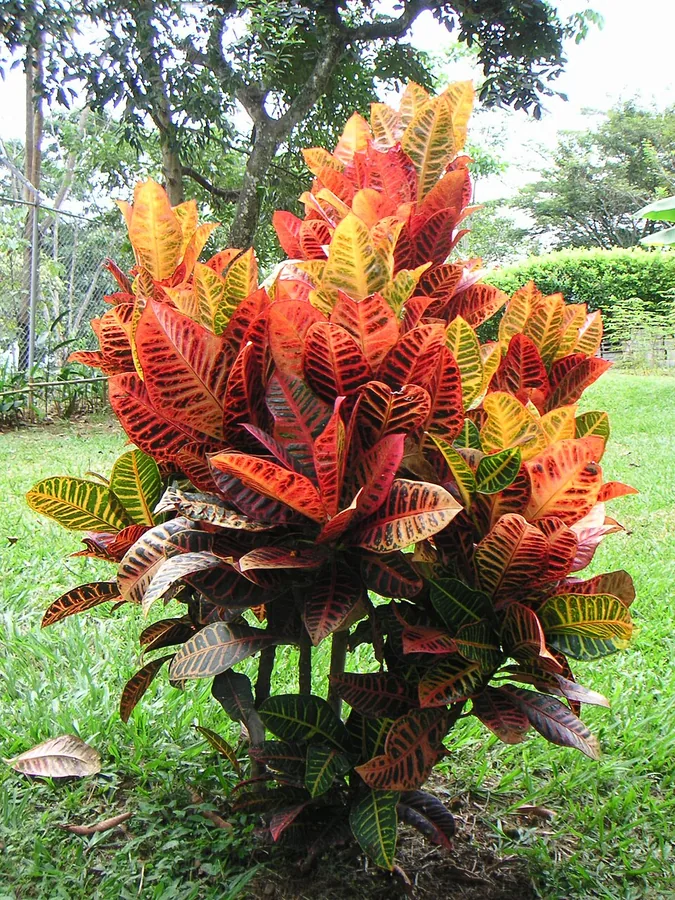
Given bright light and steady, humid warmth, the croton unfurls thick, leathery leaves brushed in red, orange, and gold.
Bright indirect
50–85°F · 10–29°C
USDA 11–12
2–8 ft · 0.6–2.4 m
Overview
The croton's leaves are the whole show, broad and thick and leathery, marked with red, orange, yellow, and green in combinations that fall differently across every plant. The species behind them is Codiaeum variegatum, a woody evergreen of the spurge family whose native range runs from Malesia into the southwest Pacific. Indoors the stems stiffen into a bold shrub that lifts those painted leaves past head height as it ages.
What loads the leaves with color is light. Under a bright spot with a little direct sun the reds and golds saturate and the veining sharpens, while in a dim corner the fresh leaves emerge greener and flatter, the markings barely there. The plant carries the heavy, glossy foliage of a tropical native that wants warmth and humidity, and a sudden move or a cold draft can send a whole flush of those leaves to the floor.
The plant takes some tending, but the leaves repay it once it has steadied. Keep it warm, water as the top of the soil dries, and keep the milky sap off your skin and away from pets, since every part of the plant, leaf, stem, and root, runs with an irritant.
Care
The short version: bright light with some direct sun deepens the leaf color, warmth stays above 50°F (10°C), humidity stays high, and water comes only when the top half-inch to inch of soil dries.
Light
Light is what paints the leaf, and the more it gets the deeper the reds, oranges, and yellows run. Give it bright indirect light with some direct sun, since in shade the new leaves come in flat and green. Harsh, all-day sun overdoes it and bleaches the most exposed leaves to a dull gray, so filtered or shifting sun keeps the color clean.
Water
Water when the top half-inch to one inch of soil dries, soak it through, and let the surplus run off. Pull back in winter as growth slows. The thick leaves go limp and drop at either extreme, so they suffer when the soil sits soggy or dries out hard for long.
Soil
Set it in a well-drained, humus-rich mix thick with organic matter. Drainage counts most, because water held against the roots brings on rot in a plant whose leathery leaves otherwise want the soil kept evenly moist.
Temperature
Hold it between 50°F and 85°F (10°C to 29°C), never below 50°F. Cold drafts, chilled glass, and quick swings loosen the leaves at the stem until they fall, so a warm, steady spot keeps the foliage on the plant.
Humidity
Croton wants high humidity like the tropical air it came from, and dry indoor air dries the leaf edges until the tips brown and curl. Cluster it with other plants, stand the pot on a pebble tray, or run a humidifier through the heating season.
Feeding
Feed a general-purpose fertilizer through the growing season, spring into autumn, while new leaves keep unfurling from the tips. Drop to a light hand in winter, when the plant stops pushing fresh growth.
Pruning
Croton stands a hard cut in early spring, before new growth breaks, the moment to take down a plant gone leggy and bare-stemmed. Cutting the stems back wakes lower buds into fresh, leafy branches. Wear gloves, since each cut weeps the irritant sap.
Repotting
Repot every 1 to 2 years, or sooner once rootbound, into a slightly larger pot in spring. Roots circling out of the drainage holes, water running straight through, and growth that has stalled all show the rootball has filled the pot.
Size & spacing
Indoors the woody stems carry the leaves to 2 to 8 feet (61 to 244 cm) tall and 2 to 6 feet (61 to 183 cm) across, taller still in the tropics. Leave space so air moves between the broad leaves and they do not press against one another.
Troubleshooting
Almost every croton problem writes itself onto the leaves, in their color, their texture, and where they fall, and the cause is usually light, water, humidity, or a change it did not like. Read the look of the foliage below to catch a slip before the stems are left bare.
Limp stems gone soft above dark, foul soil
When the leaves wilt while the soil stays wet, root rot has set in from overwatering or a pot that will not drain, and the roots turn brown and mushy instead of firm and pale. Stop watering, lift it into fresh, well-drained mix in a pot with drainage holes, cut away the rotted roots, and water again only once the top of the soil dries.
Fix:
- Stop watering and allow the soil to dry to the appropriate level
- Repot into fresh, well-drained, humus-rich mix in a pot with drainage, trimming rotted roots
- Resume watering only when the top half-inch to inch of soil dries
Leathery leaves let go suddenly after a chill or move
When the leaves loosen and fall all at once, the trigger is usually a new spot, a cold draft, or a temperature swing. Cold below 50°F (10°C) and soil that lurches between soggy and bone dry pull the leaves down the same way. Hold it in one warm, stable place, water it evenly, and new leaves push back out along the stems.
Fix:
- Settle the plant in one stable, warm, draft-free spot and avoid further moves
- Keep temperatures above 50°F / 10°C and away from cold windows, doors, and vents
- Maintain consistent moisture, watering only when the top half-inch to inch of soil dries
Silvery webs and pinprick speckling over the leaves
Hot, dry air brings spider mites, which spin fine webbing and leave a speckled, dusty stippling over the undersides of the leaves. Rinse the foliage and raise the humidity to set them back, then treat with insecticidal soap or horticultural oil and repeat as directed. Keep the plant away from the others until it is clean.
Fix:
- Rinse foliage and increase humidity
- Treat with insecticidal soap or horticultural oil, repeating as directed
- Isolate the plant to limit spread
Waxy white tufts and brown bumps with a glossy film
White cottony tufts tucked into the leaf joints are mealybugs, while the immobile brown bumps stuck along the stems are scale, and both leave a sticky film of honeydew on the leaves. Dab the visible pests off with an alcohol-soaked swab, then treat with insecticidal soap or horticultural oil and keep at it. Set the plant apart from the rest until the bugs are gone.
Fix:
- Wipe off or dab visible pests with an alcohol-moistened swab
- Treat with insecticidal soap or horticultural oil, repeating as directed
- Isolate the plant until the infestation is cleared
Red and gold leaves greening over
In too little light, each new leaf opens greener and duller, the reds and golds thinned out and the veining muted. A brighter spot, ideally with some direct sun, brings the color back across the fresh growth. Where a sunny window is scarce, 'Petra' keeps more of its color in interior light.
Fix:
- Move to a brighter spot with bright indirect light, ideally with some direct sun
- For best color give the brightest light the plant can tolerate without scorching
Gray, crisped patches on the most sun-facing leaves
Pushed into harsh, all-day sun, the most exposed leaves lose their depth and fade to a flat gray, dull, or scorched surface. Bright but filtered light, or sun that moves across the day rather than dwelling for hours, keeps that from happening. A slow increase in light lets the leaf tissue adjust instead of burning.
Fix:
- Provide bright but filtered/indirect light or shifting sun rather than intense all-day direct sun
- Acclimate gradually when increasing light
Lower leaves yellowing and dropping off
When the yellowing and loss gather low on the plant, on the shaded leaves, the spot is simply too dim. Brighten it and turn the plant so light reaches the lower leaves more evenly. Lift away any leaf that has fully spent and let go.
Fix:
- Increase light levels
- Remove fully spent leaves and reposition for more even light exposure
Brown, crispy tips and leaf edges
Dry indoor air pulls moisture from the leaf margins until the tips brown and crisp, since croton wants high humidity, and soil left too dry between drinks deepens it. Group the plants, set the pot on a pebble tray, or run a humidifier, and keep the soil evenly moist by watering once the top half-inch to inch dries.
Fix:
- Raise humidity with a pebble tray, grouping plants, or a humidifier
- Keep soil evenly moist (not wet), watering when the top half-inch to inch dries
Toxicity
Look closely at a cut croton and you will see beads of milky sap rise from the wound. That latex carries irritant diterpene esters that can inflame the mouth and gut of pets and raise contact dermatitis on skin, and no part of the plant is safe to eat. Wear gloves when you cut it, and keep the leaves and trimmings away from animals and children.
Toxic to
Cats · Dogs · Horses · Rabbits · Livestock · Birds · People
Cats Mild
A cat that chews a leaf usually drools and may vomit or pass loose stools, and the milky sap leaves the mouth and skin red and irritated.
Dogs Mild
A dog that gnaws the plant tends to drool, turn queasy, and sometimes pass diarrhea, while sap smeared on the muzzle or paws reddens the skin.
Horses Caution
The same irritant sap stings the mouth and gut, so keep a horse from grazing or mouthing the leaves and any cut stems.
Rabbits Caution
A small grazer should not be nibbling these leaves at all, since the diterpene esters in the sap inflame the mouth and digestive tract, so keep it well out of reach.
Livestock Caution
Goats, sheep, and cattle should stay away from the plant and any prunings, since the caustic sap irritates the mouth and stomach if the leaves are eaten.
Birds Caution
A curious bird can be harmed by the irritant sap, so keep it clear of the leaves and any chewed or fallen pieces.
People Caution
No part of the croton is edible. The milky sap is a caustic irritant to skin and eyes that can raise contact dermatitis, so wear gloves when you cut it and keep the leaves away from children.
Wear gloves when cutting or propagating; the milky sap can irritate skin and mucous membranes and may stain. Keep cut surfaces and fallen leaves away from pets and children
Helpline numbers

United States
ASPCA Animal Poison Control: (888) 426-4435 (fee applies)
Poison Control: (800) 222-1222



Canada
Poison Centres: 1-844-764-7669
Varieties
The named cultivars are told apart by the shape of the leaf and how the colors fall across it, from broad ovals to narrow twists. These are the ones you are most likely to see up close.
'Petra'
The most common cultivar, its dark green leaves cut through with veins of yellow, pink, and orange-red, and the one UF/IFAS singles out for holding its color well in indoor light.
'Gold Dust'
Its rounded, oval leaves are bright green and flecked all over with golden yellow.
'Mammy'
Its leaves are narrow and twisting, caught in a bright jumble of colors.
'Eleanor Roosevelt'
Its medium green leaves are dotted with golden yellow that deepens to a dark red.
'Andreanum'
Its leaves are broad and oval and yellow, edged and veined in gold.
'Spirale'
Its red and green leaves twist into a loose spiral down the stem.
'Majesticum'
Its leaves grow long, around nine inches, banded across in yellow and red.
How to propagate
Croton grows on from cuttings or from a rooted stem by air-layering, and both keep a named cultivar's leaf pattern true to its parent. Wear gloves either way, since cutting the stem releases the milky sap onto skin.
Stem cuttingsModerate
Summer · Several weeks to root
In summer, softwood or tip cuttings rooted in a moist medium take several weeks to set roots and hold firm. Wear gloves, since the cut weeps milky, irritant sap. Cuttings reproduce the parent's leaf pattern exactly, while seedlings come out looking nothing like it.
Air layeringModerate
Spring · Several weeks
Croton air-layers easily in spring, putting out roots along the wounded stem over several weeks before it is severed and potted. Wear gloves here too, since the cut stem leaks irritant sap onto skin.
Myths
The vivid-leaved houseplant is a true Croton-genus plant.
Despite the name, the plant in front of you is Codiaeum variegatum, not a species of the genus Croton. The two share the Euphorbiaceae family, but Kew's Plants of the World Online lists Codiaeum variegatum as the accepted name in its own genus. The common name is only a carryover.
A croton casting off leaf after leaf is dead already.
Heavy leaf drop is the plant reacting to change, not dying back. A move, a draft, cold below 50°F, or uneven watering can each set it off. Once you steady its conditions it usually recovers and pushes fresh leaves back out along the stems.
A croton's fiery leaves stay vivid in any light.
The color in each leaf depends entirely on light. In a dim spot the leaves slide back toward plain green and the markings fade out, while bright light, often with some direct sun, is what draws the color out. Too much harsh sun goes the other way and bleaches the leaf surface to gray.