Vegetable · Euphorbiaceae
Cassava
Manihot esculenta
A tall, woody shrub whose swelling underground roots feed millions.
Full sun
Every 7–14 days
59–95°F · 15–35°C
240–360 days
Overview
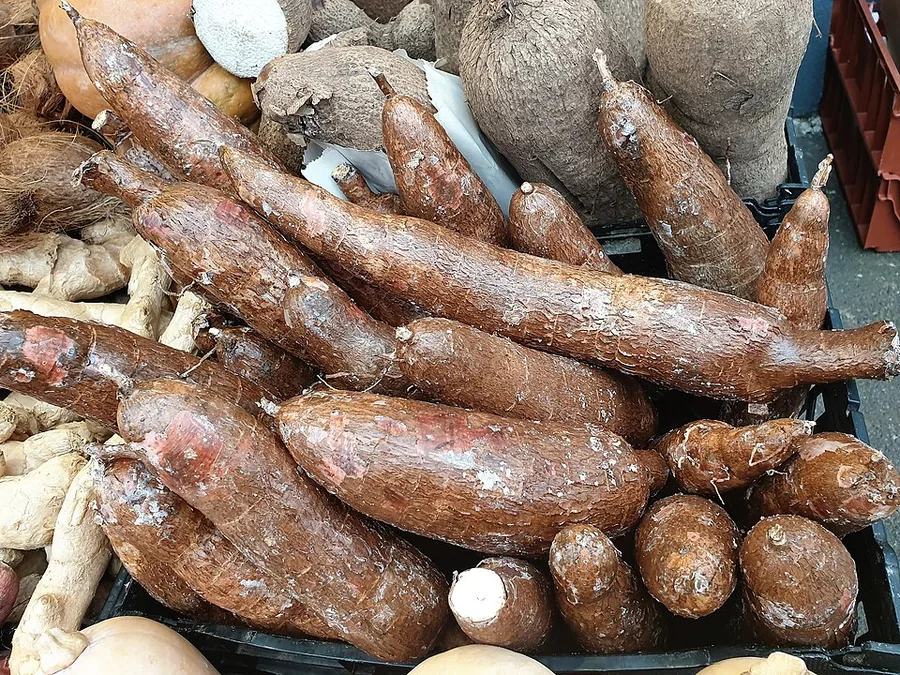
Cassava is a woody tropical shrub in the spurge family, Euphorbiaceae, native to South America and grown there for thousands of years. It stands tall at 5 to 10 feet (1.5 to 3 m) and spreads wide at 3 to 6 feet (90 to 180 cm), all of it supported by woody stems that thicken with age. Beneath the soil it builds the part people grow it for: starchy storage roots that swell and bulk as the season runs on.
Above ground the plant grows at a moderate, steady pace as a perennial that lives outdoors only, never in a container. The woody stems do double duty: at the close of the season they are cut into stakes and saved as next year's planting material. Underground, the tubers keep packing on starch for many months before they are firm and full enough to lift.
This is a major staple crop across warm regions, and the plant earns that role by shrugging off drought once it is settled. Its toughness comes with a hard rule, though: every part holds cyanide-forming compounds, so the roots and leaves are only safe to eat after careful peeling, soaking or grating, and thorough cooking.
Care
The short version: give cassava full sun and well-drained sandy loam, plant woody stakes once frost is past and the soil is warm, then water young plants to settle them in and ease off after that since it is highly drought-tolerant. Feed a balanced NPK with potassium at planting, keep it out of waterlogged ground, and lift the swelling roots 8 to 18 months later, always before the first frost.
Light
Full sun suits cassava best and brings out the strongest growth in the woody shrub, though it will tolerate partial shade. The more light it gets, the better the tubers bulk underground.
Water
Once settled in, cassava is highly drought-tolerant and copes with dry spells well. Water young plants to establish them, then cut back, giving a drink every 7 to 14 days in dry weather and letting the top 3cm dry between. Standing water rots the roots and ruins the swelling tubers, so never let the soil stay waterlogged.
Soil
Plant into well-drained sandy loam with a pH of 5.5 to 6.5. Loose, free-draining ground lets the starchy storage roots swell freely and keeps them away from the wet conditions that bring on rot.
Temperature
Cassava wants warmth, thriving between 59°F to 95°F (15°C to 35°C). It is frost-tender: a night near freezing blackens the foliage and stems, so keep it strictly within the warm season unless your climate stays frost-free.
Humidity
Average humidity of 40% to 70% works fine, and the plant copes with drier air without complaint. No misting or extra moisture is needed.
Feeding
Apply a balanced NPK with adequate potassium for root development at planting time, and that single feeding carries the crop. The potassium especially helps drive the bulking of the roots.
Pruning
Keep pruning light. Strip off the lower lateral shoots to steer growth upward, and cut away any frost-killed or damaged stems. At season's end, save the healthy woody stems as stakes for next year's planting.
Repotting
not typically container-grown
Size & spacing
Allow room for a tall, wide-spreading shrub that reaches 5 to 10 feet (1.5 to 3 m) high and 3 to 6 feet (90 to 180 cm) across. Space plants so the woody, spreading frame has space to fill out above the bulking roots below.
When to plant
Cassava runs on warmth from start to finish. Push woody stakes into warm soil only after frost danger has passed, let the tubers bulk underground through the long growing months, and dig the roots 8 to 18 months later before cold returns.
Northern hemisphere
Southern hemisphere
Typical months for a temperate climate: start earlier in warm zones, later where spring frosts linger.
- Plant: Plant woody stem cuttings (stakes) after all danger of frost has passed and soil is warm.
- Harvest: Harvest roots 8-18 months after planting, once tubers have bulked.
Hardiness
USDA hardiness zones: 9–11
Temperature: down to -7°C
Troubleshooting
Most trouble with cassava traces back to three things: a virus that mottles and distorts the leaves, wet soil that rots the swelling tubers underground, and cold that blackens the whole plant. Each shows clear physical signs in the foliage, stems, or roots.
Mottled, twisted leaves point to mosaic virus
When yellow-green mosaic mottling marbles across the foliage and the leaves pucker and distort, cassava mosaic virus has taken hold. The plant stunts as the patterning spreads. There is no cure once infected, so pull and destroy affected plants, replant from certified virus-free stakes, and keep whiteflies in check since they carry it from plant to plant.
Fix:
- Remove and destroy infected plants
- Use virus-free planting material
- Control whitefly vectors
Cold turns leaves and stems black
A night near or below freezing leaves the foliage and stems blackened and slumping, because this is a frost-tender shrub with no cold defense. Dig the roots ahead of any frost, and outside the warmest zones treat the whole thing as a single warm-season crop, planted and harvested inside the frost-free window.
Fix:
- Harvest roots before frost
- Protect or relocate if possible
Soft, foul-smelling tubers mean the roots are rotting
Underground, the storage roots that should be firm and swelling turn soft, discolored, and foul-smelling while the plant above wilts. Soil that sits waterlogged or poorly drained is the trigger. Plant on ridges or a free-draining site, ease back on water, and dig the roots once they have bulked rather than leaving them to sit wet.
Fix:
- Improve drainage
- Avoid overwatering
- Harvest promptly once mature
Toxicity
Cassava is a staple for millions, yet every part of the plant, roots and leaves alike, holds cyanide-forming compounds that release hydrogen cyanide when the tissue is damaged. Raw or half-processed material is genuinely poisonous to people and animals, so treat all unprocessed parts as dangerous.
Toxic to
Cats · Dogs · Horses · Rabbits · Livestock · Birds · People
Cats Severe
A cat that chews raw cassava may drool heavily and vomit, then move into labored breathing, dilated pupils, and weakness; in serious cases it progresses to convulsions and collapse.
Dogs Severe
Expect drooling and vomiting first, followed by breathing trouble and a staggering, unsteady gait; severe exposures can bring on seizures.
Horses Toxic
A horse shows fast, distressed breathing along with trembling and stumbling; a large enough dose can be fatal.
Rabbits Toxic
Small bodies handle cyanide poorly, so a rabbit can decline quickly with weakness, gasping, and twitching.
Livestock Severe
Cattle, goats, and sheep show rapid breathing and drooling, then staggering, muscle tremors, and in bad cases convulsions and collapse.
Birds Toxic
Poultry and pet birds develop labored breathing and sudden weakness; their small size means even a modest amount is serious.
People Caution
A staple for millions, but only after peeling, grating or soaking, and cooking; raw or half-processed roots and leaves release cyanide that causes vomiting and dizziness, and steady under-processing can lead to konzo paralysis, so never eat any part raw.
Proper processing (peeling, grating/soaking, and thorough cooking) drives off the cyanide and renders cassava safe to eat; the raw plant and unprocessed roots/leaves are dangerous. Keep raw plant material away from children and animals.
Helpline numbers

United States
ASPCA Animal Poison Control: (888) 426-4435 (fee applies)
Poison Control: (800) 222-1222


Canada
Poison Centres: 1-844-764-7669
Varieties
Cassava splits into two broad types set apart by where the cyanide-forming compounds sit inside the root. Both still need peeling and cooking; the difference is how much processing it takes to make the starchy flesh safe.
Sweet cassava
Carries fewer cyanide-forming compounds, with most of them concentrated in the peel of the root; the flesh still has to be peeled and cooked before it is safe.
Bitter cassava
Holds cyanide-forming compounds all through the flesh of the root, so it demands heavy processing: grating, soaking, fermenting, and cooking.
How to propagate
Cassava is grown from woody stem cuttings, not from tubers or seed. Take stakes from mature, healthy stems, set them in warm soil at the start of the season, and watch for fresh shoots and roots within a few weeks.
Stem cuttingsEasy
Plant mature woody stem cuttings (stakes) at the start of the warm season after frost danger has passed. · 2 to 4 weeks for sprouting and rooting
Cut stakes 20 to 30 cm long from mature, healthy woody stems rather than tubers or seed, push them into warm soil at the start of the warm season, and new shoots and roots break in about 2 to 4 weeks.
Myths
A quick boil makes any cassava safe to eat.
Bitter types must be peeled, grated, soaked, and cooked at length; a brief boil leaves far too much cyanide behind, and under-processing over time leads to cyanide poisoning and konzo paralysis.
Only the roots of cassava are poisonous.
The leaves carry the same cyanide-forming compounds as the roots; both have to be properly processed before any person or animal can eat them safely.