Shrub · Rubiaceae
Coffee
Coffea arabica
Give it warmth, bright indirect light, and humid air, and the coffee plant fills out into a glossy evergreen that may one day hang with its own red cherries.
Bright indirect
Every 5–7 days
59–82°F · 15–28°C
USDA 10–11
Overview
Native to the cool upland forests of Africa, coffee is a tropical evergreen that spends its wild life rooted in the filtered gloom under a canopy of larger trees. The leaves draw the eye first: rich green, thick, and lacquered with a high shine, set in facing pairs along the stems and drawn out to a fine tip. Its woody trunk can rise to a small tree out in the open, yet in a pot or a bed it holds to a dense, leaf-heavy shrub.
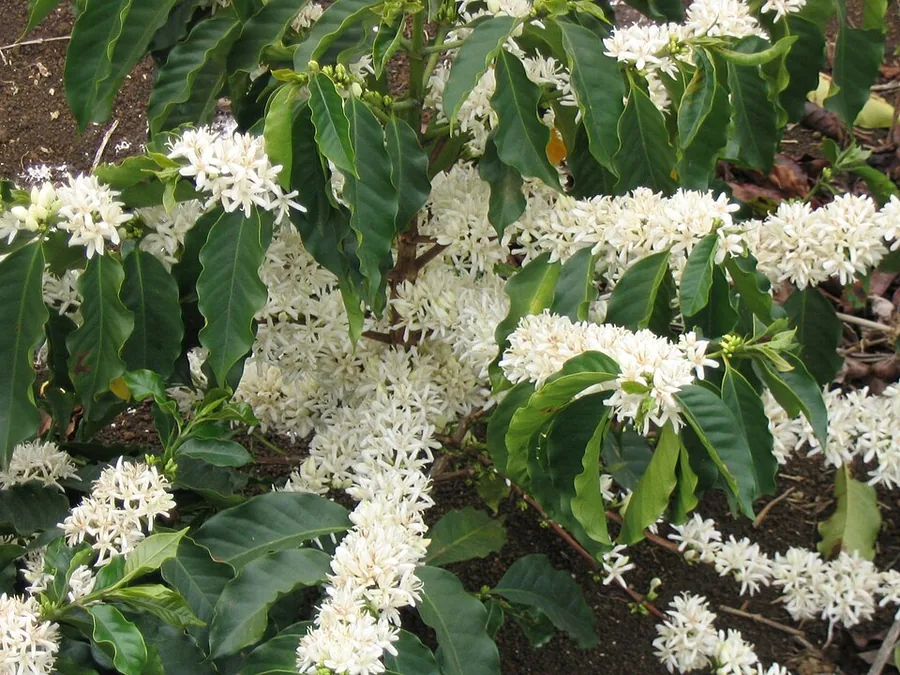
Up close, the foliage is what holds attention, broad blades with a smooth, slightly leathery surface that reflects the light. Given warmth and time the plant opens fragrant white flowers in small clusters where the leaves meet the stem, and red cherries follow months later, each a small round fruit holding the seeds known as coffee beans. Fruit usually waits until the plant is 3 to 4 years old, so for most of its life the leaves are the whole picture.
Every part of its look traces back to the forest floor it came from. Steady warmth, humid air, and bright filtered light keep the leaves firm and glossy, while cold drafts and harsh sun mar them fast. Match those forest conditions and the foliage stays deep green and full for years.
Care
The short version: bright filtered light, kept warm above 60°F (16°C), with humid air, soil kept damp yet never sodden, and a monthly feed while it grows.
Light
Coffee wants bright, indirect light, the kind that filters through a sheer curtain or falls an arm's length from a sunny window, which keeps the leaves a deep, even green. It takes partial shade or partial sun, but hot direct rays bleach and scorch the glossy blades. The brightest spot out of direct sun suits the foliage best.
Water
Aim to keep the soil steadily damp yet never waterlogged, tipping in water roughly every 5 to 7 days and pulling back through winter. Once the top has dried a touch, soak it until moisture drips from the drainage holes. Leave the roots sitting in a puddle and the lowest leaves lose their green and go sallow.
Soil
Set it into a loam that is rich in organic matter and drains well, leaning slightly acidic at a pH of 6.0 to 6.5. Blend peat with a generous handful of perlite so the mix stays moist for the roots yet lets excess water slip straight through. Sharp drainage keeps the root tips pale and firm instead of soft and browning.
Temperature
Hold it within 59°F to 82°F (15°C to 28°C) and keep the warmth even all year. The genuine threat to the leaves is cold, since a draft or anything close to 50°F (10°C) can strip them off in a sudden drop. Positioned away from frosty windows, the plant keeps its leaves clinging to the stems right through winter.
Humidity
Moist air suits it, ideally in the 50% to 80% band, which holds the leaf faces smooth and lacquered. Let the air go dry and the margins turn brittle and curl, so cluster it among other plants, perch it on a tray of wet pebbles, or set a small humidifier working close by. The damper and more tropical the surroundings, the stiffer and more polished each blade looks.
Feeding
Feed monthly through spring and summer, while the plant pushes out new leaves, using a balanced or acid-loving liquid fertilizer. Hold off in the cooler months when growth slows. A light, regular feed deepens the green more evenly than an occasional heavy one.
Pruning
Prune in spring to keep the height and shape in check, since an unchecked plant stretches tall and leggy. Pinching the growing tips pushes side branching and a fuller cap of leaves. Regular tip pinching is what keeps a young plant dense and well clothed in foliage.
Repotting
Shift it into a larger pot every 2 to 3 years in spring, or earlier the moment it packs out its container. Root tips poking through the drainage holes, growth that grinds to a halt, and soil that goes bone-dry within a day are all signs it has swelled past its home. Go up by a single pot size on each move.
Size & spacing
Kept pruned indoors, coffee holds to a dense, leafy shrub, though left alone it climbs to 5 to 10 feet (1.5 to 3 m) tall and spreads 3 to 6 feet (90 to 180 cm) wide in glossy foliage. Give the canopy breathing space so air threads through it, which keeps pests and fungal spotting off the blades.
When to plant
Indoors, coffee keeps no real planting season and grows year-round while it stays warm. In the ground it suits only the frost-free tropics of zones 10 and 11, set out after all cold has passed. The white flowers open in spring and summer, and the green cherries that follow slowly flush to red over about 6 to 9 months.
Northern hemisphere
Southern hemisphere
Typical months for a temperate climate: start earlier in warm zones, later where spring frosts linger.
- Sow: year-round in warm conditions above 70°F using fresh seed
- Plant: after all frost danger has passed; year-round outdoors in zones 10-11
- Harvest: fragrant white flowers in spring/summer; red cherries ripen about 6-9 months later, usually once the plant is 3-4 years old
Hardiness
USDA hardiness zones: 10–11
Temperature: down to -1°C
Troubleshooting
Most coffee trouble traces back to light, water, or temperature drifting out of the range this forest plant likes, and the leaves register it before anything else. The glossy blades brown at the edges, fade to yellow, or fall depending on the cause. Match the look below, then adjust before the damage spreads across the foliage.
Brittle, browned leaf margins and bleached scorch spots
Brown, brittle edges and pale scorched patches on the blades are leaf scorch, which shows up where hot direct sun meets dry air. Coffee grew up under a forest canopy, so harsh light burns the soft green surface. Move it into bright indirect light, raise the humidity around it, and the new leaves unfurl clean and whole.
Fix:
- Move to bright indirect light or filtered shade
- Raise humidity by grouping plants or using a humidity tray
Sallow, yellowing leaves down near the base
When the lower leaves fade from deep green to yellow while the soil stays wet, the cause is overwatering, with the roots sitting in soggy ground. Coffee wants steady moisture, not a swamp. Cut back the watering, make sure the pot drains freely, and tip out any water pooled in the saucer.
Fix:
- Reduce watering frequency
- Ensure the pot drains freely and empty the saucer
Leaves loosening and falling after a cold night
A sudden fall of leaves from the stems is cold-shock leaf drop, usually after a draft or a night near 50°F (10°C). This warmth-loving tropical resents chill, and the leaves let go all at once. Move it somewhere snug above 60°F (16°C) and keep it clear of cold windows and doors.
Fix:
- Move the plant to a warm spot above 60°F
- Keep away from cold windows and doors
Sticky glaze, cottony white tufts, and dull mottled leaves
A tacky sheen across the blades, little cottony knots tucked where leaf meets stem, or a lusterless, pinprick-stippled surface all point to sap-sucking pests, among them scale, mealybugs, or spider mites. Turn the leaves and trace the stems for the culprits, for beads of sticky honeydew, or for gauzy threads of webbing. Rub them away, follow up with insecticidal soap or horticultural oil, and stand the plant apart from the rest until the leaves come back clean.
Fix:
- Wipe off pests and treat with insecticidal soap or horticultural oil
- Isolate the plant until controlled
Toxicity
Handsome as its glossy leaves and red cherries are, this is a plant to station well clear of animals. Caffeine and related methylxanthines saturate every part, the foliage, the ripe cherries, and even the used grounds set beside it, and those compounds are toxic to cats, dogs, horses, and others besides. People take the roasted bean as a drink, while the raw plant offers nothing safe for pets or children.
Toxic to
Cats · Dogs · Horses · Rabbits · Livestock · Birds · People
Cats Severe
Let a cat gnaw a leaf or crunch a few beans and it may turn sick and jittery, its heartbeat galloping and its body shaking in a way that can escalate into seizures. This warrants a vet at once, not a wait-and-see.
Dogs Severe
Dogs tend to make straight for the beans or the leftover grounds, where the caffeine sets off sickness, a restless inability to settle, a hammering pulse, and shaking; a larger mouthful can escalate into seizures.
Horses Toxic
That very same caffeine and its companion methylxanthines strike horses severely, bringing colic, a sped-up pulse, edgy nerves, and quivering muscles, so every scrap of the plant should stay far from them.
Rabbits Toxic
A rabbit's small frame handles caffeine badly, and even a nibble of leaf or cherry can churn the gut and knock the heartbeat into a fast, uneven rhythm, which puts the plant entirely off-limits for them.
Livestock Toxic
Browsing animals such as cattle, goats, and sheep may swallow harmful quantities from the leaves and the cherries dropped underfoot, which brings on digestive upset and overexcites both the heart and the nervous system.
Birds Toxic
Birds react sharply to caffeine, which can throw the heartbeat into an erratic beat and leave them agitated and shaking, so pet birds are best kept clear of the plant and of any coffee about the home.
People Caution
The roasted and brewed bean is an ordinary daily drink, yet the raw plant is another matter, for gnawing the leaves or the green cherries hands over a harsh jolt of caffeine, so children should be kept from tasting it.
Keep the plant, its cherries/beans, and any coffee grounds out of reach of pets and children.
Helpline numbers

United States
ASPCA Animal Poison Control: (888) 426-4435 (fee applies)
Poison Control: (800) 222-1222



Canada
Poison Centres: 1-844-764-7669
Varieties
A handful of named Arabica selections turn up among home growers, set apart by their size, their yield, and the shape of their leaves and cherries. These are the ones worth knowing.
'Typica'
The first and tallest of the Arabica heirlooms, treasured for its flavor in the cup though it bears fewer beans than newer strains.
'Bourbon'
An esteemed heirloom bearing more fruit than Typica, and marked out by the rounder shape of both its leaves and its cherries.
'Caturra'
A spontaneous mutation of Bourbon that folds a bigger yield into a lower, denser bush.
'Nana' (Dwarf)
A dwarf, densely branched pick raised to spend its life in a pot and settle in easily as an indoor plant.
Companions
Plant near
shade trees such as banana or Inga: Provide the filtered light and wind protection coffee prefers, mimicking its natural understory habitat.
Keep apart
turfgrass or aggressive groundcovers at the base: Compete with shallow coffee roots for moisture and nutrients.
How to propagate
You can raise more coffee from seed or from cuttings, and the route you pick decides how long you wait before the first cherries form.
SeedModerate
Spring or year-round in warmth · 2-3 months to germinate; several years to first fruit
Use only fresh seed, because coffee's viability drops away quickly and stale seed hardly ever comes up. Given warmth, germination runs to 2 to 3 months, and from there the little seedling puts in several years of growth before the first fruit appears. Its white blooms fertilize themselves, so even a solitary plant can go on to set cherries.
Stem cuttingsModerate
Warm season · About 6-8 weeks to root
Rooting cuttings gets you to a fruiting plant sooner. In the warm months, slice semi-hardwood stems about 3/16 to 5/16 inch across, press the cut base into rooting hormone, and settle them beneath a humidity tent in dappled shade. Fresh roots break out in something close to 6 to 8 weeks.
Myths
Coffee plants want nothing less than full sun.
In its native range Coffea arabica lives as a shrub of the shaded understory, thriving where the sun arrives filtered or where light shade falls across it. Drive it under fierce, unbroken rays and the glossy blades sear and crisp along their margins. What it truly craves is bright but indirect light, the sort that holds the leaves a smooth, deep green.
Coffee is a tree, not a shrub.
In botanical terms it is a woody, evergreen shrub, one that will lengthen into a small tree if nobody intervenes, though most growers cut it back to a shrub's stature. The tall form and the low form are a single identical plant, held at whatever height the pruning leaves, and both wear the same glossy leaves.
Coffee grounds left in the bin can't hurt a pet.
Used grounds still hold a strong dose of caffeine, and the beans and foliage do the same. Every one of them stays toxic to cats and dogs if swallowed, so spent grounds belong shut inside a lidded bin rather than left within a pet's reach.