Ornamental · Sarraceniaceae
Cobra Lily
Darlingtonia californica
A hooded carnivore whose pitchers rear up like a striking cobra over a cold mountain bog.
Full sun
Every 1–3 days
1095–1825 days
USDA 6–9
Overview
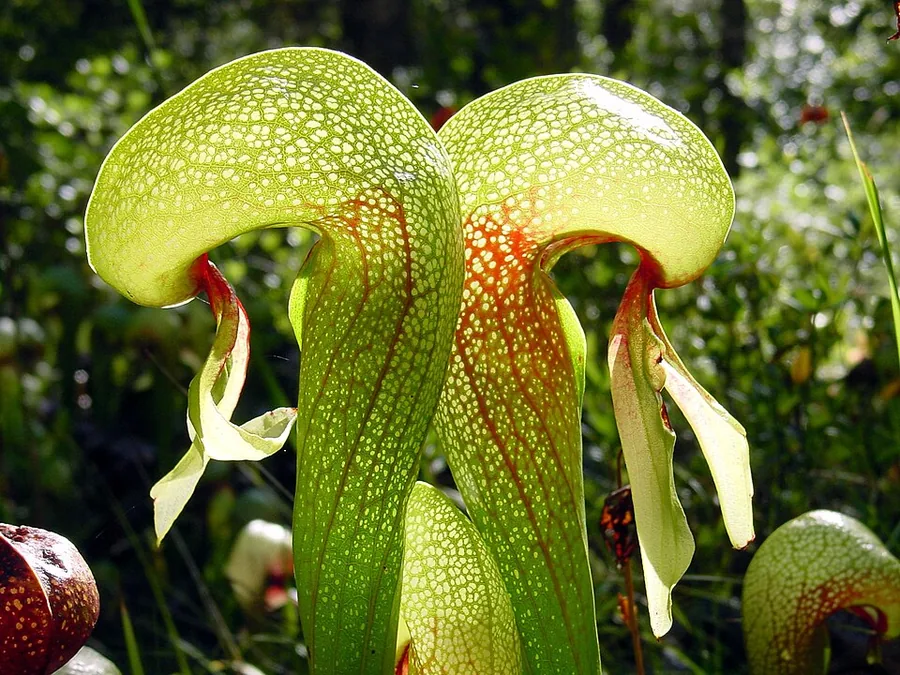
The Cobra Lily, Darlingtonia californica, turns each leaf into a hooded pitcher that rears up like a striking snake, the swollen tube curving over into a translucent dome flecked with bright light patches. Beneath the opening hangs a forked, tongue-like flap, the detail that earns the plant its cobra name. It is a carnivorous pitcher plant in the family Sarraceniaceae and the only species in its genus.
Up close, the hood works as a trap. Insects crawl toward the bright translucent patches in the dome, lose track of the way out, and slide down into the digestive pool below. Under full sun the hood fills with deep red veining; in weak light the new pitchers come up green, pale and floppy instead. This is a plant of cold mountain bogs and seeps in northern California and Oregon, and despite the name it is not a true lily.
What makes it demanding is the split it asks for: a hot top and a cold bottom. In the wild, cold snowmelt runs constantly over the roots while the pitchers stand out in open sun. Get that balance right and the hoods color deeply and the plant creeps outward on its stolons; let warm water pool around the roots and even a sun-soaked, well-watered plant will fail.
Care
The short version: the Cobra Lily wants strong light over cool, constantly wet roots in a nutrient-poor acidic bog mix, watered only with distilled, RO, or rainwater. Never fertilize it, since the pitchers feed themselves on insects. The whole game is keeping the root zone cold while the hoods sit in the sun.
Light
Give it full sun as the goal, because strong light is what brings the deep red veining out across the translucent hood. It will take partial sun or light shade, but in dim spots the new pitchers come up green, pale and floppy. The catch is that the strong light must pair with cool roots, never a hot dry position.
Water
Keep the bog mix constantly wet, checking every 1 to 3 days, and use only distilled, reverse-osmosis, or rainwater, because tap or mineral water kills it. Keep that water cold. Warm standing water around the roots is the single most common way to lose one, even when the pitchers are thriving in full sun.
Soil
Pot it in a nutrient-poor bog mix of live sphagnum or a peat-perlite blend, acidic at a pH of 4.0 to 6.0. Standard potting soil is lethal; the roots want the same lean, sour ground they grow in among the mountain seeps.
Temperature
It is cold-hardy across 5°F to 86°F (-15°C to 30°C), but the roots want to stay cool even on hot days. Heat at the crown does far more damage than cold, so a chilly bottom matters more than worrying about a frost.
Humidity
As a bog plant it likes damp air around 50% to 80%, and airflow matters just as much as moisture. Set outdoors in a cool, breezy spot it usually looks after its own humidity.
Feeding
Do not fertilize it at all. The pitchers catch and digest their own insects for nutrients, and fertilizer or a scrap of fatty meat will rot the plant from inside.
Pruning
There is little to do. Once a pitcher has fully browned and died back, snip it off at the base with clean scissors. Otherwise leave the plant alone and never cut it to shape.
Repotting
Refresh it every 2 to 3 years in early spring into clean bog mix. Signs it is due include stolons crowding the pot edge, the medium broken down and compacted, and pitchers coming up smaller or weaker.
Size & spacing
Expect 10 to 31 inches (25 to 80 cm) tall, with the plant spreading 12 to 24 inches (30 to 60 cm) as its stolons creep outward. It is a slow grower, so give it room and let it fill in over time.
When to plant
This is a hardy outdoor perennial for zones 6 through 9, and it keeps a slow clock. Sow seed in late winter after a cold spell breaks its dormancy, set divisions and plants out in spring once the last frost has passed, and watch for the nodding flowers in late spring before the new pitchers fill in.
Northern hemisphere
Southern hemisphere
Typical months for a temperate climate: start earlier in warm zones, later where spring frosts linger.
- Sow: late winter after cold stratification
- Plant: spring after last frost
- Harvest: late spring
Hardiness
USDA hardiness zones: 6–9
Temperature: down to -23°C
Troubleshooting
Most failures trace back to the root zone running too warm, while the visible symptoms show up in the pitchers. Here are the three problems you are most likely to meet and how to read the hoods, tips, and color of the pitchers to tell them apart.
Cooked roots while the hoods bake in the sun
The pitchers can be standing tall in bright light and still the plant fades, because the trouble sits down at the root zone. Warm water pooling around the roots starves a plant built for cold snowmelt running over them, and warm roots do far more damage than cold ever will. Move it to a cool, airy spot and flush the medium with cold pure water on hot days. Top-dressing with a layer of live sphagnum keeps the root zone cooler.
Fix:
- Move the plant to a cooler, airy spot out of reflected heat
- Flush the medium with cool distilled or rainwater on hot days
- Top-dress with live sphagnum to insulate and cool the root zone
- Avoid leaving the pot in warm standing trays in summer
Browning pitcher tips from mineral burn
The slender tops of the pitchers brown and shrivel, and over a few weeks the whole plant loses its tone. The tell is a white mineral crust forming on the surface of the medium and around the pot rim, left behind by tap or hard water salts. Switch to distilled, RO, or rainwater only and flush the mix again and again to wash the salts out. Where the buildup runs deep, repot into fresh nutrient-poor bog mix.
Fix:
- Switch to distilled, RO, or rainwater only
- Flush the medium repeatedly with pure water to leach salts
- Repot into fresh nutrient-poor bog mix if contamination is severe
Pale floppy pitchers crying out for light
New pitchers push up green, pale and floppy instead of standing firm, and the giveaway is that they never develop the deep red veining through the hood. That washed-out color points straight at too little light. Give the plant brighter light, ideally full sun while the roots stay cool, and step the exposure up over a week or two so the tissue does not scorch.
Fix:
- Provide brighter light, ideally full sun with cool roots
- Acclimate gradually to avoid scorch
Toxicity
Despite the predatory pitchers, the Cobra Lily is not toxic to anyone. The danger runs the other way: a curious paw or nose is far more likely to wreck the fragile bog setup than to come to any harm from the plant.
Safe for
People · Cats · Dogs · Horses · Rabbits · Livestock · Birds
Cats None
No poisoning to expect. The pitchers swallow gnats and flies, not cats, and the wet acidic leaves hold no appeal as food. A curious nibble on the fibrous leaf might bring on mild drooling or a brief upset stomach at worst, and the bigger risk is a paw flattening the fragile bog setup.
Dogs None
Nothing toxic here. A dog that mouths a tough fibrous pitcher might get a little drool or a passing stomach upset, and that is the ceiling of it. A nose pushing into the cool wet medium is far more likely to disturb the planting than to come to any harm.
Horses Safe
Safe. There is no toxic compound in the hooded pitchers or the slow-creeping stolons, and the sour wet foliage is not appealing as forage for a horse.
Rabbits Safe
Safe. The acidic, water-soaked leaves carry no poison, and a rabbit finds nothing tempting to graze in this bog plant.
Livestock Safe
Safe. No toxic principle sits in the pitchers or roots, and the wet sour leaves are unappetizing to grazing animals.
Birds Safe
Safe. The plant itself holds no toxin. A bird is most likely to raid the trapped insects sitting in the digestive pool of a pitcher rather than touch the plant tissue.
People Safe
Safe. There are no toxic principles of concern and it is not grown as food. The pitchers digest small insects, never people, so it poses no poisoning risk.
No special handling hazards; the pitchers digest small insects, not pets, and the plant has no toxic principles of concern.
Varieties
Being the only species in its genus, there is little to confuse it with. The points below cover the wild form and the one named selection you may run across, each told apart by the color of the hood.
Darlingtonia californica
The lone species in its genus, known at a glance by each leaf swelling into a hooded pitcher that rears up like a striking snake, with a forked, tongue-like flap dangling beneath the opening.
'Othello'
A cultivated selection that comes up an even all-green, missing the deep red veining that usually marks the translucent hood.
How to propagate
Both routes are demanding and slow, asking for cool wet bog mix and patience. You can lift and split a clump along its creeping stolons in early spring, or start from seed after a cold winter spell, knowing a seed-grown plant takes years to reach size.
DivisionDemanding
Early spring before active growth · 1-2 growing seasons
Lift the plant in early spring before growth picks up and separate the offsets riding along the running stolons. Take only pieces that carry their own roots, settle them into fresh cool wet bog mix, and let them root in over one to two growing seasons.
SeedDemanding
Sow after cold stratification in late winter · 3-5 years to mature plant
A slow road. The seed needs several weeks of cold, moist stratification in late winter to break dormancy, and the seedlings inch along after that. Count on 3 to 5 years before a plant reaches mature size.
Myths
You have to hand-feed it insects or scraps of meat to keep it alive.
The pitchers catch every bit of prey the plant needs on their own, so hand-feeding does no good. A piece of meat or a dose of fertilizer can rot the crown from the inside. What actually keeps it going is light, pure water, and cool roots.
Treat it like a houseplant: keep it warm and pot it in regular potting soil.
It wants the opposite. The roots need a nutrient-poor acidic bog mix and mineral-free water, while warm roots and rich soil are lethal to it. Holding the root zone cool is the single hardest part to get right.