Ornamental · Cleomaceae
Cleome
Cleome hassleriana
Sown once in full sun, the spider flower lifts its whiskered heads tall, blooms until frost, and reseeds itself.
Full sun
Every 5–10 days
55–90°F · 13–32°C
70–80 days
Overview
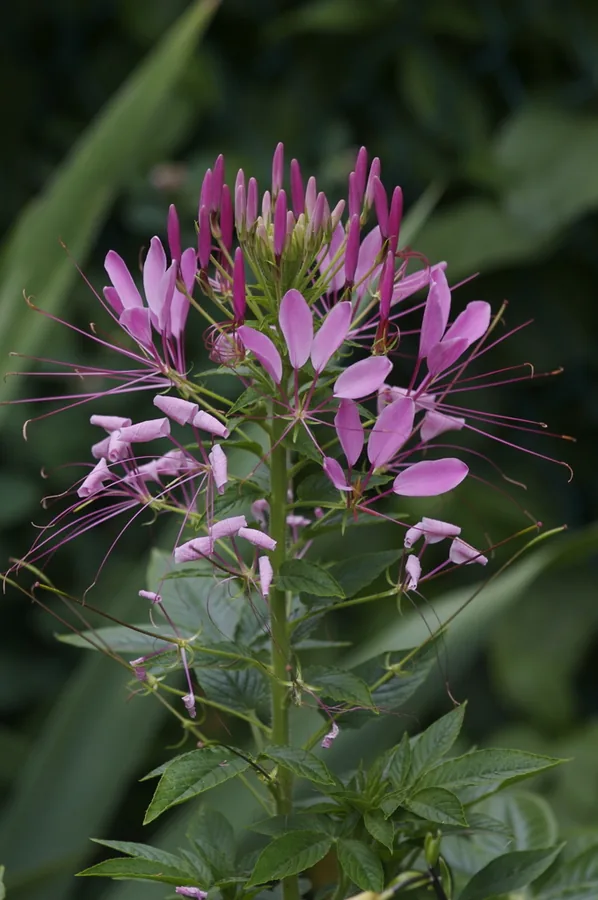
Cleome, the spider flower, is a tall garden annual topped through summer with rounded heads of airy bloom, each crowded with slender flowers. Long stamens shoot out well past the petals like fine whiskers, and behind them slim seed pods reach out on thin stalks that splay like spider legs, the look that earned the name. The stems climb fast to 2 to 6 feet (60 to 180 cm) in a single season, lifting the flower heads high.
It asks for little to put on this show. Give it full sun and ground that drains, and it holds firm through heat, dry spells, and lean soil that would wilt softer plants. Its one strong habit is self-sowing, since the pods split and scatter seed that comes up as volunteers the next spring unless the spent pods are cut away.
Bees, butterflies, and hummingbirds work the flowers from early summer until frost cuts the plant down. The stems are studded with small prickles and the divided leaves give off a musky scent when brushed, so gloves help when you take hold of it, or one of the smooth-stemmed, scentless selections can stand in its place.
Care
The short version: cleome wants full sun, average well-drained soil, and only the odd watering once it has rooted in. Keep the feeding light, pinch young plants to thicken them, and snip the spent pods if you would rather skip the volunteers next year.
Light
Cleome wants full sun, 6 or more hours a day to hold its stems straight and pack the heads with flower. It will take a little afternoon shade, but in dim light the stems stretch tall and floppy and the bloom count drops away.
Water
Keep the soil moist while the plants are young, then ease off once the roots take hold, since cleome shrugs off dry spells. Water through a true drought and no more, because too much leaves the stems soft and leggy rather than firm.
Soil
Average, well-drained loam suits the roots best, though they take to clay or rocky ground as long as water moves through. Aim for a pH of 6.0 to 7.0, and leave poor soil lean, since rich ground only loosens the stems.
Temperature
Cleome thrives in warmth, growing strong between 55°F and 90°F (13°C to 32°C). It needs heat to push fresh growth and will not stand a frost, so its stems and leaves last a single season in cold-winter gardens.
Humidity
Ordinary outdoor humidity is no trouble, so there is no level to chase. Air circulation counts for more, since still air around crowded plants leaves a film of mildew and rust on the leaf surface.
Feeding
Feed lightly through the growing season with a balanced fertilizer, once a month at most. A heavy hand only swells soft, leggy stems that struggle to hold the heavy flower heads, so lean toward less when in doubt.
Pruning
Pinch the stem tips in early summer to send fresh branches out lower down for a fuller plant. Cut off the spent seed pods through the season to keep the freely scattered seed from filling the bed.
Size & spacing
The stems rise 2 to 6 feet (60 to 180 cm) tall and the foliage spreads 1 to 5 feet (30 to 150 cm) wide depending on the strain. Set the plants 10 to 15 inches (25 to 38 cm) apart so air slips between the leaves and mildew stays off.
When to plant
Cleome is a warm-season annual that waits on heat and will not stand a frost. Seed goes in indoors in late winter or straight into the ground once it warms, and the whiskered heads open from early summer right up to the first frost.
Northern hemisphere
Southern hemisphere
Typical months for a temperate climate: start earlier in warm zones, later where spring frosts linger.
- Sow: 6 to 8 weeks before the average last spring frost
- Plant: After all danger of frost has passed and soil reaches 70 to 75°F; or direct sow then
- Harvest: Early summer until first frost
Hardiness
USDA hardiness zones: 10–11
Temperature: down to -1°C
Troubleshooting
Cleome is one of the more trouble-free flowers you can grow, and most of what marks the leaves or weakens the stems traces back to too much water, too little sun, or crowding. Match what you see below, and the answer is usually a small change to how you are growing it.
Stems standing tall and limp, thick with leaf and thin on flowers
When the stems turn soft and lean and the foliage outpaces the blooms, that leggy growth traces to too much water or feed, or to light too weak for firm tissue. Pull both back, and stand the plant in full sun with 6 or more hours of light so the stems stiffen. A pinch to the stem tips in early summer pushes fresh side shoots from lower down.
Fix:
- Reduce watering and feeding
- Site in full sun (6+ hours)
- Pinch back stem tips in early summer to force branching
A chalky white film or rust-orange flecks across the leaf surface
A dusty white coating or small rust-orange pustules on the leaves are powdery mildew and rust, which take hold in hot, humid air around crowded plants. Loosen the planting so air drifts through, strip away the most marked leaves, and water at the base to leave the foliage dry. A gap of 10 to 15 inches between plants keeps the leaves clear of it.
Fix:
- Improve air circulation
- Remove affected foliage
- Water at the base to keep leaves dry
Crumpled new shoots glazed with a sticky film
When the soft new shoots curl and crumple under a sticky glaze, clusters of aphids, spider mites, or whiteflies are feeding there. A hard jet of water knocks them off the tender tips, and insecticidal soap is held back for a heavy crowd of them. A firm, unstressed plant grows clean new tissue past the damage on its own.
Fix:
- Spray off with a strong jet of water
- Apply insecticidal soap if infestation is heavy
Ragged holes and bitten notches in the leaf blades
Ragged holes and clean-bitten notches in the leaves are the feeding marks of flea beetles or cabbage budworm. Lifting off any caterpillars by hand clears the chewers. Cleome is a tough, largely pest-free plant, so a strong one in full sun pushes out fresh leaves past the nibbled ones.
Fix:
- Handpick caterpillars
- Tolerate minor damage as plants are generally pest-free
Toxicity
For households with pets, the picture is easy: cleome is non-toxic to cats, dogs, and horses, and the ASPCA has no records of toxic ingestion. The only thing to mind is the fine prickles on the stems and the musky leaves, so keep a pair of gloves handy when you take hold of the plant.
Safe for
People · Cats · Dogs · Horses · Rabbits · Livestock · Birds
Cats Safe
The ASPCA lists spider flower as non-toxic to cats, so a nibble at a leaf does no harm. The small prickles studding the stems are the only sting, and a cat keeps clear of them on its own.
Dogs Safe
Cleome holds no poison for dogs. A dog that chews through a lot of any plant might feel a touch queasy, but the divided green leaves and stems carry nothing harmful inside them.
Horses Safe
Cleome is safe for horses and holds no known toxins. The musky smell rising off the leaves usually turns grazers away before a single bite is taken.
Rabbits Safe
Rabbits run no poisoning risk from cleome. The prickle-set leaves and the strong scent off the foliage send them hopping toward softer, tastier plants nearby.
Livestock Safe
Cattle, goats, and sheep can graze beside cleome without harm. No records of toxic ingestion exist, and the musky, pungent foliage rarely draws a mouthful from them.
Birds Safe
Cleome poses no toxic threat to backyard or wild birds. The long-stamened flowers draw pollinators and hummingbirds, and the slim seed pods split open to feed birds later in the season.
People Safe
No part of the plant is poisonous, so it is safe around children. The catch is the fine prickles along the stems and leaves, so gloves are worth wearing when you take hold of it.
Stems and leaves bear prickles/spines and the foliage has a pungent, musky scent; wear gloves when handling. Thornless cultivars exist. These are handling nuisances, not toxicity.
Varieties
Cleome comes in a handful of named strains that differ mostly in height, flower color, and whether the stems carry the usual prickles and the leaves the usual scent. These are the ones you are most likely to find.
Helen Campbell
An old favorite whose fragrant, pure white flowers ride atop tall stems that climb 4 to 5 feet.
Queen series
The classic 3 to 5 foot strain in shades of rose, violet, pink, and white, sold as Rose Queen, Violet Queen, and the rest.
Linde Armstrong
A compact 18 to 24 inch pink selection with smooth, prickle-free stems and none of the musky scent.
Senorita series
Thornless, odorless sterile hybrids grown from cuttings, their stems smooth to the touch and free of stray seedlings all season.
How to propagate
Cleome rises from seed alone, and a settled plant scatters most of the next generation itself once it takes to a spot.
SeedEasy
Start indoors 6 to 8 weeks before last frost, or direct sow after frost when soil is 70 to 75°F · Germinates in 7 to 14 days; blooms about 70 to 80 days after germination
Cleome rises from small seed alone. Sow it indoors 6 to 8 weeks before your last frost, or press it straight into warm ground once the soil reads 70°F to 75°F (21°C to 24°C). A thin scatter of soil over the top is enough, and the first green shoots break through in 7 to 14 days, with the whiskered flowers opening about 70 to 80 days on. Some strains such as the Queen series sprout more evenly after 4 or 5 days of cold in the refrigerator, and a settled plant drops next year's seed where it stands.
Myths
Cleome is poisonous to cats and dogs.
The ASPCA lists spider flower as non-toxic to cats, dogs, and horses, and no records of toxic ingestion exist. What reads as danger is the fine prickles on the stems and the musky smell of the leaves, both handling nuisances rather than poison. Cleome is safe to grow around pets and children.
Cleome has to be started indoors and transplanted to do well.
The roots resent disturbance, so a lifted plant tends to sulk after the move. Seed dropped straight into warm ground after frost sends up its first leaves without that setback. Direct sowing often works as well as transplants, and a settled plant scatters its own seed freely.