Ornamental · Acanthaceae
Black-eyed Susan Vine
Thunbergia alata
Hand it full sun, steady water, and something to climb, and this twining annual covers itself in dark-eyed flowers from summer to frost.
Full sun
Every 2–4 days
50–86°F · 10–30°C
70–100 days
Overview
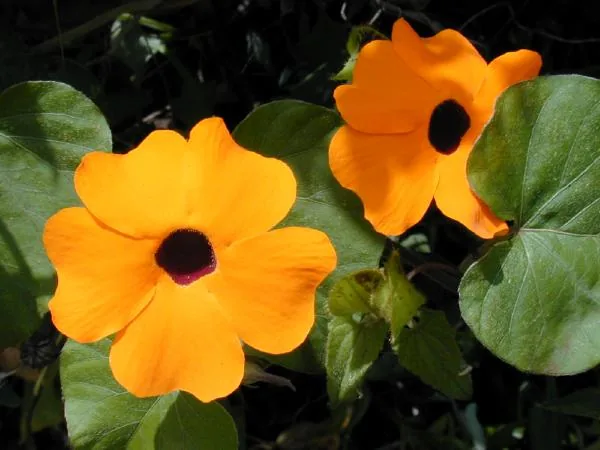
The black-eyed Susan vine is a quick, twining climber prized for the unbroken run of cheerful flowers it carries. Native to East Africa, it is a tender perennial, yet most gardens treat it as a warm season annual that races up a trellis, fence, or hanging basket over one summer. Each bright bloom opens in orange, yellow, or white, and the dark eye that marks most of them is what earned the plant its name.
Its value lies in how fast it climbs and how long it keeps flowering. Hand it something to twine up and it will sheathe an arbor or pour over the lip of a container, stretching 3 to 8 feet (91 to 244 cm) across a single season. The flowers run from early summer all the way to frost, and the plant usually shows its best face in late summer and fall after the fiercest heat lets up.
This is an easy plant that asks for nothing beyond sun, water, and a support for its twining stems. Stop the soil from parching in a heat wave and pinch the young stems to thicken the vine, and it pays you back with month after month of color.
Care
The short version: full sun to part shade, with afternoon shade where summers run hot. Hold the soil evenly moist so it never parches, set it in rich, well-drained ground beside a support for its twining stems, and feed it across the growing season.
Light
Full sun is where the black-eyed Susan vine flowers most heavily, though it copes with part shade easily enough. Where summers grow harsh, a little afternoon shade takes the edge off the heat, while too little light leaves you a leggy plant heavy with foliage and short on blooms.
Water
Hold the soil evenly moist and water often enough that it never parches, roughly every 2 to 4 days when the weather is warm. Let the vine run dry through a hot, dry spell and it sheds its buds and flowers, so keep it from going short on water across summer.
Soil
Set it into rich, fertile, well-drained ground carrying steady moisture and a good measure of organic matter worked through. The soil ought to grip water without turning soggy, which serves garden beds and containers alike.
Temperature
It thrives in the range between 50°F and 86°F (10°C to 30°C) and carries no tolerance for frost at all. Blooming eases off through the peak of summer heat, then surges back as the air cools toward late summer and fall.
Humidity
Plain outdoor humidity suits it well, so there is no figure to chase. Good airflow counts for more here, because stagnant, crowded growth draws in spider mites and whiteflies, above all on plants held indoors.
Feeding
Feed it monthly across the spring and summer growing season using a balanced, general-purpose fertilizer. Regular feeding keeps a fast grower like this in leaf and flower with no single nutrient falling short.
Pruning
Pinch the young stems early on to draw out side branching and a fuller, bushier vine. As the season runs, cut back any leggy or sprawling stems to hold its shape and draw out more flowers.
Repotting
In containers, refresh or pot up each spring to open room for the roots and renew the mix. Look for roots circling the pot or pushing out the drainage holes, water that pours straight through, and growth that has stalled, each one a signal it has outgrown its quarters.
Size & spacing
Trained on a support, the vine climbs 3 to 8 feet (91 to 244 cm) tall and spreads 3 to 6 feet (91 to 183 cm) wide over a season. Allow it room and a trellis or fence for the twining stems to grasp so it has a path to follow.
When to plant
Warmth is what this vine wants, and frost is what it cannot stand. Sow the seeds indoors in early spring, move the plants outside only once the cold has wholly let go and the soil has warmed, and watch the flowers come on from early summer until frost closes the season.
Northern hemisphere
Southern hemisphere
Typical months for a temperate climate: start earlier in warm zones, later where spring frosts linger.
- Sow: 6-8 weeks before last spring frost
- Plant: after last spring frost when soil and air have warmed
- Harvest: early summer to frost; best bloom in late summer and fall after peak heat moderates
Hardiness
USDA hardiness zones: 10–11
Temperature: down to -1°C
Troubleshooting
Nearly every problem this vine runs into comes down to heat, light, or pests, and it surfaces first in the flowers or the leaves. Catch those early signals and you can act before the blooming drops away. Find your symptom below, then move on it while it still does some good.
Buds and flowers falling off during a hot, dry stretch
What you are seeing is heat and drought stress rather than any disease, and it surfaces when the soil bakes dry through a run of hot days. To spare itself, the vine simply halts its flowering, then resumes once cooler air arrives in late summer and fall. Keep the moisture steady and even, lay mulch over the roots so they stay cool, and screen the plant from harsh afternoon sun wherever the heat turns punishing.
Fix:
- Water regularly to keep soil evenly moist during heat
- Provide afternoon shade in hot climates
- Mulch to conserve soil moisture and keep roots cool
Speckled, tacky leaves laced with webbing or tiny insects
Spider mites, whiteflies, aphids, or scale tend to settle on plants that are stressed or kept inside, dotting the leaves with stippling, coating them in stickiness, or threading them with webbing. Flip a leaf to spot which pest you are dealing with, blast it off with a forceful jet of water, and then treat the undersides with insecticidal soap or horticultural oil. Run the treatment again and loosen up the air around the plant, particularly for ones grown indoors.
Fix:
- Rinse foliage with a strong spray of water to dislodge mites and aphids
- Apply insecticidal soap or horticultural oil, covering leaf undersides
- Repeat treatments and improve airflow for indoor plants
Lots of foliage and hardly a flower in sight
A vine that stretches out long and leafy yet stays bare of blooms is usually sitting in too much shade. Full sun is where this plant flowers hardest, so shift a container into a brighter position and give it no fewer than several hours of direct light each day. Hand it the sun it craves and the flowers will arrive.
Fix:
- Move container plants to a sunnier spot
- Site in full sun to part shade with at least several hours of direct sun
Toxicity
Households with animals can breathe easy: the black-eyed Susan vine carries no listing as toxic to pets or people. Grow it freely where cats, dogs, and inquisitive children all share the garden. A large mouthful of foliage, as with any plant, might bring a bit of passing stomach upset, so it remains wise to keep pets from chewing on it.
Safe for
People · Cats · Dogs · Horses · Rabbits · Livestock · Birds
Cats Safe
Since the vine never appears on the ASPCA toxic list, a curious cat can gnaw the leaves with no harm done. Swallow a large mouthful of any greenery and the worst that follows is a touch of drooling or a hairball.
Dogs Safe
This plant poses no problem for dogs. A nibble at most brings on a brief spell of mild stomach upset, just like most ornamental foliage will.
Horses Safe
Horses have no recorded toxicity from it. A bite of a stray vine here and there will cause no genuine harm.
Rabbits Safe
The foliage is safe for rabbits to browse. Bring it into their diet slowly, as you would any fresh green, so an abrupt switch doesn't upset their gut.
Livestock Safe
No documented danger threatens cattle, goats, or sheep from this vine, so a mouthful out in the pasture calls for no concern.
Birds Safe
Birds face no known threat from the plant. Hens in the yard can peck away at the leaves and seeds with no ill effect.
People Safe
Nobody has a record of being poisoned by it, and the vine is raised for its flowers and not for the table. Still keep watch over small children, who ought not be tasting garden plants in any case.
As with any plant, ingestion of plant material may cause mild, transient stomach upset in pets.
Varieties
Black-eyed Susan vines reach the market mostly as seed series bred across a spread of warm flower colors. The ones below are what you are most likely to come across.
Susie series
A widely grown seed series carrying blooms in orange, yellow, and white, some wearing the trademark dark eye and some without it.
Arizona series
A strong-growing series in warm shades of orange, apricot, and gold, every flower centered on a dark eye.
Spanish Eyes
Wraps soft terracotta and apricot tones around a dark eye, giving a warmer and more muted cast.
Blushing Susie
Pulls together quiet apricot, rose, and ivory tones, the eyes often softening away rather than standing out.
Alba
A crisp white-flowered form that holds onto the trademark dark purple-black eye at its center.
How to propagate
Multiplying this vine takes little effort, whether you sow fresh from a seed packet each spring or strike cuttings to bring a favorite plant safely through the winter.
SeedEasy
Start indoors 6-8 weeks before last frost, or sow directly outdoors after the last frost. · Germinates in about 1-3 weeks; weeks to a few months to a flowering vine
Growing this annual vine from seed is the standard route, and an easy one at that. Sow it indoors 6 to 8 weeks before your last frost, or drop the seed straight into warm ground after the frost has gone, and you will see sprouts in about one to three weeks. The vine then needs anywhere from a few weeks to a couple of months to climb its support and open its first flowers.
Stem cuttingsModerate
Take cuttings in late summer for overwintering indoors. · A few weeks to root
Taking cuttings is the way to bring a favorite plant safely through winter. Snip them in late summer, let them strike roots across a few weeks, and hold the young plants in a warm, sunny window until spring returns. The method demands a little more attention than seed, yet it preserves a variety you would like to grow once more.
Myths
Black-eyed Susan vine is the same plant as the Black-eyed Susan wildflower.
A shared name and a dark center are all the two have in common. Black-eyed Susan vine (Thunbergia alata) is a tender twining annual climber in the family Acanthaceae, native to East Africa. The wildflower Black-eyed Susan (Rudbeckia hirta or fulgida) is an upright, daisy-like perennial or biennial in the aster family. They are completely different plants that simply resemble one another at the dark eye of the bloom.