Houseplant · Acanthaceae
Polka Dot Plant
Hypoestes phyllostachya
Green leaves stippled with pink, rose, or white hold their freckled markings in bright filtered light.
Bright indirect
61–81°F · 16–27°C
USDA 10–11
12–30 in · 30–76 cm
Overview
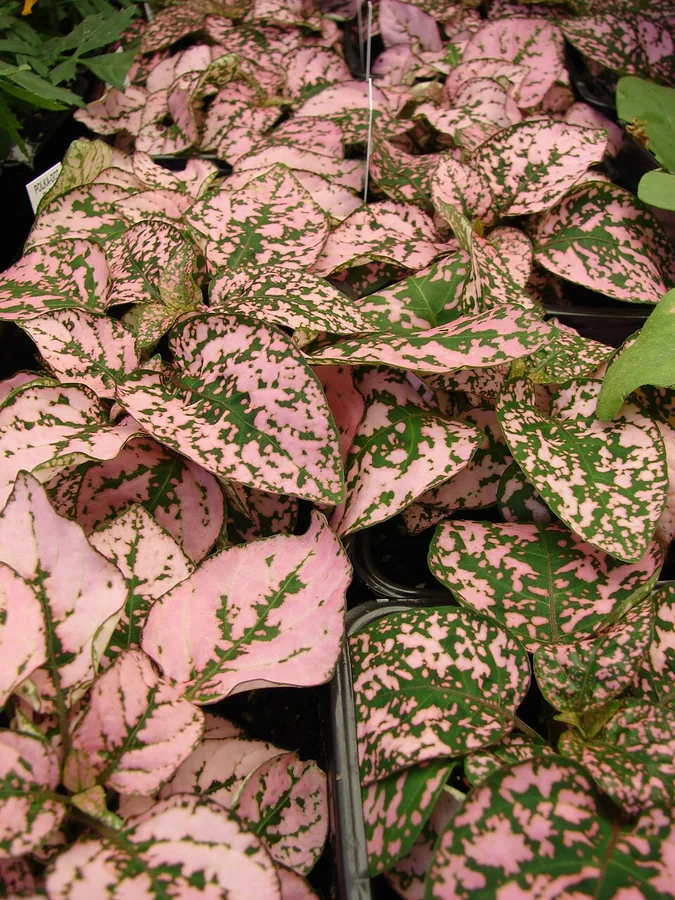
The polka dot plant carries oval green leaves stippled all over with pink, rose, or white, as if flecked with spattered paint. The species, Hypoestes phyllostachya, comes from Madagascar and sits in the Acanthaceae family, grown almost everywhere indoors. Its flowers are small and lilac to pink, tubular, and held on slender spikes, but the speckled leaves carry the color, so growers usually pinch the blooms away.
The plant builds a compact, bushy mound that reaches 12 to 30 inches (30 to 76 cm), and it fills in fast. Fresh stems crowd with new spotted leaves in a single season. Left alone, the stems lengthen and thin, the lower leaves drop, and the spotting pales, at which point a short 4 inches (10 cm) tip cutting renews the whole look.
Every bit of the plant's appeal sits in its foliage. Each leaf reads green at the base, then breaks into a scatter of pink, rose, or white dots that thicken or thin from leaf to leaf. Bright filtered light keeps those dots crisp and saturated. As the light drops, the dots wash toward pale green, and the pattern goes flat. It is an easy plant to keep looking sharp.
Care
The short version: bright filtered light keeps the pink and white dots crisp, evenly moist but never soggy soil, warmth above 60°F (16°C), and a regular pinch for dense, well-spotted growth.
Light
In bright, filtered light the pink and white dots stay crisp and deeply colored. Harsh direct sun bleaches the leaf and burns brown patches into it, while deep shade lets the spots dissolve toward plain green. A bright window behind a sheer curtain holds the color at its best.
Water
Kept evenly moist through active growth, the leaves stay firm and full. Water well, then let just the surface dry before the next round. A brief dry spell leaves the plant limp but recovering, though steady moisture keeps the foliage turgid and unmarked.
Soil
A porous, organic-rich mix of peat moss or leaf mold, loose and free-draining, holds the roots. The plant takes a pH from 5.5 to 7.5 without complaint. Water must drain clean through and never pool at the base.
Temperature
Held in 61°F to 81°F (16°C to 27°C), the plant keeps pushing fresh spotted leaves. Below about 60°F (16°C) the new growth slows and the plant looks sullen. Cold drafts and chilled glass show up as stalled, dull foliage.
Humidity
The plant reaches for humid air, more than most rooms carry. Grouped plants, a pebble tray, or a winter misting keep the thin leaf margins from browning and curling. Dry air crisps those edges first.
Feeding
Fed through spring and summer, the plant lays down dense, well-colored leaves. A dilute balanced liquid fertilizer about once a month keeps the leaves deeply colored, and feeding can stop once growth slows for the year.
Pruning
Pinched at the tips, the stems fork and the plant thickens into a dense, spotted dome instead of a few bare shoots. The small flower spikes get nipped off as they rise, which keeps every bit of color in the leaves.
Repotting
The plant moves up a pot once a year, or when white roots circle out of the drainage holes. It grows fast and coarsens within a couple of years, so many growers simply raise a fresh, tighter plant from cuttings.
Size & spacing
At full size the plant makes a rounded clump 12 to 30 inches (30 to 76 cm) tall and 9 to 30 inches (23 to 76 cm) wide, packed with spotted leaves. Set several too close and the still air films them with powdery mildew, so leave gaps between plants.
Troubleshooting
Most of what goes wrong shows plainly on the leaves and stems: light, water, or a pest leaves a visible mark. Pale, washed dots and long bare stems are the two clearest tells. Match the look below to its cause and correct it early.
Wilting, soft brown stems, or a white powdery dust
Limp leaves over soft, browning stems at the soil line mark root rot from soaked soil, while a fine white dust across the leaf surface is powdery mildew spreading in still, damp air. A porous, well-drained mix and a dry surface between waterings save the roots. Moving air thins the white film before it spreads.
Fix:
- Use a porous, well-drained mix and let the surface dry between waterings
- Improve air circulation to limit mildew
Sticky film, twisted new growth, or tiny insects
A sticky sheen on the leaves and puckered, curled new growth mark whiteflies, aphids, or mealybugs, the insects that settle on this plant indoors. The leaf undersides carry the clustered bodies or small white cottony tufts, and whiteflies rise in a cloud when the foliage is brushed. Insecticidal soap or neem oil, repeated as directed with the plant set apart, clears them.
Fix:
- Treat with insecticidal soap or neem oil
- Repeat applications as directed and isolate affected plants
Long, bare stems with thin, pale leaves
Stems that draw out long and drop their lower leaves, tipped with pale, thin growth, are short on light or simply old and never pinched. Bright, filtered light and frequent tip-pinching pack the growth back in. A badly drawn-out plant renews cleanest from short tip cuttings.
Fix:
- Move to bright, filtered light
- Pinch back stem tips regularly to force branching
- Take and re-root tip cuttings to renew an old, leggy plant
The pink and white dots fade or scorch brown
When the freckles wash toward plain green or brown at the edges, the light is wrong at one end or the other. Fierce direct sun bleaches and scorches the leaf, while deep shade lets the pigment drain away. The dots come back deepest in bright filtered light or light partial shade.
Fix:
- Relocate to bright, filtered light rather than full sun or deep shade
Toxicity
For homes with pets and children, the plant is non-toxic. The ASPCA lists it as safe for cats, dogs, and horses, and extension sources agree. A chewed leaf brings at most a brief, mild stomach upset from the plant fiber.
Safe for
People · Cats · Dogs · Horses · Rabbits · Livestock · Birds
Cats None
The ASPCA lists it non-toxic to cats. A bitten leaf may bring up a little clear vomit from the plant fiber, then settles.
Dogs None
It is non-toxic to dogs on the ASPCA list. A chewed leaf leaves at most a brief, mild churn in the stomach.
Horses None
The ASPCA clears it for horses as well, so a grazed mouthful of the spotted leaves does no harm.
Rabbits Safe
No toxin sits in the leaves for rabbits. A slow introduction still helps, since a sudden switch of greens can loosen their gut.
Livestock Safe
Goats, sheep, and other grazers can crop the plant without harm, since nothing in it is poisonous.
Birds Safe
Pet birds are safe among the leaves. The foliage holds no toxic compounds, so a torn, tasted leaf does no damage.
People Safe
The plant is harmless to people, children included. It is not grown to eat, but a leaf in a small mouth is no cause for alarm.
As with any non-food plant, ingestion may cause mild, self-limiting vomiting or diarrhea simply from the plant material.
Varieties
Most polka dot plants are sold by their color rather than a strict cultivar, though a few named selections have a distinct look.
'Splash Select Pink'
A compact plant whose leaves carry heavy pink spotting above short spikes of small purple flowers.
'Confetti Compact White'
A small, tidy form freckled in white rather than pink, the pale dots set over small purple blooms.
Pink Splash / Freckle Face types
Green leaves washed and dotted with rose, pink, or white, the spots running from a light dusting to a dense blush across seed-grown strains.
How to propagate
The plant copies itself with almost no effort. A cut tip roots in a glass of water, and seed raises a fresh, freckled crop.
Stem cuttingsEasy
Any time during active growth · Roots in a few weeks
A cut tip roots readily and comes back identical. Take a shoot about 4 inches (10 cm) long during active growth, pull the lower leaves off the stem, and stand it in water or moist mix. Fine white roots break from the stem within a few weeks.
SeedEasy
Sow indoors 8-10 weeks before the last frost · Germinates in as little as 4 days at about 68°F (20°C)
Seed raises a whole flat of spotted seedlings. Sown indoors 8 to 10 weeks before the last frost and held near 68°F (20°C), it splits and sprouts in as little as 4 days. Each seedling carries its own spread of spots, from sparse flecks to a heavy wash.
Myths
The polka dot plant is the same plant as the polka dot begonia.
The two are separate plants in separate families. The polka dot plant is Hypoestes phyllostachya in the Acanthaceae, and the polka dot begonia is Begonia maculata in the Begoniaceae. Only Hypoestes is the true polka dot plant.
The polka dot plant is poisonous to cats and dogs.
The ASPCA lists Hypoestes phyllostachya as non-toxic to dogs, cats, and horses. A chewed leaf brings a mild, passing stomach upset at most, nothing more.