Bulb · Ranunculaceae
Poppy Anemone
Anemone coronaria
Soak the knobby corms, give them sun and sharp drainage, and poppy anemones open cup-shaped blooms in jewel colors.
Full sun
Every 5–7 days
84–120 days
USDA 7–10
Overview
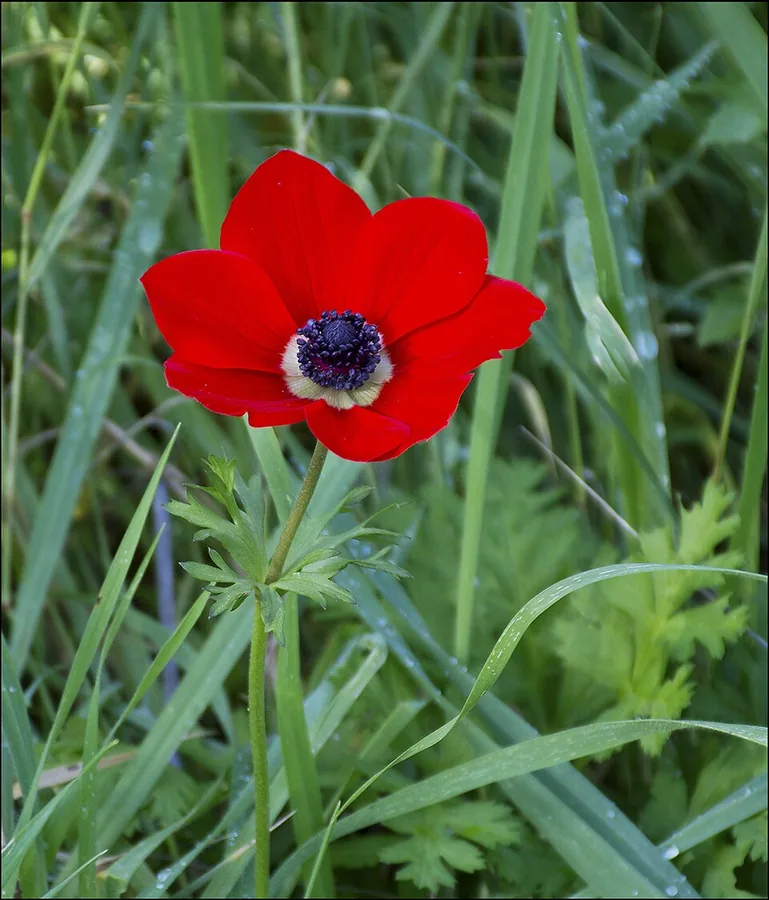
Up close, the poppy anemone flower is a shallow cup of overlapping petals, and the color runs saturated through red, blue, purple, pink, and white. At the center sits a dark boss of stamens that throws the bright petals into sharp relief. The whole bloom rides a single slender stem above a low ruff of ferny, deeply cut leaves, a feathery texture that marks it as kin to ranunculus in the buttercup family. It rises from a small, hard, knobby corm rather than seed.
The corm itself is the part that tells the plant's story. Dried, it looks like a shriveled dark knuckle, and a soak plumps the wrinkled tissue back to a firmer, rounder shape before it goes in the ground. From that lump come the dissected basal leaves and then the bare flower stems, and the plant is perennial in mild ground but short-lived, hardy only in zones 7 to 10, so the corms get lifted or replaced where winters bite.
Watch the flower through its run from April into June and the cup opens wide in light, the petals smooth and almost papery, then closes again as the day cools. After bloom the ferny foliage yellows from the tips and softens to limp tissue as it dies back. The corm has no tolerance for wet ground, where its firm flesh turns mushy and rots.
Care
The short version: full sun to a little shade, rich fast-draining soil, and even moisture through the growing season keep the cupped blooms and ferny leaves at their best. Soak the wrinkled corms before planting, then ease off the water once the foliage dies back so the corm can rest.
Light
The cupped flowers open widest in full sun, though the plant takes partial sun or light shade in stride. Give it at least 6 hours of direct light a day, because too much shade leaves you with the ferny leaves and few of the blooms.
Water
Keep the soil evenly moist while the dissected leaves are in active growth from fall through spring, watering every 5 to 7 days as the ground dries. Once the flowers fade and the foliage dies back, ease off and let the corm rest dry, since wet ground in dormancy turns its firm flesh to rot.
Soil
Plant the corms in rich, sandy, well-drained loam worked over with organic matter. They are easy on pH and content anywhere from 6.0 to 8.0, but the corm's hard flesh demands sharp drainage above all.
Temperature
These cool-season growers take a wide swing in temperature, from about 10°F to 75°F (-12°C to 24°C). The foliage handles frost in its hardy range but wilts and stalls in real summer heat, which is the corm's cue to go dormant.
Humidity
Ordinary outdoor air suits them, so there is no number to hit. Good airflow counts for more than any humidity reading and keeps the ferny foliage clean and dry.
Feeding
Work a balanced fertilizer or compost into the soil at planting, then feed again while the leaves are in active growth in spring. Rich, organic ground does most of the work, so there is no need to push them.
Pruning
Snip off the spent cupped flowers to keep the planting tidy and bring on more bloom. After flowering, leave the ferny leaves alone and let them yellow and die back on their own, since that is how the corm recharges for next year.
Repotting
Lift and divide crowded clumps of corms every 2 to 3 years to keep them vigorous, or grow them as annuals and replant fresh corms each fall or early spring. Fewer flowers and small, crowded corms are the signs a clump has outgrown its space.
Size & spacing
9–18 in (23–46 cm) tall
When to plant
Anemones run on a cool-season clock, pushing up dissected leaves through fall and winter and lifting their cupped flowers in spring. Plant the corms in fall where winters stay mild, or in early spring where they turn cold, and the blooms open from April into June.
Northern hemisphere
Southern hemisphere
Typical months for a temperate climate: start earlier in warm zones, later where spring frosts linger.
- Sow: Start corms in pots in fall for overwintering in a cool, frost-free space (e.g., cold frame or sunporch); set out in early spring
- Plant: Plant soaked corms 2-3 inches deep and 4-6 inches apart in fall in mild zones, or in early spring in colder zones
- Harvest: Spring bloom, April to June (or roughly 3 months after spring planting)
Hardiness
USDA hardiness zones: 7–10
Temperature: down to -18°C
Troubleshooting
Anemones carry few pests or diseases, so most trouble shows in the plant's own tissue rather than from bugs. The corms, the cupped flowers, and the ferny leaves each give an early read on water and light. Match what you see below, then act.
Corms gone soft and moldy with no shoots showing
Wet feet are the usual killer, and corm rot sets in when the soil stays soggy or the corms sit too deep in heavy ground. A lifted corm gives it away, its firm knuckle gone mushy and soft or furred with mold. Dig out anything soft, work sand and compost into the bed, and replant the firm corms at the right 2 to 3 inch depth.
Fix:
- Improve drainage by amending soil with sand and organic matter
- Lift and discard rotted corms
- Replant healthy corms at the correct 2-3 inch depth in well-drained soil
Plenty of leaves but barely any flowers
When the ferny leaves look full but the cups never come, the plant is usually short on sun or short on root room. Anemones want at least 6 hours of direct light, and corms that have grown crowded and small stop forming flowers. Move them somewhere brighter, divide the tight clumps, and feed the replanted corms in enriched soil.
Fix:
- Move or plant in a site with full sun to part shade
- Divide congested clumps and replant in enriched soil
- Feed with balanced fertilizer or compost at planting
Green leaves turning yellow then brown as summer opens
Leaves that yellow from the tips after the spring flowers are almost always normal dormancy, not a disease, as the plant draws its green back into the corm for next year. Let the foliage fade and soften on its own and ease off the water. Too much moisture through that rest period is the one thing that turns a healthy die-back into rot.
Fix:
- Allow foliage to die back naturally and stop supplemental watering
- Reduce irrigation after flowering to give the corm a dry rest
Toxicity
Handle this one with respect, since the same sap that feeds those bright cups is an irritant. Every part holds protoanemonin, a buttercup-family compound released when the tissue is crushed or chewed, and it burns the mouth and gut if eaten and reddens or blisters bare skin where the fresh sap touches. Keep the corms and cut stems away from pets, livestock, and children, and wear gloves before you cut or divide it.
Toxic to
Cats · Dogs · Horses · Rabbits · Livestock · Birds · People
Cats Mild
A cat that bites the leaves crushes the tissue and floods its mouth with irritating sap, so watch for drooling, pawing at the mouth, and vomiting. The damage stays in the mouth and gut and usually clears on its own.
Dogs Mild
Chewing the ferny foliage leaves a dog drooling with a sore mouth and an upset stomach. Most dogs spit the bitter plant out fast, which keeps the reaction small and short.
Horses Toxic
The same protoanemonin that bothers smaller pets blisters a horse's lips and mouth and brings on colic and drooling. Horses tend to leave the bitter foliage alone unless grazing runs thin.
Rabbits Toxic
Never offer anemone to a rabbit. The irritant sap inflames the mouth and digestive tract, and a small body handles it poorly.
Livestock Toxic
Cattle, sheep, and goats can suffer mouth blistering, drooling, and severe gut irritation if they graze it. Trouble shows up most where pasture runs short and animals turn to plants they would normally pass by.
Birds Toxic
Keep the plant and its cut stems away from pet birds, since the protoanemonin in the tissue irritates the mouth and crop. Treat it as off limits rather than risk a curious peck.
People Caution
No part of this plant is meant to be eaten, and a bite brings burning and a swollen, blistered mouth. The fresh sap can redden and blister bare skin too, so wear gloves whenever you cut or divide it.
Wear gloves when cutting or dividing, as fresh sap can irritate skin. Keep corms and cut stems away from pets and children.
Helpline numbers

United States
ASPCA Animal Poison Control: (888) 426-4435 (fee applies)
Poison Control: (800) 222-1222



Canada
Poison Centres: 1-844-764-7669
Varieties
Most garden anemones come from a few well-known strains, with a couple of named selections that differ mainly in petal form and color. These are the ones you are most likely to meet.
De Caen Group
French breeders shaped this cutting strain, whose broad single flowers open like poppies in a rich span of colors.
St. Brigid Group
A Dutch and Irish strain that carries semi-double to double flowers, the petals layered in extra rows, and makes an excellent cut bloom.
Mr. Fokker
A De Caen-type selection whose single flowers open in a deep violet-blue.
The Bride
A De Caen-type selection whose single flowers open in pure white.
How to propagate
There are three ways to multiply poppy anemones, and they are not equal. Corms are quick and easy, division splits an old clump of them, and seed is the slow road for the patient.
Bulbs & cormsEasy
Plant corms in fall in mild zones, or early spring in colder zones · Roughly 3 months to bloom after spring planting
Corms are the easy, fast route, and they bring the cupped flowers in about 3 months from a spring planting. Soak the dried, wrinkled corms in lukewarm water for a few hours, no more than 4, until they plump and firm up, then plant them 2 to 3 inches deep and 4 to 6 inches apart in rich, well-drained soil.
DivisionModerate
Lift and divide dormant tuberous rhizomes after foliage dies back · One growing season
Once a clump of corms grows crowded, wait until the ferny foliage dies back and the plant is dormant, then lift and split the knuckled mass. Dividing every 2 to 3 years keeps the corms plump and flowering well, and the splits settle in over a single growing season.
SeedModerate
Sow fresh seed; germination can be slow and erratic · Often more than one season to reach flowering size
Seed is the slow road. Sow it fresh, but expect germination to come slow and uneven, and count on more than one season before the seedlings build a corm large enough to flower, which is why most gardeners reach for corms instead.
Myths
Those bright anemone blooms are harmless to curious pets and little ones.
Bright as the petals look, this is false, because every part of the plant is poisonous. The tissue holds protoanemonin, which burns and irritates the mouth and gut if eaten and can inflame or blister skin where the fresh sap touches, so site it well away from pets and small children.
A poppy anemone corm keeps blooming year after year wherever it grows.
They are hardy only in zones 7 to 10, and even there the corms are short-lived. Many gardeners grow them as annuals, lifting or replanting the corms each season, and in colder zones the corm will not survive winter at all.