Ornamental · Ranunculaceae
Columbine
Aquilegia canadensis
Set in dappled shade and moist, free-draining soil, columbine dangles spurred, nodding spring flowers that hummingbirds dip into.
Partial shade
Every 5–10 days
USDA 3–8
1–3 ft · 0.3–0.9 m
Overview
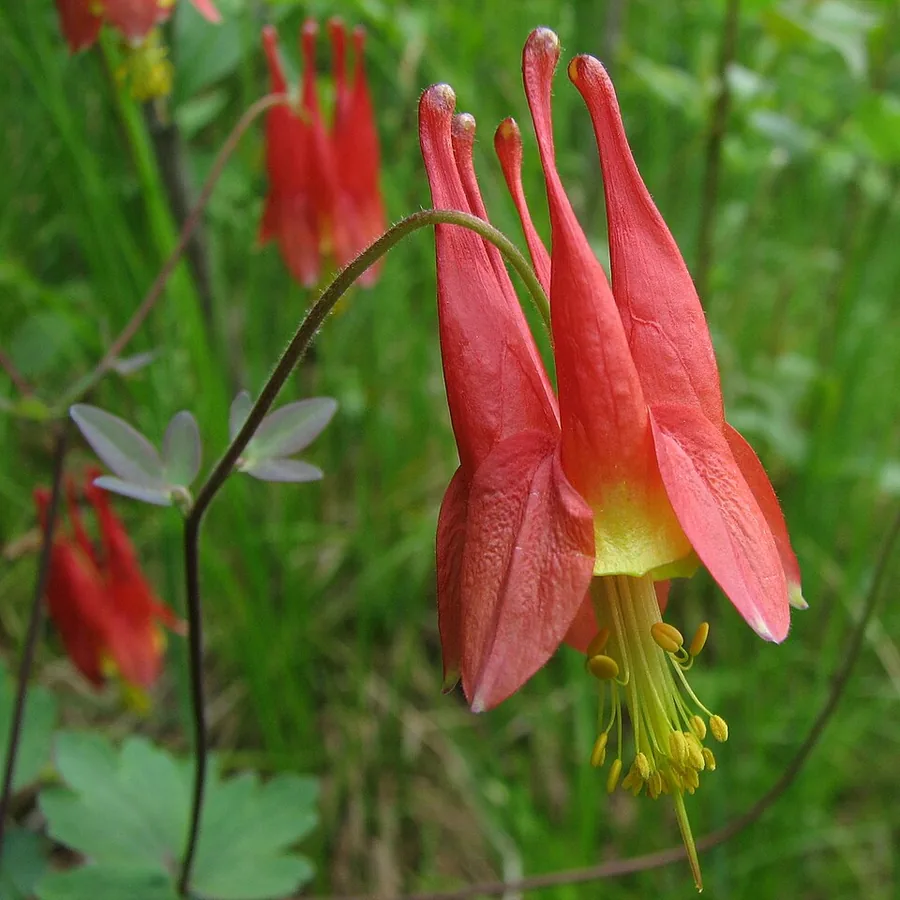
Columbine is a woodland perennial in the buttercup family, and the native Eastern red kind, Aquilegia canadensis, grows wild across much of eastern North America. Each nodding, spurred flower swings from a thin, wiry stem, its backward-pointing spurs holding the nectar that draws hummingbirds as spring warms. Below the blooms sits a low mound of soft, blue-green foliage, the leaves cut into rounded, lobed segments that catch the light with a matte, cool tone.
This is an easygoing plant for partial shade, settling at a border edge or in a woodland patch where taller plants cast a little cover. Its slender flower stalks rise well clear of the leafy base, lifting the dangling spurred blooms into open air. The native form carries red and yellow flowers, while across the genus the petals shade into blue, violet, white, and pink, each one tipped with the long, hollow spurs that give the flower its hooked, lantern-like outline.
Columbine wants ground that stays moist while draining fast, and little more. The flowers give way to slender upright seedpods that dry and split open at the top, spilling small dark seeds. Those seeds drop and sprout nearby, so fresh low rosettes of finely divided leaves keep appearing around the parent each season.
Care
The short version: partial shade with rich, moist, well-drained soil. Keep the ground evenly damp but never soggy, give a light spring feed, and cut back the tired, fading foliage after bloom to clear the way for fresh leaves and slow the self-seeding.
Light
Columbine does best in partial shade, the broken, dappled light of a woodland edge that suits its thin stems and soft leaves. It takes full sun in cooler regions and tolerates partial sun, but in hot summers the deeper shade keeps the blue-green foliage from scorching brown at the edges.
Water
Keep the soil evenly moist but never waterlogged, watering roughly every 5 to 10 days once rain is counted in. An established plant rides out the odd dry spell as the leaves droop and recover, yet soggy ground through a hot summer rots the crown, so let the surface dry a touch between waterings.
Soil
Plant it in rich, well-drained loam worked with organic matter, though columbine takes to sand or clay as long as water moves through the grains. It handles a wide pH band from 6.0 to 8.0, so most garden soil suits the deep taproot without fuss.
Temperature
This is a cold-hardy perennial, comfortable across USDA zones 3 to 8 and weathering temperatures from -40°F to 90°F (-40°C to 32°C). The deep winter cold helps, since the small dark seeds need a chill before the hard coat will break and sprout.
Humidity
Ordinary outdoor humidity is all it asks, so there is no figure to hit. Air movement matters more than the moisture, because still, crowded conditions let a chalky powdery mildew settle across the leaf surfaces.
Feeding
Columbine is a light feeder. A single balanced feed or a topdress of compost in spring carries it through the season, and piling on more fertilizer only pushes soft, sappy growth that draws aphids to the tips.
Pruning
Cut the spent flower stems after bloom to coax a second flush and curb the heavy self-seeding from the splitting pods. If the foliage browns and frays by mid-summer, shear it to the ground and a fresh, clean mound of leaves follows.
Size & spacing
Plants reach 1 to 3 feet (30 to 91 cm) tall, the flower stems rising well above a leafy base that spreads 12 to 18 inches (30 to 46 cm) wide. Give each one that much room so air slips between the clumps and mildew stays off the leaves.
When to plant
Columbine times itself to spring. Start seed indoors in late winter after a cold spell to break dormancy, or press it straight into the ground in spring or fall. The spurred, nodding flowers open from March into May and hang on their wiry stems for four to six weeks before they fade and set seed.
Northern hemisphere
Southern hemisphere
Typical months for a temperate climate: start earlier in warm zones, later where spring frosts linger.
- Sow: Late winter, 6 to 8 weeks before last frost; seeds benefit from cold stratification.
- Plant: Spring after last frost, or sow seed outdoors in fall.
- Harvest: Spring (March to May), with bloom lasting about four to six weeks.
Hardiness
USDA hardiness zones: 3–8
Temperature: down to -40°C
Troubleshooting
Columbine is an easy plant, and most of its troubles read plainly on the leaves or down at the base. Look closely at the foliage and crown, since the early marks point straight to the cause and a quick trim or a watering change usually clears them. Match what you see below, then act.
Stems drooping over a soft, browning base
When the stems sag and the base of the plant turns soft, brown, and mushy in summer heat, crown rot has taken hold in soil too wet and airless to breathe. The rotted crown cannot knit back together, so the whole plant is lifted out. Loosen the soil for sharper drainage before replanting, and let the watering slacken through the hottest stretch so the next crown stays firm.
Fix:
- Remove affected plants
- Improve soil drainage before replanting
Pale serpentine trails etched across the leaves
Thin white or tan lines snaking across the green leaf blade trace the path of leaf miner larvae chewing along between the upper and lower surfaces. The etched look is unsettling, but it stays cosmetic and the plant keeps its strength. Pick off the scribbled leaves, and once the flowers fade, cut the foliage to the ground so a fresh, unmarked mound of leaves rises in its place.
Fix:
- Remove and destroy mined leaves
- Cut affected foliage to the ground after bloom to flush fresh growth
- Choose resistant species such as Aquilegia canadensis
Soft green or black specks massed on buds and tips
Tight knots of tiny green or black aphids stud the softest tips and unopened buds, draining sap until the new leaves crumple and a shiny, sticky film coats the surface. A hard jet of water scours most of the soft little bodies off the stems. Insecticidal soap follows for a stubborn crowd, and a lighter nitrogen feed keeps the tender, sappy growth they cling to in shorter supply.
Fix:
- Spray plants with a strong jet of water
- Apply insecticidal soap if populations are heavy
Chalky white bloom dusting leaves and stems
A fine, chalk-white bloom dusted over the leaves and stems is powdery mildew, a fungus that creeps across the surfaces where the air hangs still and the plants press close. Open space between the columbines so a breeze can comb through the foliage. Strip away the dusted leaves, and send the water to the soil rather than across the blades so the leaf surfaces stay dry and bare.
Fix:
- Improve air circulation by spacing plants
- Remove and destroy infected foliage
Toxicity
Columbine is only mildly toxic, and the spurred flowers themselves are low-risk. The trouble hides in the small dark seeds and the roots, which hold cardiogenic toxins and cyanogenic glycosides that can upset the stomach if eaten in quantity. Routine gardening needs no special handling, but keep pets and children from chewing the dry seedpods.
Toxic to
Cats · Dogs · Horses · Rabbits · Livestock · Birds · People
Cats Mild
A cat that bites into the small dark seeds or the roots may drool, vomit, or pass a loose stool. The flowers and leaves are low-risk, and trouble follows only a fair amount eaten.
Dogs Mild
Most dogs come through untouched. Crunching through the hard seeds or fibrous roots in quantity can bring on drooling and a short bout of vomiting or diarrhea.
Horses Mild
Horses tend to graze around columbine, and a stray mouthful does little. Only a large feed of the seed-laden pods or roots is likely to upset the gut.
Rabbits Mild
Keep rabbits off the ripening seedpods and the roots, where the cyanogenic compounds concentrate most. A light nibble of the soft foliage rarely causes more than a passing tummy ache.
Livestock Mild
Cattle, goats, and sheep usually leave the plant alone, and poisoning is uncommon. Heavy grazing on the dry seeds or roots can still trigger mild digestive upset.
Birds Mild
Hummingbirds probe the spurred flowers for nectar with no harm at all. The seeds hold the cyanogenic glycosides, so keep poultry from gorging on the ripe, splitting pods.
People Caution
Columbine is not for eating. The flowers are low-risk, but the seeds and roots hold cardiogenic toxins, so eating them in quantity can cause stomach upset and should be avoided, especially by children.
No special handling is needed for routine gardening; wash hands after extended contact and supervise pets and children around the seeds.
Helpline numbers

United States
ASPCA Animal Poison Control: (888) 426-4435 (fee applies)
Poison Control: (800) 222-1222



Canada
Poison Centres: 1-844-764-7669
Varieties
Columbine runs from a wiry native wildflower to big, full-petaled garden hybrids. These are the ones you are most likely to meet up close.
Aquilegia canadensis (Eastern red columbine)
The native species hangs nodding red and yellow spurred flowers from thin, wiry stems, and its leaves stay clean of the leaf miner that scribbles across its relatives.
Aquilegia vulgaris (Granny's bonnet)
The old European columbine opens flowers in blue, violet, white, pink, or red, though its leaves show the etched tracks of leaf miner far more than the native plant does.
Aquilegia chrysantha (Golden columbine)
A southwestern species whose clear yellow flowers trail unusually long, slender spurs and hold up in heat, though its crown softens and rots fast in soil that drains poorly.
Aquilegia × hybrida (Hybrid columbine)
The garden hybrids unfurl the largest blooms, often two-toned with long sweeping spurs, across the widest range of colors from mid-spring into early summer.
How to propagate
Columbine all but sows itself from its splitting seedpods, and you can add to it with saved seed or a careful division of an established clump.
SeedEasy
Sow indoors in late winter with cold stratification, or direct sow outdoors in spring or fall. · Seedlings typically flower in their second year.
Seed is the surest way to raise more columbine, and the plant scatters its own small dark seeds into loose colonies wherever the ground suits it. Start that seed indoors in late winter after a cold spell to break its dormancy, or sow it straight outdoors in spring or fall. The first flowers come in the seedling's second year, since the opening season goes into a low rosette of leaves over a thickening crown.
DivisionModerate
Early spring or fall. · One growing season; columbine has a deep taproot and resents disturbance, so divide carefully.
Division can be done in early spring or fall, but it is the harder path. Columbine drives down a single deep taproot that resents being torn, so ease the clump apart and tuck the pieces back into the soil at once. One growing season usually sees a careful division rooted in, though seed stays the more dependable route.
Myths
Columbine is deadly poisonous and should never be grown around pets or children.
The fear runs ahead of the facts, since the genus is only mildly toxic and extension sources note no serious poisoning problems for it. The small dark seeds and the roots do hold cyanogenic compounds, so a large mouthful of those parts can bring mild stomach upset, but the plant is safe to grow with normal supervision and the flowers are low-risk.
Every columbine gets chewed to ribbons by leaf miner.
Whether the leaves stay clean or end up scribbled depends on the species. The native Aquilegia canadensis keeps its foliage largely unmarked while hybrids and other species often show heavy tracks, so picking a resistant species is the simplest fix.