Ornamental · Poaceae
Zoysia Grass
Zoysia japonica
A dense weave of fine, stiff blades, zoysia knits a tight, wear-hardened mat that greens in summer and fades to straw in winter.
Full sun
Every 5–10 days
365–1095 days
USDA 5–11
Overview
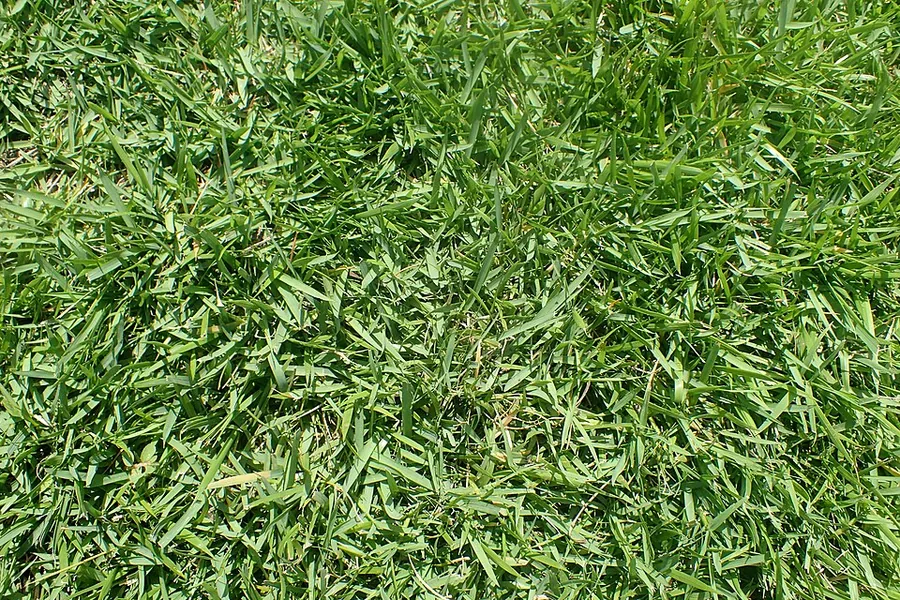
Zoysia is a warm-season turfgrass from East Asia, and up close it reads as a dense, fine-bladed carpet packed tight enough to take a beating. Its leaves are narrow and notably stiff and tough to the touch, stiff enough to dull a mower, and they knit into a springy mat. New growth travels outward on wiry stolons that run across the soil surface and rhizomes that creep below it.
Color shifts with the season and with thirst. Through the warm months the blades hold a deep green, then under drought they fold, wilt, and take on a blue-gray cast before a dry spell tips the whole stand into a straw-brown dormancy. That brown holds through winter, hiding crowns and runners that stay alive underneath, and green returns only as the soil warms in late spring.
Bloom is an afterthought in this grass, which throws up only inconspicuous, spikelike seedheads in late spring into summer, slim and easy to miss against the turf. Blade texture separates the kinds across a long climatic stretch, from the cold edge of USDA zone 5 down through zone 11: the coarser, broader leaf of Zoysia japonica and the finer, slimmer blade of the other species.
Care
The short version: give it full sun, mow the stiff blades short with a sharp reel mower, and water deeply only when they fold and turn blue-gray. Feed lightly through summer, dethatch every year or two, and let the turf fade to straw and go dormant in winter.
Light
Zoysia knits its densest, deepest-green mat in full sun, and the blades thin and scatter where shade lies heavy. It keeps more of its cover in partial sun or light shade than many warm-season grasses, but the tightest weave always forms in the brightest ground.
Water
Watch the blades for the signal to water. When they fold inward, wilt, and shade toward blue-gray, the established grass is thirsty, and a deep soak of about 0.5 to 0.75 inches at a time sets it right. Left dry, the whole stand slides into a straw-brown summer dormancy, which does it no lasting harm.
Soil
The roots take to most any ground that drains, from loam to loose, sandy soil. A slightly acidic pH of 6.0 to 6.5 suits the blades best and lets the runners spread and settle.
Temperature
Heat only deepens its green, and the blades hold near 100°F (38°C) without scorching. Cold drives the stand into dormancy down to about 10°F (-12°C), where the browned leaves shelter living crowns and runners, and the toughest strains endure the coldest ground.
Humidity
Plain outdoor air is all the blades ask for, so no reading applies. What shapes the turf more is how fast the leaves dry, since a dense, damp, slow-drying mat is exactly where the orange rot of large patch takes hold.
Feeding
Feed through the warm months, roughly May through August, with a modest measure of nitrogen at about 2 to 4 pounds per 1,000 square feet a year across several small doses. Pile on too much, or feed late in fall, and the dense blades pack into thatch and turn disease-prone.
Pruning
Cut the tough, wiry blades short, around 1 to 2.5 inches (2.5 to 6 cm), with a sharp reel mower, since their stiffness blunts a rotary and tears the tips into scalped brown. Rake out the spongy thatch every year or two once that under-layer thickens past about half an inch.
Repotting
none
Size & spacing
Mown low, the leaves sit at just 1 to 2 inches (3 to 6 cm), a short, even nap. Below and across the soil the runners reach far, from about 1 to 10 feet (30 cm to 3 m) per plant, threading outward until a few plugs weave into a solid sheet.
When to plant
Zoysia is a warm-season grass that stirs only after the soil warms, then creeps outward on its runners. Set sod, plugs, or sprigs from late spring into early summer, and sow seed of Zoysia japonica from April through July. The fine blades knit together slowly, taking two or more seasons to close the gaps.
Northern hemisphere
Southern hemisphere
Typical months for a temperate climate: start earlier in warm zones, later where spring frosts linger.
- Plant: Sod, plug, or sprig in late spring to early summer once soil is warm; seed (Z. japonica only) April-July
- Harvest: Inconspicuous spikelike seedheads in late spring to summer; grown for turf, not bloom
Hardiness
USDA hardiness zones: 5–11
Temperature: down to -29°C
Troubleshooting
Much of what looks wrong in zoysia is just the grass changing color and texture with the season. Learn to read a normal straw-brown dormancy and a slow fill-in apart from the spongy feel of thatch or the rotted sheaths of large patch. Match what you see below before treating anything.
Wide brown rings of thinning blades with rotted bases
The circles of dying blades are large patch, a Rhizoctonia fungus that wakes in cool, wet soil and feeds on excess nitrogen. The rings widen while soil holds around 65°F to 75°F (18°C to 24°C), and the outer leaves lift free at soft, orange-brown rotted sheaths. Lay down a labeled fungicide as soil cools toward 70°F (21°C) in fall, dry the ground with better drainage, thin the thatch, and withhold fall and early-spring nitrogen.
Fix:
- Apply a labeled fungicide preventively in fall when soil cools to about 70 degrees F
- Improve drainage and reduce thatch
- Avoid fall and early-spring nitrogen and over-watering
- Water early in the day so turf dries quickly
New plugs and sprigs with bare gaps between them for seasons
The bare ground between plugs is slow establishment, the natural crawl of zoysia rather than a failure. The grass advances only as fast as its wiry runners can thread across the soil, so plugs set too far apart or planted late leave the gaps open longer. Keep the young patch watered and weeded, set plugs closer or lay sod for an instant sheet, and feed lightly through the season to draw the runners together.
Fix:
- Be patient; keep newly planted area watered and weeded
- Space plugs closer (e.g. 6 in centers) or use sod for faster cover
- Control weeds while turf fills in
- Apply light, regular fertility during the growing season to speed spread
A spongy mat of thatch that scalps to brown when mowed
Under the dense blades sits a thick, spongy pad of thatch, deepened by too much nitrogen. It gives underfoot, and mowing the tall grass low shears the tips into brown, scalped patches. Rake the thatch out every year or two, mow often with a sharp reel mower so no more than a third of the blade comes off, and cut back the nitrogen.
Fix:
- Dethatch with a vertical mower or power rake every year or two
- Mow regularly at the recommended height with a sharp reel mower
- Avoid excess nitrogen that drives thatch
- Keep mower blades sharp and mow frequently enough to remove only one-third of the leaf
A stand of straw-brown blades in fall, slow to green in spring
The straw color is winter dormancy, the way a warm-season grass answers frost. The leaves brown top to bottom while the crowns and runners stay alive beneath, greening again as the soil warms, and a cool spring only stretches the brown interval. Do not push it with fertilizer, and if patches stay brown and rot at the base into spring, look closer for the rotted sheaths of large patch disease.
Fix:
- Expect dormant brown color from first frost until warm spring weather; no treatment needed
- Avoid heavy traffic on dormant turf
- Do not over-fertilize to force green-up; wait for warm soil
- If patches stay brown and rot at the base in spring, check for large patch disease
Toxicity
Nothing in these blades is poisonous, so the tight green mat is safe to touch and safe to chew. Cats, dogs, horses, rabbits, livestock, and birds can all nibble the foliage without harm. The only irritant is the fine grass pollen it sheds, which can set off hay fever in people who are sensitive.
Safe for
People · Cats · Dogs · Horses · Rabbits · Livestock · Birds
Cats None
Nothing in the blades can poison a cat. One that chews a few may cough a strand back up on occasion, but that is a hairball, not the grass.
Dogs None
The leaves carry no toxin, so a dog can crop and roll across them freely. An occasional mouthful of grass and a mild bout of vomiting is ordinary and harmless.
Horses None
These blades sit among the plain forage grasses horses crop by the mouthful, and they hold nothing poisonous.
Rabbits None
Rabbits can shear off the blades with no harm, since the leaves hold no toxic compound.
Livestock None
Cattle, goats, and sheep can crop the foliage safely; it stands among the common pasture grasses.
Birds None
Hens and wild birds can pick and peck through the blades with no risk from the grass itself.
People None
The blades pose no poisoning risk to children or adults. The single catch is the fine pollen they shed, which can raise hay fever in those prone to it.
The grass itself is not poisonous. Grass pollen can trigger hay-fever allergies in sensitive people, and pets that nibble grass may occasionally vomit, but this is not a sign of poisoning. Rarely, grass awns can cause mechanical irritation.
Varieties
The zoysias split mostly by the feel of the blade, from coarse to fine, along with their shade tolerance and cold hardiness. These are the ones you will handle when choosing sod, plugs, or seed.
Zoysia japonica (e.g. Meyer, Zenith, Compadre)
Its blades are the coarsest and broadest of the zoysias, the most cold-hardy of the group, the only one offered as seed, and the source of Meyer, once sold as a miracle grass.
Zoysia matrella (manilagrass)
A finer, narrower blade than Z. japonica that takes shade better, though it creeps more slowly and browns sooner in the cold.
Emerald (Z. japonica × Z. tenuifolia)
A fine-textured hybrid whose slim blades knit into an especially dense turf, though those leaves come through winter less well than Meyer.
How to propagate
Zoysia grows from living runners and crowns far more readily than from seed, and even seeded stands come in slowly. Here is how each takes hold.
DivisionModerate
Late spring to early summer once soil is warm · 2 or more growing seasons to fully fill in
Nearly all zoysia starts from living runners and crowns, and the hybrids grow no other way. Lay sod for a finished sheet at once, set plugs about 6 to 12 inches apart, or scatter sprigs across warm late-spring soil. Whichever you choose, the runners take two or more growing seasons to thread the gaps shut.
SeedModerate
April to July · Germinates in about 2-3 weeks, then 6-8+ weeks to establish; slow overall
Seed sets only on Zoysia japonica, such as Zenith or Compadre. Sow from April through July and watch for thin green shoots in about 2 to 3 weeks, then another 6 to 8 weeks or more before they knit into turf. A seeded stand comes in slower and patchier than sod.
Myths
Zoysia is a no-care miracle grass that stays green all year, never needs mowing, and chokes out every weed overnight.
Zoysia does weave a fine, tough, drought-tolerant mat, but the miracle story ignores what the blades actually do. They take two or more seasons to close in from plugs, fade to straw and go dormant every winter, pack into thatch, and still need mowing, feeding, and disease care. It is a fine-bladed, hard-wearing grass, not a hands-off one.