Tree · Rosaceae
Yoshino Cherry
Prunus × yedoensis
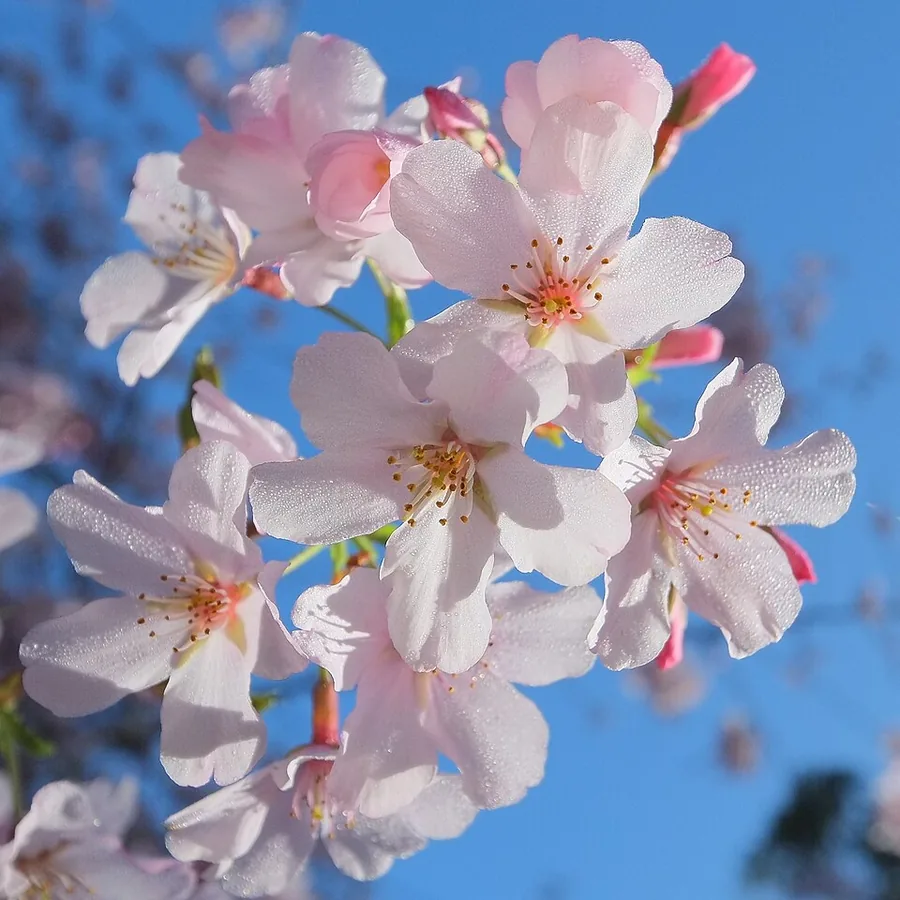
Every spring the Yoshino cherry breaks into clouds of white-to-pink blossom, thousands of petals massing along the bare limbs for two weeks.
Full sun
Every 5–10 days
USDA 5–8
30–40 ft · 9.1–12.2 m
Overview
The Yoshino cherry is the tree behind the famous spring displays, the Tidal Basin plantings in Washington among them. In early spring its bare limbs fill with fragrant white to pale-pink flowers, opening ahead of the leaves so the whole crown reads as a drift of pale petals, snow-white from a distance. As the petals loosen and fall, small, hard black drupes swell in their place through summer, dark beads that the birds pick clean.
This is a hybrid cherry, Prunus x yedoensis, a rose-family tree that fills out fast into a broad, rounded crown of 30 to 40 feet. Its bark is thin and smooth, and the tree is short-lived, about 15 to 20 years before borers and canker work into the wood. The spring flush, dense and pale, is what makes it worth the short life.
Set in full sun on moist, well-drained soil with room to spread, a Yoshino largely sees to itself. It carries one brief, pale flood of bloom, then settles into a canopy of clean green leaves that turn gold before they drop in fall.
Care
The short version: full sun, deep moist soil that drains well, and steady water through dry spells. Prune only just after the petals drop, leave wide room for the spreading crown, and shield the thin, smooth bark from the mower.
Light
In full sun the crown sets its heaviest, most even sheet of bloom. Under partial shade the flowers thin to scattered clusters and the limbs stretch and lean toward the brightest side.
Water
Keep the soil consistently moist, soaking it about every 5 to 10 days and more in a heat wave. The tree bears heat and humidity, but its roots have poor drought tolerance, so the soil should never bake dry through a long dry spell.
Soil
It roots best in average, medium-moisture, well-drained loam, slightly acidic to neutral at a pH of 6.0 to 7.0. It takes to many soils as long as water moves through them, since roots left sitting in wet ground soften and rot.
Temperature
This is hardy wood, holding across USDA zones 5 to 8 and the full stretch from -20°F to 100°F (-29°C to 38°C). The open flowers are the tender part, their petals browning overnight when a late frost catches them.
Humidity
Plain outdoor air suits it, with nothing to measure or change. It carries a muggy summer, though damp air trapped in a crowded canopy leaves the leaves spotted and the twigs cankered more easily.
Feeding
It feeds itself for the most part. A balanced slow-release tree fertilizer in early spring only matters when new growth comes thin and short, and a mature tree in decent soil takes none.
Pruning
Cut crossing or rubbing branches right after the petals fall, since a later cut strips off the buds set for next spring. Take out dead or diseased wood any time, cutting 4 to 8 inches below the black knot swellings, and scrape the tent caterpillar egg masses off the twigs in winter.
Repotting
This is a tree for open ground, not a pot, so there is no repotting. A young one held too long in its nursery container coils its roots into a circling, girdling knot that should be teased straight before planting.
Size & spacing
It rises fast to about 30 to 40 feet (9 to 12 meters) tall, the crown spreading just as wide into a broad dome. Give it open ground well clear of buildings, walks, and other trees so that rounded shape can fill out.
When to plant
Plant a Yoshino while the branches are bare and dormant, in early spring or fall, so the roots take hold before the leaves push out. The show comes in early spring, when white-to-pink flowers sheathe the naked wood through March or April, followed by small black drupes that darken over summer.
Northern hemisphere
Southern hemisphere
Typical months for a temperate climate: start earlier in warm zones, later where spring frosts linger.
- Plant: Plant balled-and-burlapped or container trees in early spring or fall while dormant.
- Harvest: Fragrant white to pale-pink flowers in early spring (March-April) before or with emerging leaves; small black drupes follow in summer.
Hardiness
USDA hardiness zones: 5–8
Temperature: down to -29°C
Troubleshooting
Most of what ails a Yoshino writes itself on the bark, the twigs, and the leaves, in sunken sores, black lumps, and chewed edges. The worst of it burrows out of sight into the wood. Read the marks below, then act while the damage is still shallow.
Sawdust, gummy ooze, and holes near the trunk base
Sawdusty frass and beads of gummy ooze low on the trunk mark borers tunneling the wood, hollowing the limbs as the branches die back. No spray reaches them, so a vigorous tree that seals the grubs off in its own wood is the best guard. Keep mowers and trimmers off the bark, mulch under the canopy, water through drought, and accept that this pale-flowered cherry lives only about 15 to 20 years.
Fix:
- Keep trees vigorous so they can resist and wall off borers
- Protect bark from mowers and string trimmers with mulch
- Follow extension timing for borer management on confirmed infestations
Sunken, oozing cankers and dying-back branches
Those sunken sores, weeping a sticky gum, are brown rot and canker fungi at work in the bark, and the same fungi rot the little fruit and blight the twigs. Cut the infected wood well below each canker, wiping the blades with disinfectant between cuts. Rake up the shriveled, mummified fruit and fallen debris so the spores have no dark corner to overwinter in.
Fix:
- Prune out and destroy infected wood well below the canker, disinfecting tools between cuts
- Remove mummified fruit and fallen debris to reduce inoculum
- Improve air circulation and avoid wetting foliage when watering
Hard black knots swelling along the twigs
The rough, coal-black lumps swelling around the wood are black knot, a fungus of cherries and plums that stands out starkly against the bare winter twigs. Prune the knots in late winter before growth, cutting at least 4 to 8 inches below each one, then burn or bury the lumpy wood. Pull out any wild cherry or plum nearby, since they seed the same black growths back onto the tree.
Fix:
- Prune out knots in late winter before growth starts, cutting at least 4-8 inches below each knot
- Destroy pruned material by burning or burying
- Disinfect pruning tools between cuts
Silk tents in the branch forks and holed leaves
The gauzy white nests webbed into the branch forks are Eastern tent caterpillars, while summer brings Japanese beetles that chew the leaves down to lace and aphids or scale that glaze them in sticky honeydew and black sooty mold. Pull the tents and egg masses off by hand and drop the beetles into soapy water. A healthy, well-watered tree carries this chewed, spotted look easily, since it is only skin-deep.
Fix:
- Remove and destroy tent caterpillar tents and egg masses by hand
- Hand-pick Japanese beetles into soapy water
- Wash off aphids or treat heavy scale/aphid infestations per extension guidance
Toxicity
The pale flowers are the only part to enjoy, since the rest of the tree is genuinely dangerous. The leaves, twigs, bark, and hard seed pits hold cyanogenic glycosides that release cyanide, and the danger sharpens once leaves wilt and curl after pruning, a storm, or a frost. Keep pets, horses, and livestock away from clippings and fallen debris, and let no one bite the bitter fruit or crack its pits.
Toxic to
Cats · Dogs · Horses · Rabbits · Livestock · Birds · People
Cats Toxic
A cat that chews the wilted leaves, twigs, or hard seed pits can turn up with brick-red gums, wide-blown pupils, and labored, panting breaths. Cases are rare, but cyanide moves fast, so any struggle for breath is an emergency.
Dogs Toxic
A dog that gnaws fallen twigs or cracks the pits meets the same cyanide. Look for heavy drool, gums flushed bright red, dilated pupils, and sudden distress, and get to a vet at once.
Horses Severe
Horses are in the sharpest danger here. A few wilted leaves from a pruned or storm-downed branch can be rapidly fatal, turning the membranes bright red as breathing quickens into weakness and collapse within minutes.
Rabbits Toxic
The leaves, twigs, and hard pits all hold the same cyanide-releasing compounds, so none of it is safe near a rabbit. Keep every clipping and fallen scrap well out of reach.
Livestock Severe
Cattle, sheep, and goats fall fast to wilted cherry leaves, which can kill within 15 to 20 minutes. Watch for slobber, rapid breathing, a weak pulse, membranes flushed bright red, and convulsions, and never throw prunings into a pasture.
Birds Caution
Wild birds swallow the ripe black drupes whole and pass the hard pits unharmed, scattering the seed as they go. The pits and leaves stay off-limits, since a cracked seed releases cyanide.
People Caution
This is a tree for looking at, not eating. The small bitter drupes are worthless on the tongue, and the leaves, twigs, and hard pits carry cyanogenic compounds, so keep curious children from chewing any part.
Do not leave pruned or storm-downed branches where livestock or horses can browse the wilting leaves; keep fallen twigs and fruit pits away from pets.
Helpline numbers

United States
ASPCA Animal Poison Control: (888) 426-4435 (fee applies)
Poison Control: (800) 222-1222



Canada
Poison Centres: 1-844-764-7669
Varieties
Yoshino appears in a few named forms that differ mostly in the pink of their petals, and a couple of trees sold beside it are close cousins rather than true Yoshinos.
'Akebono' (Daybreak)
'Akebono' wears a deeper pink, its petals opening soft rose and paling toward white, where the straight species reads almost pure white.
'Snow Fountains' (weeping Higan cherry, Prunus 'Snofozam')
'Snow Fountains' is a weeping Higan-type cherry, not a true Yoshino, its slender branches spilling downward into a fountain hung with white spring flowers.
Kwanzan (Prunus 'Kanzan')
Kwanzan is a related Japanese flowering cherry whose blooms are thick double pink rosettes of 20 to 30 petals, set against Yoshino's flat single white-to-pink flowers.
How to propagate
Because Yoshino is a hybrid that will not come true from seed, every tree is a clone of the last, which leaves propagation mostly to the nurseries.
GraftingDemanding
Late winter to early spring (bench grafting) or summer (budding) · 1-2 seasons to a sellable grafted tree
Because Yoshino is a hybrid, its seed will not breed true, so each tree is cloned from another. Growers graft or bud it onto cherry rootstock, bench grafting in late winter to early spring or budding in summer, and it takes 1 to 2 seasons to raise a saleable tree. The work is exacting and mostly left to nurseries.
Stem cuttingsDemanding
Early summer (softwood) · Several weeks to root, then 1-2 seasons to establish
Softwood cuttings, snapped off green in early summer and rooted under mist with a rooting hormone, are the other path. They root over several weeks and then take another 1 to 2 seasons to fill out, and being far less reliable than grafting, they tempt few growers.
Myths
The small black cherries are a fruit worth eating.
The birds strip the small black drupes, but in the mouth they are bitter and all but inedible. Each hard pit holds the same cyanogenic compounds as the rest of the tree, so this is an ornamental, not a fruit crop.
Fresh green leaves are as dangerous as any other part of the tree.
The firm green leaves on the tree are low risk while they stay whole. The danger climbs once they wilt and curl, after a broken limb, a pruning cut, or a hard frost, since that is when the cyanide sharpens and poisons horses and livestock.