Tree · Arecaceae
Windmill Palm
Trachycarpus fortunei
Hardy down to single digits, the windmill palm spreads its stiff, pleated fans in gardens far colder than most palms can stand.
Partial shade
USDA 7–10
8–40 ft · 2.4–12.2 m
Overview
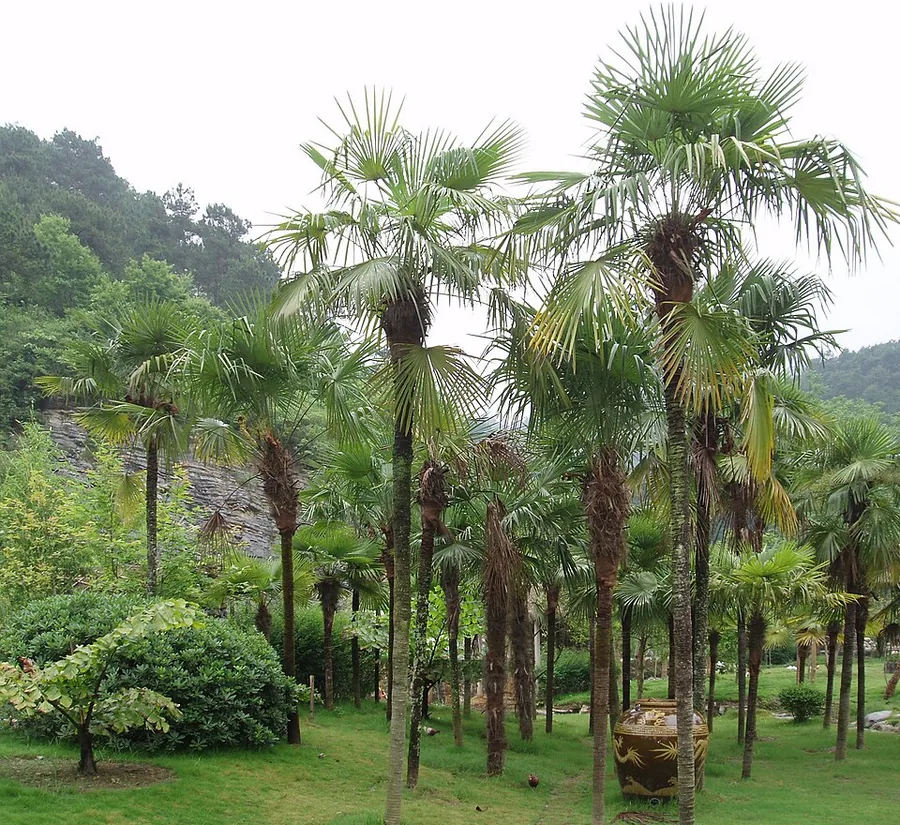
The windmill palm carries a crown of stiff, near-circular fans, each one split into long narrow segments that radiate from a central point like the spokes of a wheel. It comes from the mountains of central and eastern China, and that high-altitude home is why it withstands cold to 5°F (-15°C), far below what most palms endure. The deep green blades are held on slender stalks and turn stiffly in a breeze, and that spinning, spoked outline is what gives the palm its name.
The trunk is a single slim column sheathed in a shaggy mat of coarse, brown, hair-like fiber that clings tight to the stem. Growth is slow, often only a few inches of height a year, yet over decades that fibrous trunk can lift the crown to 8 to 40 feet (2.4 to 12 m), though most plants stay well short of it. It grows across USDA zones 7 to 10, in a large container, or under glass in a cool conservatory.
In early summer drooping sprays of small yellow flowers hang among the fans, and on female plants they give way to clusters of dark blue to nearly black, pea-sized drupes by fall. Between the pleated green fans, the hairy brown trunk, and those dusky fruits, the palm shows a distinct texture at every level. Give it decent soil, steady moisture, and shelter from harsh wind, and its bold fan-shaped canopy holds for years.
Care
The short version: part shade to full sun, rich and well-drained soil kept evenly moist but never waterlogged, a slow-release palm feed through the growing season, and shelter from cold, drying winds.
Light
The stiff green fans hold their best color in partial shade and tolerate full sun once the palm is established. Light to medium shade suits the blades, and a young plant especially keeps a cleaner leaf out of the harshest midday glare.
Water
Give it regular, ample water in soil that stays evenly moist but drains freely, and the fans stay firm and deep green. An established palm rides out a moderate dry spell, but it will not tolerate standing water or a high water table, which turns the roots soft.
Soil
Root it in rich, fertile, well-drained loam. A pH of 6.0 to 7.5 suits it, the fibrous roots take sand and a wide range of soils, and a moderate salt tolerance keeps the fronds clean in coastal ground.
Temperature
This is the hardiest trunked palm, its stiff blades holding through cold to 5°F (-15°C) and heat to 104°F (40°C). That range is what keeps the fan-shaped crown alive well beyond the usual palm country, though a young plant still wants winter shelter.
Humidity
Ordinary outdoor humidity keeps the fans in good order, so there is no figure to reach for. Shelter from cold, drying wind does far more to keep the blades from fraying than any humidity reading.
Feeding
Feed through the growing season, spring into early fall, with a slow-release palm fertilizer carrying micronutrients like manganese, magnesium, and iron. Palms run short on nitrogen, potassium, magnesium, and manganese in sandy ground, and that shortfall shows as yellowing, frizzled blades unless the right feed heads it off.
Pruning
Cut sparingly. Take only the fully dead, browned lower fronds and spent flower or fruit stalks, and never a healthy green fan. The shaggy loose fiber down the trunk may be trimmed for a cleaner line, but the growing point at the very crown must stay intact.
Repotting
Shift a container plant into a larger pot every 2 to 3 years, or once the roots crowd out. Mature landscape specimens are left rooted in place, so this applies only while the palm is still potted.
Size & spacing
Over many years the fibrous trunk lifts the crown to 8 to 40 feet (2.4 to 12 m) tall, with a spread of stiff fans reaching 4 to 6 feet (122 to 183 cm) across. Growth is slow, so give the widening canopy room for the long haul.
When to plant
The windmill palm thickens its trunk slowly all year rather than by a planting season, so there is no sowing schedule. It does keep a visible flowering and fruiting rhythm: drooping yellow flower sprays open among the fans in early summer, and on female plants the dark, pea-sized drupes ripen from late summer into fall.
Northern hemisphere
Southern hemisphere
Typical months for a temperate climate: start earlier in warm zones, later where spring frosts linger.
- Harvest: Yellow flowers on drooping panicles in early summer (June to July); dark blue to nearly black drupe fruits ripen on female plants in late summer to fall.
Hardiness
USDA hardiness zones: 7–10
Temperature: down to -18°C
Troubleshooting
The windmill palm has few real problems, and most trouble writes itself plainly on the fronds. Watch the stiff fans and the soil drainage, since a change in the blades or a soggy base is where the first sign appears. Match what you see below and act before it spreads.
A drooping, fading crown above soaking wet soil
When the crown droops and dulls above wet ground, the trouble is root rot. Roots left sitting in standing water or a high water table turn soft, dark, and slimy, and once they collapse they can no longer push moisture up to the fans, so the whole head fades. Open the drainage, water more sparingly, and keep the palm out of any low hollow where runoff gathers.
Fix:
- Improve drainage and reduce supplemental watering
- Avoid planting in low spots that collect water
Sticky, black-filmed fronds studded with small bumps
A tacky sheen and a dull black crust on the fronds mark scale insects or palm aphids. As they feed they weep a sticky honeydew, and a sooty black mold spreads across the coating until the green all but disappears. Look close and the culprits show as hard little armored bumps or soft, clustered colonies packed along the leaf tops and undersides. Horticultural oil or insecticidal soap wipes them out, and a frond crusted past saving is best cut away.
Fix:
- Treat with horticultural oil or insecticidal soap
- Remove heavily infested fronds
Pale, frizzled new fronds edged with dead tissue
New fronds opening pale, crinkled, and frizzled at the edges signal a nutrient deficiency, most often manganese, potassium, or magnesium. The fresh growth twists and discolors first, its segments curling and browning instead of standing crisp and green. Light, sandy soils drain these minerals away fastest. A slow-release palm fertilizer carrying micronutrients restores the color, fed on a steady schedule rather than in one heavy hit.
Fix:
- Apply a slow-release palm fertilizer containing micronutrients
- Correct deficiency on a regular schedule rather than a single dose
Fronds tearing and shredding along the leaf segments
The ragged, ribbon-split fans are wind damage, not disease. Cold, drying gusts catch the broad blades and tear them straight down the natural folds between segments, so each fan ends up frayed into thin strips. The plant itself stays sound underneath. Give a potted one a sheltered corner or a windbreak, and cut back only the fronds shredded worst or gone fully brown.
Fix:
- Provide a windbreak or relocate to a more sheltered position
- Trim only the most badly damaged or fully dead fronds
Toxicity
For homes with animals, the fibrous fans and dark drupes carry no danger: the windmill palm is non-toxic across the board. It is a true palm, not the poisonous sago palm it is confused with, so there is no cycasin or other toxin in its leaves, trunk, or fruit to worry pets, livestock, or children.
Safe for
People · Cats · Dogs · Horses · Rabbits · Livestock · Birds
Cats None
A cat can bat at the stiff fans without harm. The ASPCA lists the windmill palm as non-toxic, so the ribbed leaf segments hold nothing a curious cat need fear.
Dogs None
A dog can mouth the fibrous fronds safely, since the plant carries the ASPCA non-toxic listing and the tough, leathery leaves will not poison it.
Horses None
The broad fans and coarse trunk fiber are safe around horses, which NC State Extension records as non-toxic to horses.
Rabbits Safe
The pleated leaf strips hold nothing that harms rabbits, so a stray nibble at a low frond does no damage.
Livestock Safe
Cattle, goats, and sheep can browse the low fronds and fibrous trunk safely, since the plant carries no toxins that affect them.
Birds Safe
The dark, pea-sized drupes and stiff fronds pose no poisoning risk to birds, whether wild visitors or a pet indoors.
People Safe
The coarse fans and hairy trunk are safe for people, children included. This is the true palm, not the toxic sago it is mistaken for, so a handled frond is harmless.
Often confused with the highly toxic sago palm (Cycas revoluta); the true windmill palm is a different, non-toxic plant.
Varieties
Only a couple of named windmill palms turn up in gardens, and each differs in the cut and stiffness of its fans rather than in show.
Trachycarpus fortunei var. wagnerianus ('Waggie')
Its leaves are stiffer, smaller, and packed into a tighter, more rigid fan, and that firmer blade holds up to wind far better than the looser standard species.
Trachycarpus fortunei 'Nanus'
A dwarf form whose whole frame stays notably shorter and more compact than the standard windmill palm, keeping its crown low to the ground.
How to propagate
There is one way to raise more windmill palms, starting from the small hard seed and asking for real patience.
SeedModerate
Sow fresh, cleaned ripe seed in spring at its own depth in a moist, free-draining medium. · Seed germinates in roughly 1 to 3 months; several years are needed to develop a visible trunk.
More plants come from seed alone, the small hard drupes cleaned of their dark blue-black flesh, and it takes both a male and a female plant to set viable seed. Press the fresh seed into a moist, free-draining mix in spring at its own depth, and a pale shoot pushes up in 1 to 3 months. From there the wait is long, since several years pass before any real trunk thickens into view. Being a solitary, single-trunked palm, it never sends up side pups or offsets and will not strike from a cutting.
Myths
The windmill palm is the same as the sago palm and just as poisonous.
The two only look vaguely alike and are not related at all. The sago palm (Cycas revoluta) is a stiff, feather-leaved cycad and genuinely toxic, while the windmill palm is a true fan palm in the family Arecaceae with broad, pleated blades. The ASPCA lists the windmill palm as non-toxic, so the two should never be treated as one.