Tree · Arecaceae
Date Palm
Phoenix dactylifera
Hand it full sun, sharp drainage, and desert heat, and the date palm answers with sweet fruit for decades.
Full sun
USDA 8–11
49–79 ft · 15–24 m
Overview
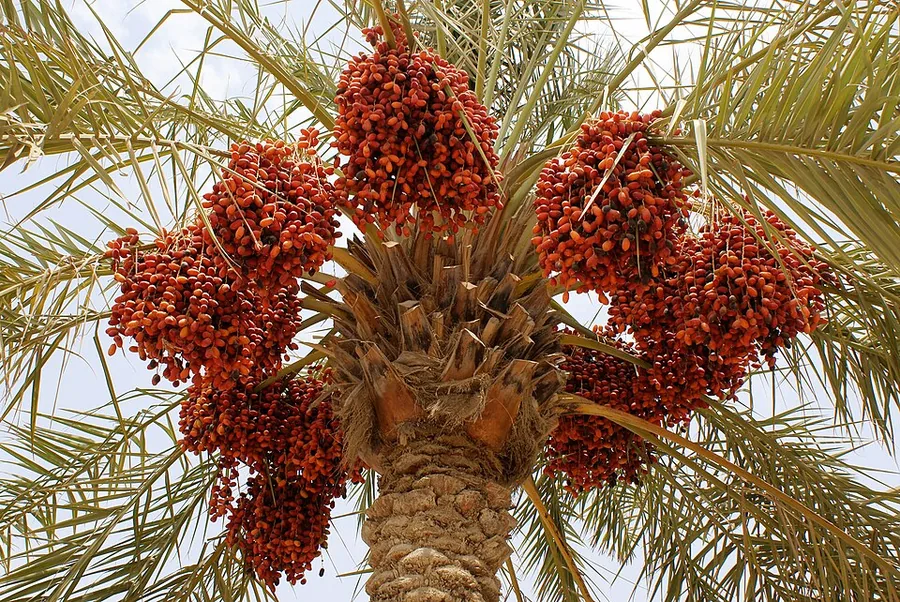
Tall and unhurried, the date palm carries a crown of long, arching fronds atop a single trunk that can climb to roughly 80 feet in the right climate. It has fed desert peoples for thousands of years and still pulls double duty as fruit tree and landscape specimen. A true palm of the family Arecaceae, it traces its native range from the Arabian Peninsula across into South Pakistan, dry country that shaped its build.
Everything about this tree reads desert. Its deep roots let it shrug off drought once they reach down, the fronds bask in full sun without scorching, and it holds steady in poor, sandy ground that would stall a softer tree. It also takes more cold than its tropical cousins, the foliage enduring down to about 16°F (-9°C), which is what carries it outdoors across USDA zones 8 to 11.
Know one thing before planting: the date palm is dioecious, each tree strictly male or female. Fruit forms only when a female has a male close enough to pollinate her, so a lone tree stays a handsome but barren crown. Watch the lower leaf bases too, where stiff spines arm the trunk, and give it clearance from paths and play areas.
Care
The short version: full sun, fast-draining soil, and steady warmth carry this tree. Water young trees until their roots take, then pull back once established, and feed a true palm fertilizer to keep the fronds deep green.
Light
Hand a date palm full sun. It will get by in partial sun, but the fronds grow densest and the fruit sets best in an open, all-day-baking spot like the one it came from in the desert.
Water
This tree is highly drought-tolerant. Water young ones steadily to settle their roots, then back away, because a mature palm in a fitting climate asks for little extra. It grows wild both in deserts riding over deep groundwater and along rivers, so it copes with dry ground far better than wet.
Soil
Plant into well-drained soil, even pure sand, which suits it perfectly. It leans toward acidic-to-neutral ground, around pH 5.5 to 7.0. The one thing it will not tolerate is water pooling around the roots.
Temperature
The date palm rides a broad span, roughly 16°F to 100°F (-9°C to 38°C). That cold tolerance is rare for a palm and pushes its range well past the tropics, though it still needs long, hot summers to ripen the fruit.
Humidity
Low humidity bothers it not at all. This is a desert tree, and dry air is exactly its element, which sets it apart from the jungle palms kept as houseplants.
Feeding
Feed it a true slow-release palm fertilizer through the warm growing season, one carrying an 8-2-12 plus 4 magnesium analysis with micronutrients. That mix wards off the potassium, magnesium, and manganese shortfalls palms slip into. Plain lawn fertilizer does more damage than good around this tree.
Pruning
Cut only the fronds gone fully brown and dead, and leave the green ones standing, since stripping live fronds saps the tree. A few growers thin some lower leaves to ease fungal pressure. Whatever comes off, wear heavy protection, because the leaf bases carry sharp 3- to 4-inch spines.
Repotting
A date palm belongs in open ground as a large landscape tree, not a pot. Repot it only while it is young and still containerized, and even then rarely. Roots circling the pot or water sliding straight through tell you a young one has outgrown its container.
Size & spacing
This is a big tree, the trunk rising 50 to 80 feet (15 to 24 m) with a crown of fronds spreading 20 to 25 feet (6 to 7.5 m) wide. Hand it generous clearance from walkways, foundations, and play areas, and plan for fronds and fruit that drop.
When to plant
A date palm is a long-lived perennial rather than a seasonal crop, so no sowing window controls it. Set it out across the warm growing months so the roots can grip, and once the tree matures its edible dates color up from late summer into autumn, but only where a male and a female share the same garden.
Northern hemisphere
Southern hemisphere
Typical months for a temperate climate: start earlier in warm zones, later where spring frosts linger.
- Harvest: Edible dates ripen in late summer to autumn; both male and female trees must be present for fruit set
Hardiness
USDA hardiness zones: 8–11
Temperature: down to -12°C
Troubleshooting
Date palm trouble splits two ways: a disease you cannot cure or a nutrient gap you can. Tell them apart by reading where the damage lands. Frizzled new growth at the crown points one direction, faded old fronds at the bottom point the other.
Whole tree fading and fronds dying back
When the whole crown loses color and the fronds slump and die across the tree, you are looking at lethal yellowing, a disease this palm readily contracts and rarely survives. An infected trunk cannot be nursed back, so it must come down and be destroyed before the rot reaches its neighbors. Your only real guard is placement: never set a date palm into ground where lethal yellowing already turns up.
Fix:
- Avoid planting where lethal yellowing is present
- Remove and destroy confirmed infected palms to limit spread
Frizzled, weak new growth at the crown
Newest fronds pushing out frizzled and necrotic at the crown while the older ones stay sound is the signature of frizzle top, a manganese shortfall that high soil pH tends to trigger. Deliver manganese through a full palm micronutrient program, and pull a high pH back down so the roots can actually draw the nutrient up. Ignore it and each new frond emerges more deformed until the palm itself falters.
Fix:
- Apply manganese as part of a complete palm micronutrient fertilization program
- Address high soil pH that reduces manganese availability
Yellowing along the edges of the oldest fronds
Pale yellow creeping along the outer edges of the lowest, oldest fronds while the fresh upper ones hold their green is the mark of a magnesium deficiency, almost always traced to the wrong feed. Move the tree onto a full palm fertilizer carrying an 8-2-12 plus 4 magnesium analysis with micronutrients and keep the timing steady. Lawn feed reaching the root zone is the usual offender, so keep it well away.
Fix:
- Apply a complete palm fertilizer such as 8-2-12 plus 4 magnesium with micronutrients
- Continue regular scheduled feeding to correct and prevent recurrence
Toxicity
A relief for any home with pets or children: the date palm holds no toxin. Its fruit is an everyday food, and ASPCA lists Phoenix palms as non-toxic to cats, dogs, and horses. The one real hazard is physical rather than chemical, the sharp 3- to 4-inch spines at the leaf bases that can drive deep puncture wounds, so keep everyone clear of the lower fronds.
Safe for
People · Cats · Dogs · Horses · Rabbits · Livestock · Birds
Cats None
Safe around cats. This is a true palm bearing edible fruit, and ASPCA records Phoenix species as non-toxic to them.
Dogs None
The plant itself poisons nothing, since Phoenix palms hold no toxin a dog would need to steer clear of. The only thing to mind is a curious nose pressing into the stiff, spined lower fronds.
Horses None
Neither the fronds nor the fruit carry anything toxic to horses; ASPCA records Phoenix species as non-toxic.
Rabbits Safe
A rabbit gnawing on a frond takes no poison, because the plant holds no harmful compound.
Livestock Safe
Cattle, goats and sheep can graze beside a date palm with no toxic reaction from its leaves or fruit.
Birds Safe
Neither the ripe fruit nor the foliage threatens birds, which strip wild dates off the tree without harm.
People Safe
The dates are a beloved food, taken fresh or dried with nothing to fear. The single true danger is mechanical: the stiff 3- to 4-inch spines along the leaf bases can drive deep puncture wounds, so handle the lower fronds carefully.
Wear thick gloves, long sleeves and eye protection when handling or pruning: the lower leaf bases carry very sharp, stiff 3- to 4-inch spines (modified leaflets) that can cause deep puncture wounds and infections. Male trees release abundant airborne pollen that is highly allergenic.
Varieties
Named date palms are grown for what hangs in the fruit clusters, and a couple of cultivars rule what reaches the market. These two are worth knowing by name.
Medjool
One of the leading commercial dates, valued for fruit that is large, soft and richly sweet.
Deglet Noor
A semi-dry date raised mostly for export and the boxed dates that line store shelves.
How to propagate
You can raise a date palm from seed or from the offshoots that crowd the base of a mature trunk, and the pick matters more than usual. Seed gambles on sex and quality, while an offshoot hands you a known, true copy of its parent.
SeedEasy
Sow ripe seed in warm conditions; viable for long periods · Several months to germinate and establish a seedling, with many years before fruiting maturity
Drop ripe seed into warm conditions and it sprouts willingly, the seed staying viable across a long stretch of time. Patience is the cost: a seedling needs several months to settle in and many years to reach fruiting age. Seed-grown trees also vary in sex and fruit quality, so they fit a landscape role better than a dependable harvest.
Offsets & pupsModerate
Remove rooted basal offshoots from an established mother palm during warm growing weather · Several months to a year to root and establish after separation
Lift rooted basal offshoots from an established mother palm during warm growing weather, then allow several months to a year for them to root and steady themselves once separated. This is how cultivars are kept true to type, and it tells you the sex of the young palm from day one, a thing seed can never guarantee.
Myths
Any palm sold as a date palm will reliably produce edible dates on its own.
Because date palms are dioecious, fruit sets only when a female tree has a male within pollinating reach. Named fruiting cultivars come from offshoots rather than seed, since only offshoots stay true to the parent and carry a known sex. Plant a single seed-grown palm and you are wagering on both fronts at once.