Tree · Rosaceae
Weeping Cherry
Prunus subhirtella
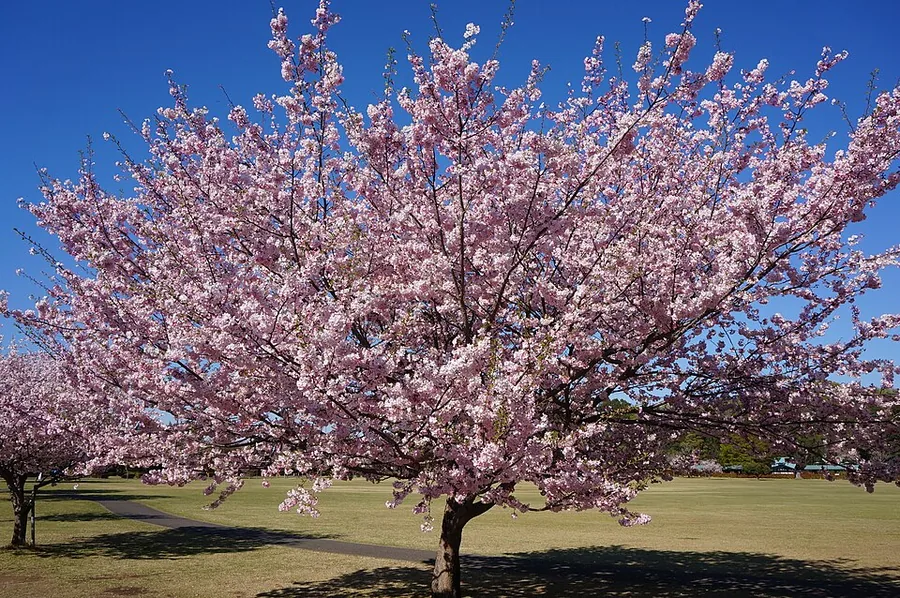
Each April the weeping cherry hangs thousands of pink and white blossoms from branches that fall like water.
Full sun
Every 5–10 days
USDA 4–8
15–40 ft · 4.6–12.2 m
Overview
Look closely at a weeping cherry and the shape tells the story first: long, slender branches lift from a grafted trunk, then bend over and trail all the way toward the ground. In early spring, ahead of any leaf, those trailing stems load up with light pink to white flowers that hang in loose rows along their length. It is a rose-family tree from Japan, where the Higan cherry has been grown for centuries.
Trace a branch to its source and you find the graft. A weeping top is fused onto an upright standard rootstock, usually at 4 to 6 feet, and from that union the whole crown pours downward. The joint is visible as a slight change in the bark, and any shoot that breaks out below it grows the other way, straight and stiff, unlike the soft fall of the grafted wood above.
Given years and room, the tree fills out fast to 15 to 40 feet (4.6 to 12 m) tall, its spread as wide as it is high, so a mature specimen reads as a broad dome of falling stems. The bark, twigs, and narrow leaves all belong to the cherries, and like the rest of that clan the foliage holds cyanide-bearing compounds beneath its quiet green.
Care
The short version: the weeping cherry wants full sun on its cascading crown, moist well-drained soil at its roots, and steady water while young. One early-spring feeding and a light prune after the petals drop keep it in form, and the straight suckers below the graft come off.
Light
Set the crown in full sun and the branches fill with the heaviest bloom, petal packed against petal. In partial shade it still flowers, just thinner along each stem. The more light the falling canopy catches, the denser the pink-and-white curtain it makes.
Water
Keep the soil around the roots moist and well drained, watering every 5 to 10 days while the tree is young or the ground goes dry. An older tree with a deep root system holds through a dry spell. Standing water, though, sours the soil it grows in.
Soil
The roots run best through moist, fertile, well-drained loam, but they take hold in clay or sand as well. A pH from 5.5 to 7.5 keeps them fed, a band that spans most garden ground.
Temperature
The bare branches endure hard cold, holding from -20°F to 100°F (-29°C to 38°C). That winter freeze is no threat; it is the very rest the buds need before they open in spring.
Humidity
The open air around the crown is humidity enough, with no figure to meet. What the branches do want is air moving freely between them, since still, damp wood is where the leaf and bark diseases of cherries take hold.
Feeding
A single feeding suffices. Lay down a balanced slow-release tree fertilizer in early spring as the buds swell, and no more, because a heavier dose throws out soft, watery shoots that pests and canker bore straight into.
Pruning
Cut just after the flowers fall, taking out dead, damaged, or crossing wood and easing the weeping lines back into shape. The stiff suckers below the graft always come off, and wide cuts are best avoided, since a large raw wound is an open gate for borers and canker.
Repotting
The weeping cherry lives in the earth, not a pot. It is not a container tree, so it goes straight into its final ground with room for the full falling spread.
Size & spacing
A grown weeping cherry stands 15 to 40 feet (4.6 to 12 m) tall and spreads 15 to 25 feet (4.6 to 7.6 m) wide, a rounded fall of stems as broad as it is high. Mark out that whole footprint at planting, clear of walls and other trees, since the fast growth soon fills every inch and resists any later move.
When to plant
The weeping cherry moves with the cold months. It is planted bare and dormant, in early spring or fall, when the branches hang leafless and pale. The flowers break first, ahead of the leaves, in early to mid spring, and only after the last petal falls do the pruners come out.
Northern hemisphere
Southern hemisphere
Typical months for a temperate climate: start earlier in warm zones, later where spring frosts linger.
- Plant: Early spring or fall while dormant
- Harvest: Early to mid spring (light pink to white flowers before leaves)
Hardiness
USDA hardiness zones: 4–8
Temperature: down to -34°C
Troubleshooting
Read the wood, not the flowers, for signs of trouble. A canker sinks and weeps on the bark, a black knot swells into a rough dark lump on a twig, and both are easier to spot before they spread. Match the look below, then cut into wood that is still firm and pale inside.
Wilting tips above sunken cankers that weep on the bark
The wood shows canker and dieback: fungi enter a wound and close off a whole limb, sometimes while borers mine the tunnels beneath the bark. In dry weather, cut the cankered wood well below the sunken lesion, and wipe the blade clean between cuts. Firm, well-watered wood with no fresh gash in the bark is what holds the disease off.
Fix:
- Prune out cankered wood well below the lesion during dry weather
- Sterilize tools between cuts
- Improve vigor with proper watering and avoid bark wounds
Rough black knots swelling hard around the twigs
Those coal-black, corky knots are black knot, a fungus welded to the twig and starkest against bare winter wood. In late winter, cut each knot away 10 to 15 cm below the swelling and burn or bag what comes off. Any wild cherry standing nearby carries the same fungus back, so it goes too.
Fix:
- Prune out knots 10-15 cm below the gall in late winter
- Destroy or remove pruned material
- Repeat inspections annually
Leaves spotted, sticky, or eaten to the veins
The foliage draws several feeders. Aphids and scale coat the leaves in sticky honeydew and pull them into curls, Japanese beetles strip the soft green and leave a lace of veins, and leaf spot or leaf curl fungi print hard-edged lesions. Wash or oil off the sap-feeders, lift the beetles by hand, and clear the fallen leaves so the fungus finds nothing to overwinter on.
Fix:
- Hose off or treat aphids/scale with horticultural oil or insecticidal soap
- Handpick Japanese beetles
- Rake and destroy fallen diseased leaves
Toxicity
Behind the soft bloom sits a hard chemical fact. The narrow leaves, the slim twigs, the bark, and the stony seed pits all carry cyanogenic glycosides that release cyanide, and a wilted, drooping leaf holds the most. Keep prunings and fallen leaves away from horses and livestock, and keep the twigs and pits out of the mouths of pets and children.
Toxic to
Cats · Dogs · Horses · Rabbits · Livestock · Birds · People
Cats Mild
A cat that chews a wilted leaf, a twig, or a seed pit can show gums flushed brick-red, pupils blown wide, and quick, panting breaths. The cases are few, but cyanide acts within minutes, so any labored breath is an emergency.
Dogs Mild
A dog gnawing bark, twigs, or fallen seeds may drool, pull for air, and show reddened gums and widened pupils. It happens rarely, yet a dog that has split the hard pits needs a vet at once.
Horses Severe
For a horse the danger is stark. A heap of wilted prunings within reach can leave it staggering, gasping, its mucous membranes a bright shocking red, its body seizing, and it can die within minutes.
Rabbits Toxic
The same cyanide-bearing compounds run through the leaves, twigs, and bark, and a rabbit cannot handle them. Keep every cutting and pruning well out of reach, since a small mouthful of wilted foliage can leave it weak and short of breath.
Livestock Severe
Cattle, sheep, and goats are the classic casualties of wilted-leaf cyanide poisoning. Within 15 to 20 minutes of eating fallen or cut leaves they may drool, breathe fast, flush bright red at the membranes, and convulse, often to the point of death.
Birds Toxic
The cyanide packed into the foliage, bark, and stony pits reaches birds as well, so keep poultry and pet birds off any prunings or cracked seeds.
People Caution
This is a tree to look at, not to eat. The pits, leaves, twigs, and bark all hold cyanogenic glycosides, so none of it belongs in the mouth, and children should be kept from chewing the seeds or foliage.
Keep pruned branches and fallen leaves away from horses and livestock, since wilting raises cyanide. Prevent pets from chewing twigs, bark, wilted leaves, or seeds.
Helpline numbers

United States
ASPCA Animal Poison Control: (888) 426-4435 (fee applies)
Poison Control: (800) 222-1222



Canada
Poison Centres: 1-844-764-7669
Varieties
The named weeping cherries part ways mostly on the flower itself: its color, whether the petals sit single or doubled, and how large the whole tree grows. These are the ones to know by sight.
'Pendula'
The classic weeping form shows a single ring of light-pink petals per flower, strung along cascading branches worked onto a 4 to 6 foot standard.
'Pendula Plena Rosea'
This weeping selection carries doubled pink flowers, each bloom thick with extra petals rather than a single row.
'Snofozam' (Snow Fountains)
A dwarf weeping cultivar, it drops pure white flowers down a short, low frame of falling stems.
'Autumnalis'
Its flowers are semi-double and pink, opening in two separate flushes, one in fall and one in early spring.
Yoshino cherry (Prunus × yedoensis)
A related flowering cherry, its habit upright and outspread rather than weeping, its petals white to pale pink.
How to propagate
The falling shape is not something a cutting can copy on its own. It depends on grafting a weeping top onto a tall upright trunk, which is why nurseries raise nearly all of these trees and a rooted cutting never hangs the same way.
GraftingDemanding
Late winter to early spring (bench graft) or summer (budding) · 1-2 years to a saleable grafted tree
Almost every weeping cherry begins as a graft. A grower joins the weeping scion to an upright standard rootstock, often Prunus avium, at 4 to 6 feet, bench-grafting in late winter or budding in summer, so the crown hangs from that fixed height. The union takes 1 to 2 years to grow into a saleable tree, and the fine handwork keeps it out of most home gardens.
Stem cuttingsDemanding
Early summer (softwood) · Several weeks to root, 1-2 years to establish
A softwood cutting taken in early summer can be rooted, but it resists, needing several weeks to strike and 1 to 2 years to fill out. Even then it has no tall trunk under it, so the branches never rise and fall from height the way a grafted crown does, and the low, formless result is why the method stays rare.
Myths
Weeping cherries grow from seed or cuttings and rise straight like an ordinary tree.
The falling shape is grafted, a weeping scion joined onto an upright standard rootstock, not raised from a seed. A sucker breaking out below the graft carries the rootstock and grows stiff and upright, the opposite of the soft cascade above, so it is cut away.
Only the flowers and fruit put animals at risk.
The soft petals are not the hazard. The cyanide-bearing compounds sit in the leaves, the twigs, the bark, and the hard seeds, and a wilted leaf holds the most, the worst of it for grazing animals.